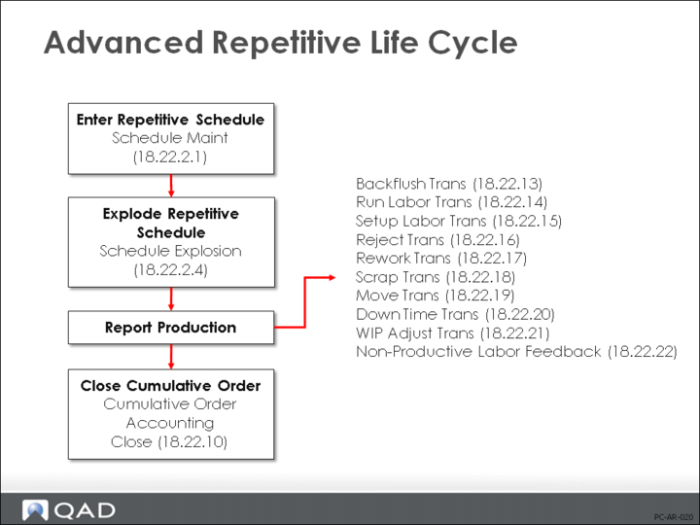
Advanced Repetitive Life Cycle
QAD Enterprise Applications offers several methods of managing manufacturing activities: work orders, Kanban, Flow, and Line Sequence Repetitive. Primarily, the choice between these has to do with the level of detail required when controlling each part of an operation. The Work Orders module manages work by tracking each individual operation and component item issued to make an item or group of items. Detailed reporting is the norm.
The Advanced Repetitive module, on the other hand, manages work using production schedules. It assumes if the schedule was met, then a certain number of operations have been completed and a certain number of components have been used. Only exceptions are reported. From a cost point of view, most costs are simply reported at standard. Actual run and setup times can be reported in various transactions and can generate variances.
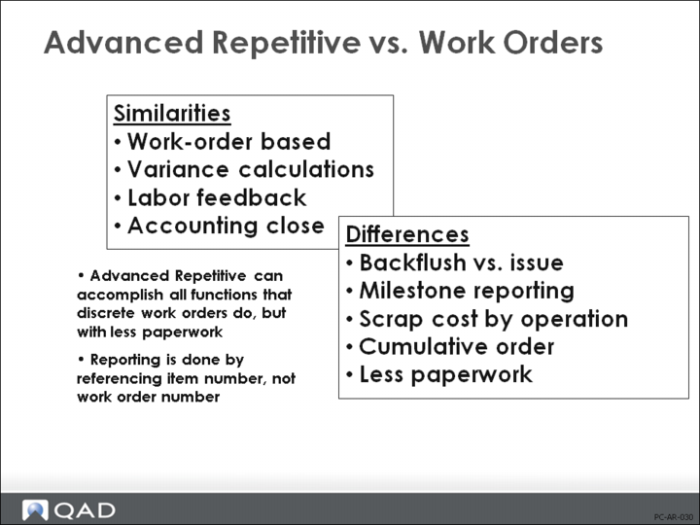
Comparison of Advanced Repetitive to Work Orders
Because the cost impact of the Advanced Repetitive function is usually the same as a counterpart in Work Orders, we will point out similarities and focus on differences.
Similarities
• Both Advanced Repetitive and Work Order functions start with a work order (in Advanced Repetitive it is system generated and transparent to the user). It has the same information as a standard work order: item, site, quantity, BOM, and routing. Attached is an exploded BOM and routing with frozen standards for calculating cost variances, as in Work Orders.
• Actual labor is entered, burden absorbed, completions reported, and overhead applied. An accounting close function reports floor stock, calculates variances, and reconciles WIP balances.
Differences
• With no separate issue or receipt functions, receipts are processed as labor is reported. Components are issued at that time and backflushed at standard cost-issued from inventory based on number of items received and standard quantity per.
• Advanced Repetitive functions require less detailed reporting. Reporting is done only at selected milestone operations. The others are backflushed at standard. Scrap can, however, be reported and accurately accounted for at any operation.
• Reporting is done by item, rather than work order, and costs are accumulated on a “cumulative order.” Costs are accumulated over a period of time, usually by accounting period.
• With work orders, both costs and operation run times come from the routing for an item. Repetitive schedules are based on units per hour run times set up in Production Line Maintenance either by production line or by item. Each production line can have a default rate that in effect says any item made on this line runs at this rate. Or rates can be set up by item. So the number of units that can be produced is set by the line rate, but the cost is still based on the times set in the routing. A good way to ensure that costs reflect run times is to use Routing Maintenance Rate Based (14.13.2) and set the units per hour in the routing to the same value set in the production line record. If the route record has setup time, it should be the same as the changeover time in the production line record.