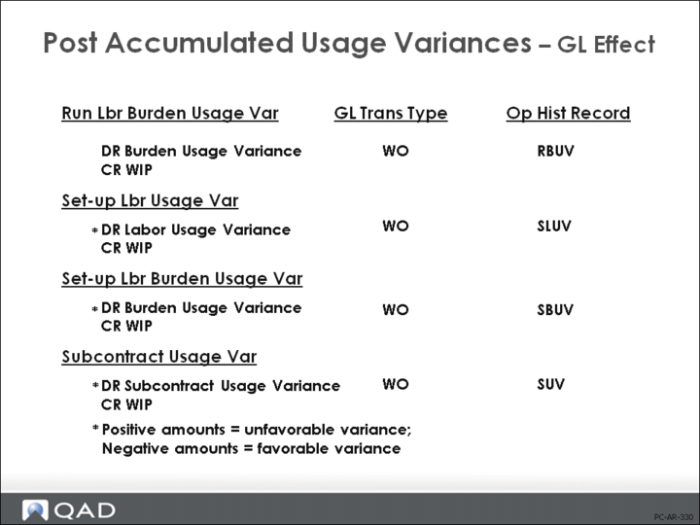
Post Accumulated Usage Variances
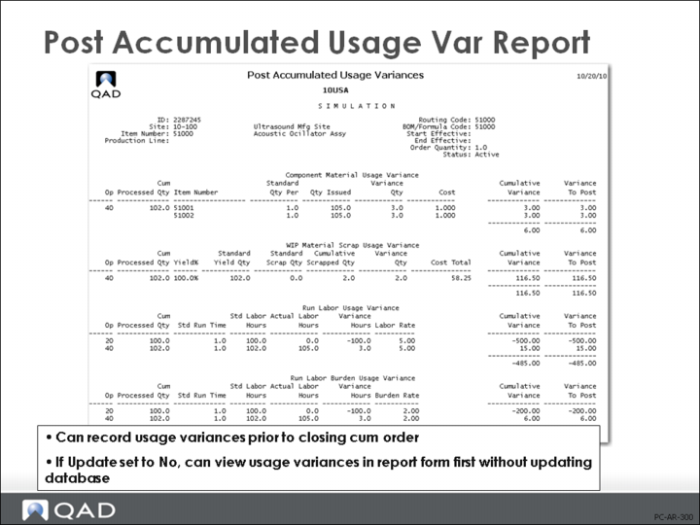
Post Accumulated Usage Variances Report
Post Accumulated Usage Variances (18.22.9) calculates and records accumulated usage variances in cumulative orders according to the criteria entered. This lets you report usage variances on demand without having to close the cumulative order.
For each open cumulative order selected, usage variances are calculated by operation for component material (including scrap), WIP labor, labor burden, and subcontract. The variances calculated are for the entire life of the cumulative order. The amounts to report are reduced by any amounts previously reported. Additionally, floor stock expense is reported. An operation history record is created for each variance.
Component Material Usage Variance
Component material usage variance is calculated as the difference between the actual and expected quantities issued, extended by the cumulative order operation component cost. The expected issue quantity is the cumulative order operation standard quantity required times the quantity processed at the operation. Component materials issued that are not in the cumulative order operation product structure are considered non-standard and are treated entirely as usage variance.
Labor and Burden Usage Variances
Labor and burden usage variances are calculated as the difference between actual and expected labor hours, multiplied by the frozen standard setup and labor rates in the case of labor usage variance and, in the case of burden usage variance, multiplied by setup and labor burden rates.
WIP Material Scrap Usage Variance
WIP material scrap usage variance is calculated as the difference between the actual and expected scrap quantities, extended by the cumulative order operation cost. The expected scrap quantity is the quantity processed, less the cumulative order yielded quantity processed at the operation. For example, if the yield factor at an operation is 75% and 100 were processed at the operation, the expected scrap quantity would be 100 less 75% = 25. The amount of variance is added to the Scrap account of the product line of the finished material item number.
• It is possible to scrap a quantity without producing a scrap posting. Consider the above example, when yield is 75% and the expected scrap quantity is 25. If the actual quantity scrapped is 25, then no variance results. If there is no labor or component usage variance elsewhere, WIP is charged with exactly the amount of resources expected to produce 75. This is reflected in the fact that the operation cost has already been yielded.
If scrap is always reported regardless of yield, then the Include Yield field in Advanced Repetitive Control (18.22.24) should be set to No. This sets the cumulative order yields to 100%.
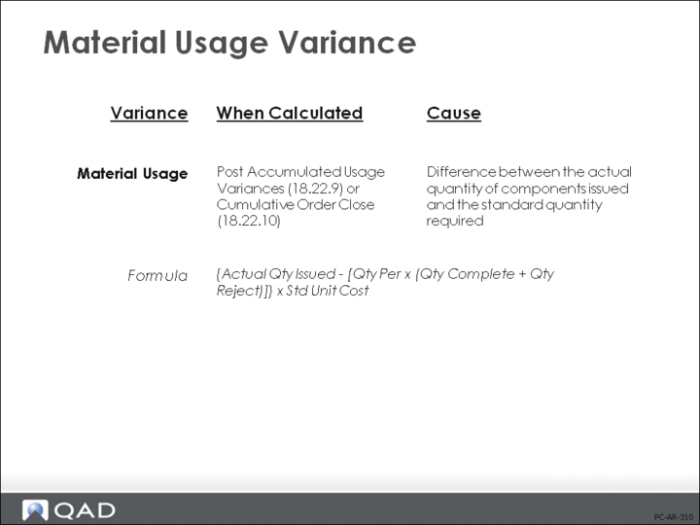
Material Usage Variance
Material usage variance is generated when there is a difference between the actual quantity of components issued/backflushed and the standard quantity required.
This variance is calculated at Post Accumulated Usage Variances (18.22.9) or Cumulative Order Close (18.22.10) as:
{Actual Qty Issued - [Qty Per * (Qty Complete + Qty Reject)]} * Frozen Std Unit Cost
• Alternate structures and issues of non-standard components will also create material usage variances, and if the costs differ from standard, a method change variance will be charged for that difference
• Specifying an alternate BOM/routing at backflush will generate a new cumulative order
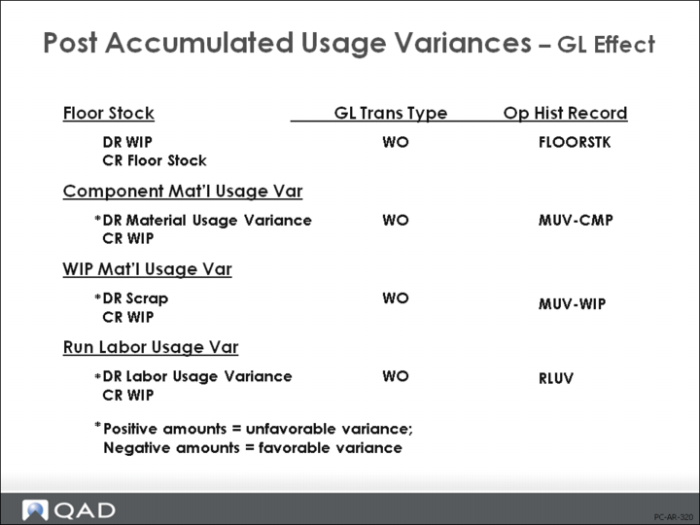
Post Accumulated Usage Variances - GL Effect