Process Flow for Legal Documents
Use the By Legal Document tab to search for fiscal receipts for which to create supplier invoices and receiver matching. The By Legal Document tab is only available when fiscal receiving is activated in Purchasing Control (5.24).
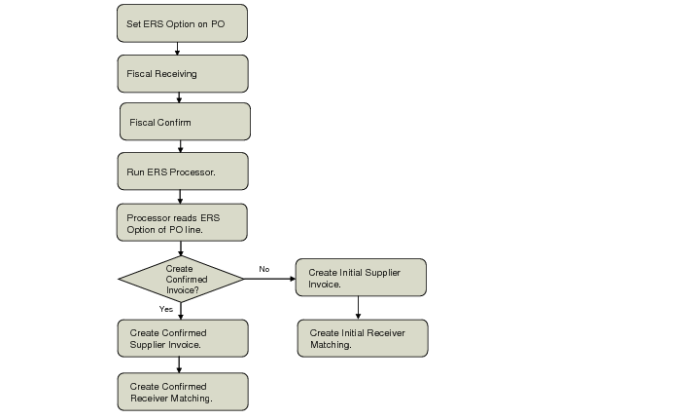
ERS Flow for Legal Documents
When fiscal receiving is activated, the ERS Processor combines fiscal receipts into a single supplier invoice, provided that the fiscal receipts have the same legal document number, the same effective issue date, the same supplier, and the same purchase order project code for the AP control account.
You can specify ranges of suppliers, sites, legal documents, and legal document issue dates to search for fiscal receipts. The processor then retrieves a group of receipts that meet your selection criteria. Selections are always based on the full legal document; you cannot create partial selections.
The ERS Processor creates matched supplier invoices as confirmed (non-initial status) or non-confirmed (initial status) supplier invoices, depending on the ERS option. The matched supplier invoices are created based on the confirmed legal (fiscal) document price, and not the PO price. The ERS Processor assigns the invoices the same due date as the confirmed legal (fiscal) document for which the invoice was created, and the tax values and postings are created based on the confirmed fiscal receipt lines.
Note: When creating supplier invoices, ERS stores the legal document number in the Reference field in the supplier invoice record, and stores the legal document effective issue date in the Supplier Invoice Date field.
When creating supplier invoices and receiver matching based on legal (fiscal) documents, the ERS Processor creates AP rate variances when there is a difference between the fiscal price and the PO price. Similarly, the ERS Processor creates AP usage variances when there is a difference between the physical receipt quantity and the fiscal receipt quantity.
Legal documents are always denominated in the base currency. However, when fiscal receiving is activated, the ERS Processor creates supplier invoices or credit notes in both the base and transaction currencies. ERS uses the fiscal receiving exchange rate to convert the invoice amount from the base currency to the transaction currency.
Example:
You create a PO for 10 items at 100.00 USD each. The total is 1000.00 USD.
The legal document must always be denominated in the base currency, which, in this example, is the Brazilian Real (BRL). The legal document is created in Brazilian Real, and the total amount is 1780.00 BRL. The exchange rate used during legal document creation is 1 BRL = 0.5618 USD.
You run the ERS Processor the next day when a different daily exchange rate is in effect. On that day, 1 BRL equals 0.900 USD.
ERS creates a supplier invoice for 1780.00 BRL (1000.00 USD) because ERS always uses the legal document exchange rate.
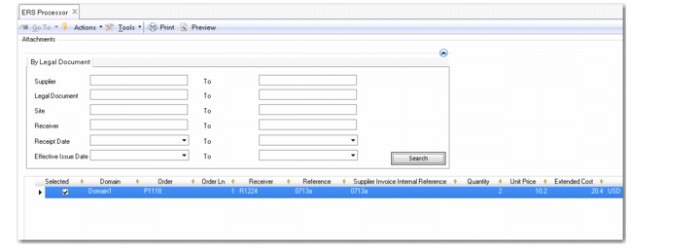
ERS Processor, By Legal Document Tab
The Supplier, Site, Receiver, and Receipt Date fields are described in
Processor Flow for Receipts.
Legal Document
Specify a range of legal documents for which to search for fiscal receipts.
Effective Issue Date
Specify a range of issue dates for which to search for fiscal receipts. The effective issue date is the date on which the legal document is issued from the supplier.
Grid
Effective Issue Date
When using ERS to process fiscal receipts, this field displays the date on which the legal document was issued from the supplier.
The remainder of the grid fields are described in
Processor Flow for Receipts.