Costs and Variances
Overview
In this chapter you will see how the Advanced Repetitive module handles costs. You will be learning how this module handles variances and yield. Also discussed is the accounting close. For complete information on costing see the Cost Management course.
In this chapter you will see how the Advanced Repetitive module handles costs. You will be learning how this module handles variances and yield. Also discussed is the accounting close. For complete information on costing see the Cost Management course.
Repetitive functions are normally used in high-volume manufacturing environments, there you do not need detailed costs for each individual production order instead you need to know the costs over a period of time. This period can be as short as a single production run, but normally is much longer (many companies accumulate and report cots on a aggregate by GL period). To allow for this, Repetitive functions accumulate costs on a special type of work order—a cumulative order—one for each item, site, and production line.
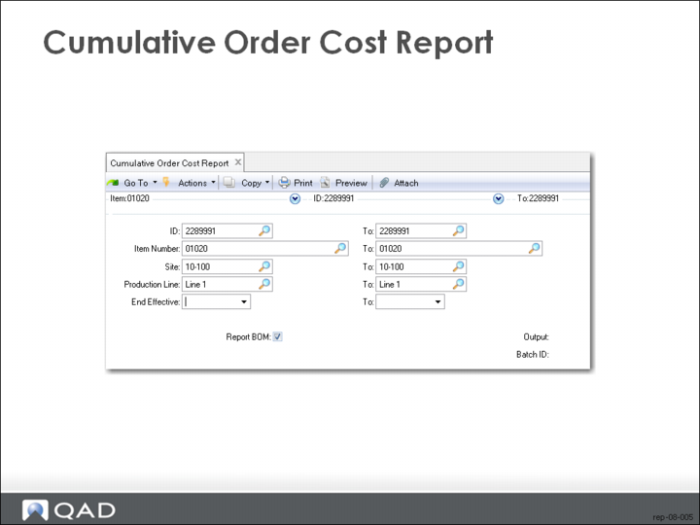
The cumulative orders are created automatically when the first production activity is reported against an item, site, and production line. At this time the system uses the current bill of material and routing, GL material costs, and work center rates to calculate a cumulative order cost. The system calculates a cost by operation and uses this cost to value WIP and scrap. The results of this calculation can be seen by running the cumulative order Cost Report (18.22.4.10). Any difference between the cumulative order cost and the GL cost will generate a method variance when items come out of WIP and enter inventory.
Costs and Variances
WIP/ Variances
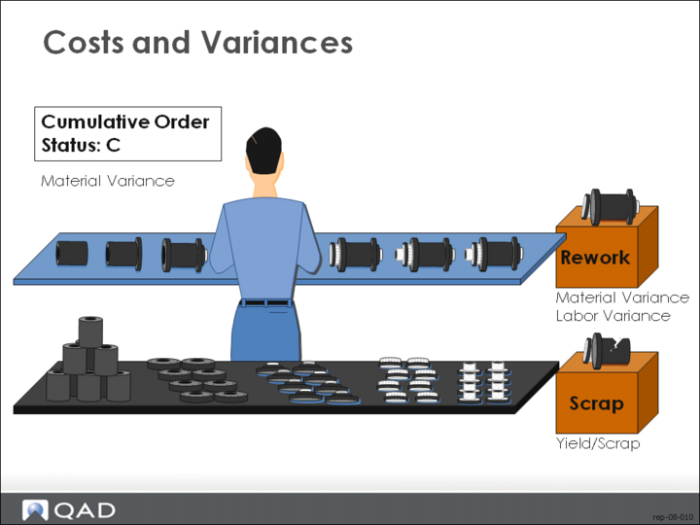
In Repetitive, both actual and standard costs are captured for all transaction reporting. In a standard cost system, the value of WIP is the standard cost at the time the system creates the cumulative order. The difference between this value and the value of all actual costs charged against the cumulative order is called a variance. For example, when units need to be re-worked, you use additional labor and, possibly, additional material. This normally produces a usage variance. If an employee who performs work on units has a different pay rate than the standard pay rate for the operation, this produces a rate variance. Variances can be either favorable (when you expend less resources than standard) or unfavorable (when you expend more resources then standard).
Yield/Scrap
Scrapped units do not always generate a variance. To generate a variance due to scrap, you must scrap either more or less than standard. For example, if an operation is expected to produce 90 units for each 100 units started, you would tell the system you expect to lose 10 percent of your units that come through that operation. You do this by putting a yield factor on the operation in the item’s routing. If you process 200 units and 20 are scrapped, you do not generate a variance. Components can also by yielded. For example, the quantity per for a component is 1.00. It has been determined that for every 100 units issued, 2 of that item will not be usable. The two percent attrition rate can be entered as a scrap percentage in the item’s product structure. When the component is backflushed, an additional 2 percent is issued to the line. No variance is generated since the 2 percent was factored into the standard.
Usage Variance
Material Usage Variance
A material usage variance is generated when there is a difference between the actual quantity of components backflushed and the standard quantity required.
Labor and Burden Usage Variance
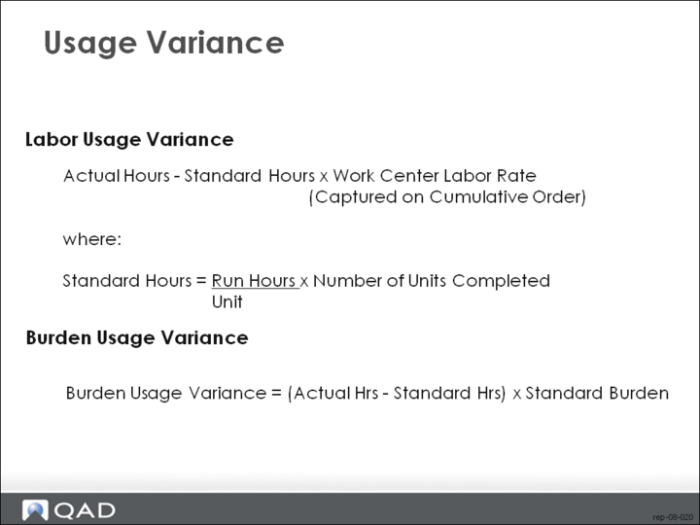
A labor usage variance is generated when there is a difference between the actual hours needed to complete an operation and the standard hours.