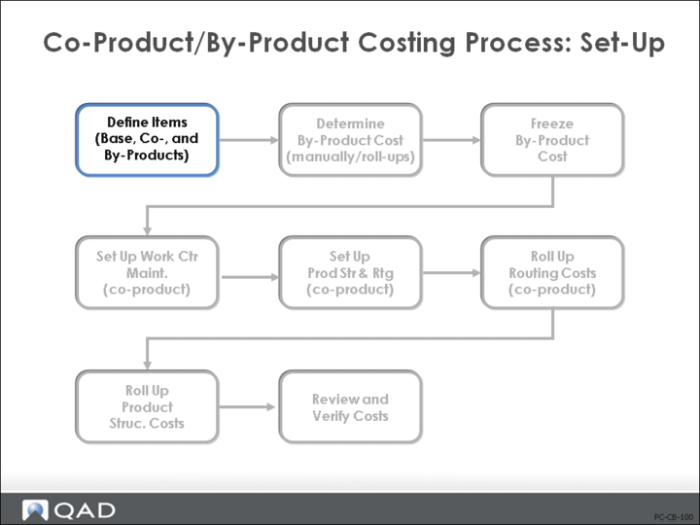
Define Items
• Base process
• Co-product
• By-product
• Components
Base Process
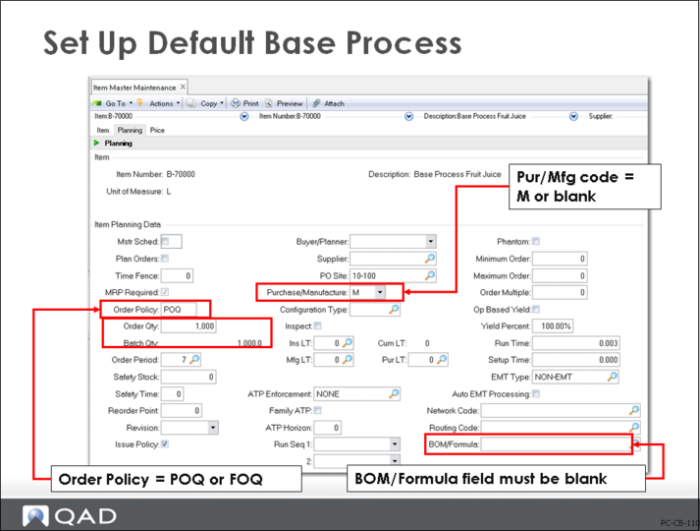
Enter information on the base process first. A base process must have a defined item record. Base processes are set up in Item Master Maintenance (1.4.1), as if they were items. Use base process “items” only for co-products/by-products.
• Set the base Pur/Mfg code to M (manufactured) or leave blank
• Details such as batch size, order policy, and order modifiers are made specific to a site in Item Site Planning Maintenance (1.4.17) so that planning parameters are unique to the conditions at each site
• Order Policy must be POQ or FOQ
• The Order Quantity should match the Batch Quantity set up in Process/Formula Maintenance, and should be the normal batch size.
• The BOM/Formula field must be blank
Co-Products
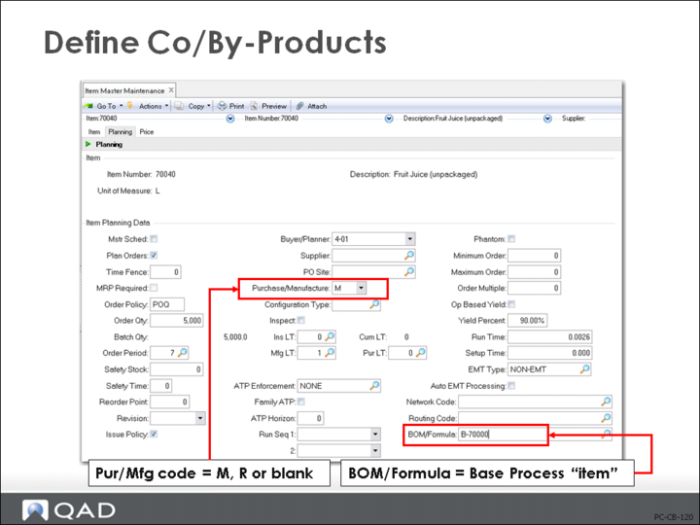
Define the Co-product and By-product items in Item Master Maintenance (1.4.1). All of the component items used by the base process must be set up in Item Master Maintenance if they are not already items.
• Set the Pur/Mfg code to M (manufactured), R (routable), or leave blank
• For the Co-Products enter the base process that is used for costing and MRP as the BOM code in Item Planning Data
• Do not enter cost data for co-products, that will be calculated by the roll up process.
Choose the default base process for each co-product with care. You can have only one BOM code for a co-product at each site. The costs developed for a co-product are based on that BOM code. The unit cost is used for the co-product in all base processes for the site.
The same co-product can result from more than one base process, but only one base process determines a co-product’s cost at a particular site. That is, a co-product receives costs only from the base process specified in the BOM/Formula field of the co-product’s item record.
The Order Policy and Order Modifiers of the base process are always used to plan and cost its co-products
By-Products
By-product costs are developed separately from the base process cost roll-up.
• You can enter by-product costs manually. Use Item Master Maintenance (1.4.1), Item Cost Maintenance (1.4.9), or Item-Site Cost Maintenance (1.4.18).
• Or, you can have the system calculate by-product costs from regular product structures or formulas. Any BOM/Formula code and Pur/Mfg code can be assigned to a by-product. You can use these codes to develop the by-product cost.
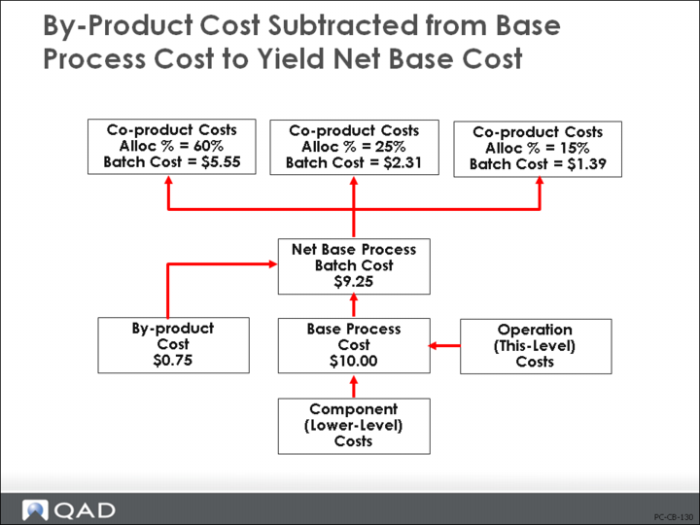
By-Product Costs Subtracted from Base Process Costs
By-product costs are subtracted from the base process batch cost before the cost is allocated to co-products. For costs to track correctly, you must have the following:
• A corresponding cost element in the cost set for the base process for each element in the by‑product’s cost set
• By-product cost elements that are not larger than the corresponding base process cost elements
• Frozen by-product costs
By-products can never receive an allocation of the base process cost. They can, however, have costs rolled up for them in the normal way. These costs must be rolled up and frozen prior to rolling up the base process and co-product costs.