Exercise 2: Working with Co/By-Products
1 Use Item-Site Planning Maintenance (1.4.17) for the two co-products (70040 and 70041) at site 10-100. For 70040 set the Purchase/Manufacture code to M, change the yield to 100%, and enter the base process code B-70000 in the BOM/Formula field.
For 70041 set the Purchase/Manufacture code to M and enter the base process code B-70000 in the BOM/Formula field.
2 Use Formula Copy (15.8) to copy the formula (product structure) from 70040 to B-7000. The source formula does not have operation numbers assigned to the components.
Use Formula Maintenance (15.5) to issue 80050 Fruit at operation 10 and all other components (80051, 80052, and 80053) at operation 30.
3 Use Process Definition Copy (15.16) to copy the process (route) from item 70040 to B-70000. Note the process route for 70040 has a 90% yield. After the copy use Process Definition Maintenance (15.13) to change the yield on operation 10 to 100%.
4 Use Process/Formula Maintenance (15.18) for B-70000 to add the Co/By-Products. In the header of the screen set the Backflush Method to 1 and the Quantity Complete Method to SUM.
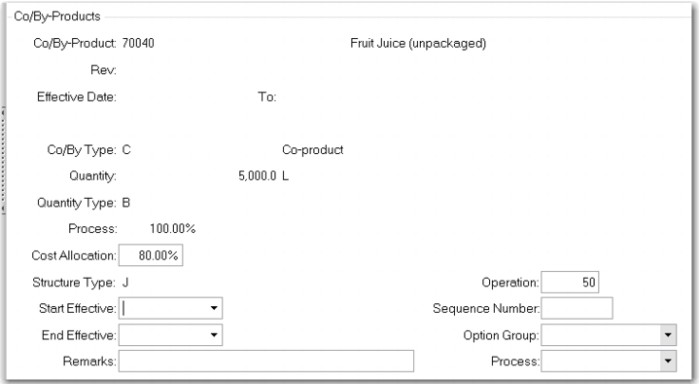
Enter the Co/By-Product number 70040, Type code is C, the quantity is 5,000L, the cost allocation is 80%, the operations number is 50.
In the same manner enter 70041. Its Co/By Type is C, the Quantity is 50, Quantity Type is B, the Cost Allocation is 20% and the Operation is 50.
Enter 70042. Its Co/By Type is B, the Quantity is 5, Quantity Type is B, there is No Cost Allocation and the Operation is 50.
Enter 70043. Its Co/By Type is B, the Quantity is 5, Quantity Type is B, there is No Cost Allocation and the Operation is 50.
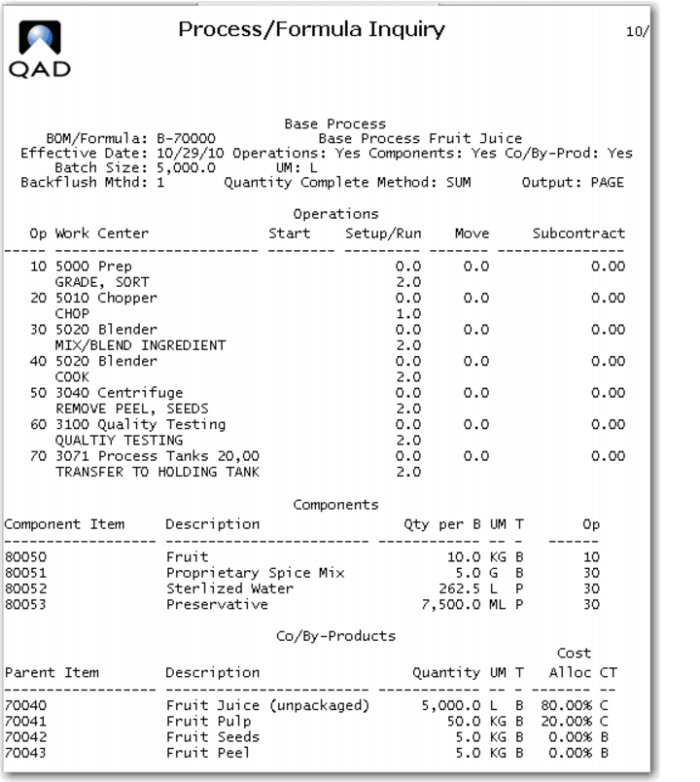
Use Process/Formula Inquiry (15.19) to review your work. It should look like this.
This inquiry shows the process operations by work center; and the setup and run times. It shows the components and quantities per batch, and the operations they are issued at.
It shows the Co/By-Products, their quantities per batch, and for the co-products their cost allocation.