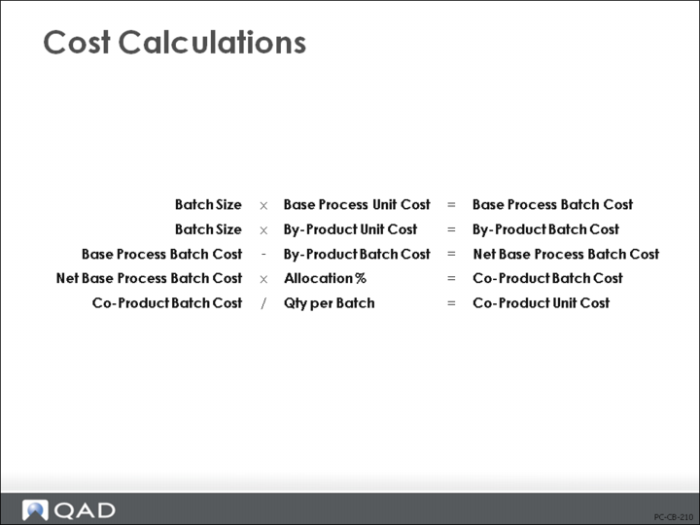
Cost Calculations
The cost calculations related to base processes, by-products, and co-products are shown in the figure above.
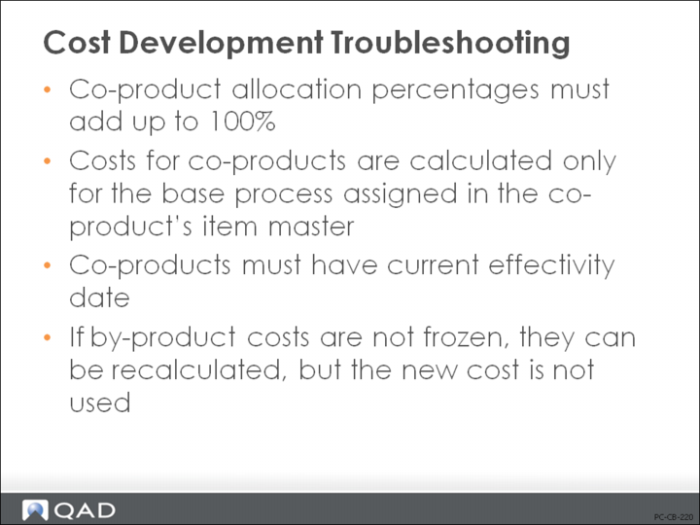
Cost Development Troubleshooting
Co-product Costs
There are a number of ways to set up co-products that causes their costs to be different than expected:
• Cost allocation among co-products does not add up to 100%
You receive warnings if you enter a co-product/by-product structure with cost allocation percentages that do not add to 100%. The warnings do not prevent you from leaving the percentages the way you entered them, though.
• Co-product in more than one base process
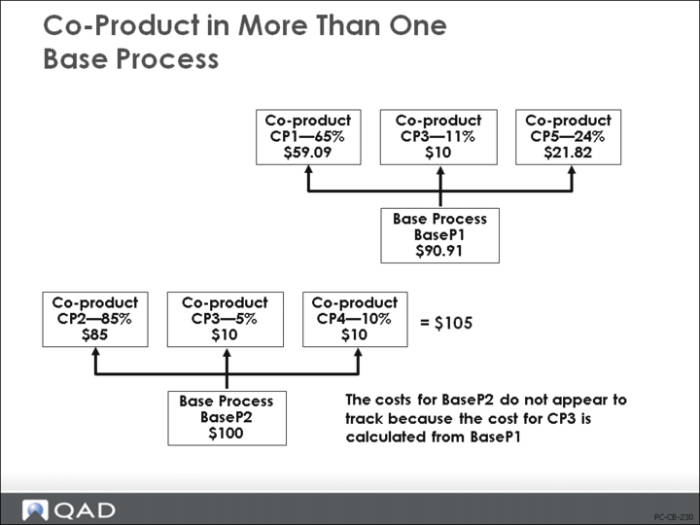
At a single site, if a co-product is in the co-product/by-product structure of more than one base process, the cost of the co-product is established by the base process whose item number is entered in the BOM/Formula code for the co-product. That co-product does not receive an allocation of costs from the other base processes from which it is produced. So, for the other base processes, adding up co-product costs does not appear to track to the base process cost. (See example on following page.)
• A co-product has an expired effectivity date
• By-product costs were not frozen
If by-product costs are not frozen once subtracted from the base process gross cost, the system recalculates the by-product costs, changing the value of the base process net cost.
Co-product in More Than One Base Process
Here is an example of a co-product (CP3) that is associated with two base processes (BaseP1 and BaseP2). The cost for CP3 is calculated from BaseP1. It appears, therefore, that the costs for BaseP2 does not track.
Five percent of the batch cost for BaseP2 is not allocated because it is assigned to CP3 in the co-product/by-product structure. The cost for CP3 is established elsewhere, so it does not add up with CP2 and CP4 to the base process batch cost for BaseP2.