Joint Order Sets
This section discusses co-product/by-product work orders, which form joint order sets, along with mix variances. The chapter ends with a look at average cost method.
Introduction
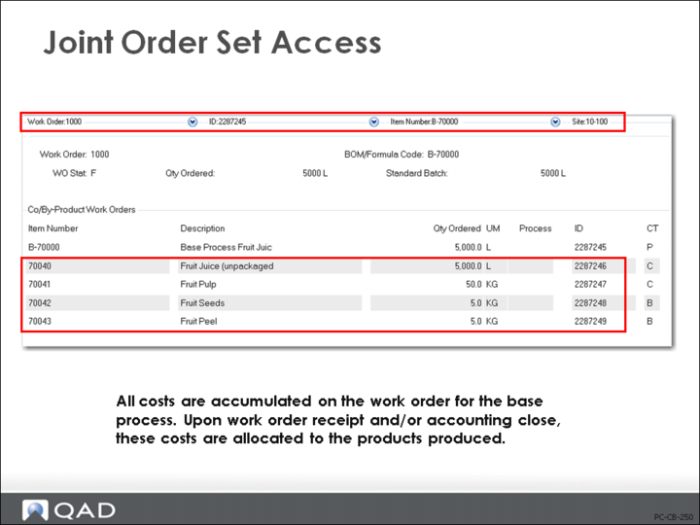
In the joint order set, a work order is generated for the base process as well as for each co-product and by-product in the joint order structure. Although the base process is not an item received to stock, the work order for the base process provides a record for accumulating all labor and material costs expended to make the items.
The graphic above shows the joint work orders created when an work order for 5000 of the base process B-70000 was created. Based on the Co/By-Product Structure, the system has created work orders to receive 5000L of the first co-product, 50KG of the second co-product and 5KG of each of the by-products.
The work order for the base process includes the work order bill and the work order route.
All orders in the joint order set share the same work order number, site, and status as the base order, but each has a unique work order ID.
For variations in the process, you can define valid alternate formula/structures and routings. Only one set of formula/BOM and routing is used for planning and costing, however.
Accounting for Joint Orders
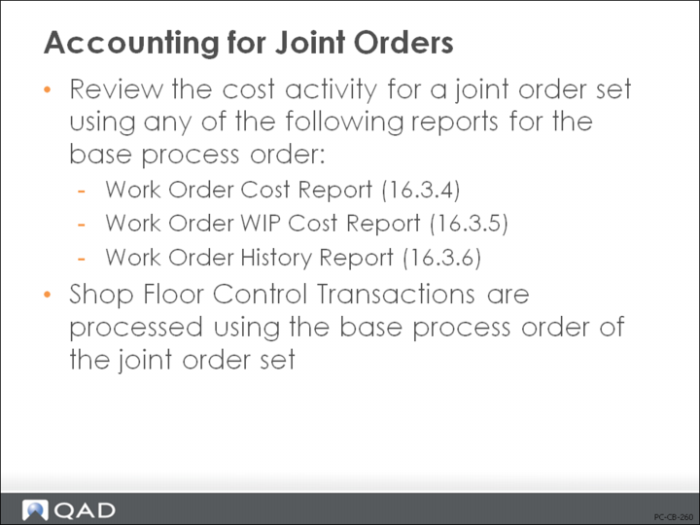
You can track all WIP costs associated with a joint order set as shop floor transactions are made.
Check cost details by making an inquiry against the work order for the base process.
The base process product line determines the work order accounts for a joint order with the exception of the mix variance account and cost center. The mix variance account and cost center are specific to the product line for the item on each of the joint orders themselves
Work Order Receipts
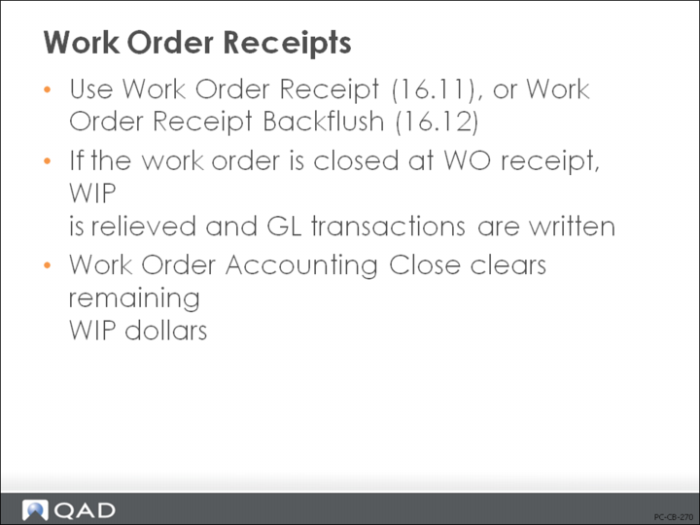
If you close the joint order set when you receive the work order to stock, WIP is reduced and GL transactions are written. If you do not close the set when you receive it to stock, WO Accounting Close allocates any WIP costs that remain.
• Any item can be received, in addition to the co-products and by-products of the joint order set
• If only pre-defined substitute items can be received, you must set these up in Item Substitution Maintenance (13.19) and set Modify Co/By-Product Receipts to Yes in Regulatory Attributes (Compliance) module control (1.22.24)
• A work order is created for each received item that is not part of the joint order set
Processing Joint Orders at Work Order Close
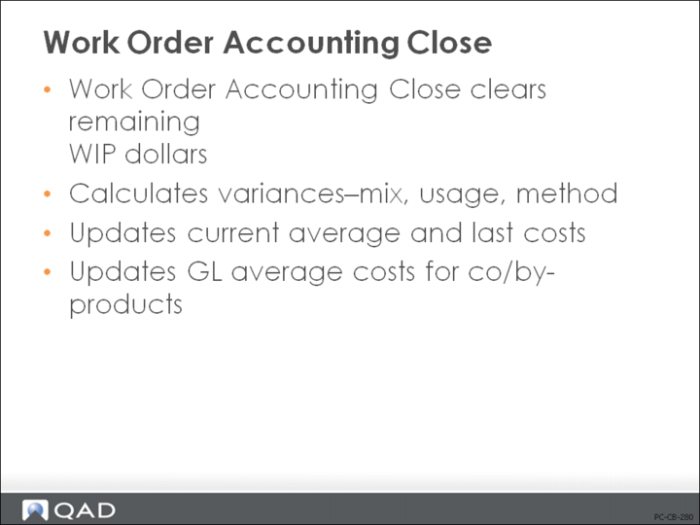
Work Order Accounting Close (16.21) calculates variances (mix, usage, and method), updates current average and last costs, and updates GL average costs for co-products and by-products.
• Method variance, rate and usage variances are calculated and booked in the same way as regular work orders.
• Mix variance is calculated and booked to joint order sets only.
• If co-product costs do not add up to the base process net cost when work orders are closed, method change variances result.
Reviewing Joint Orders
• To print information for each order related to a base process work order, use Work Order WIP Cost Report (16.3.5)
• To print information on items received and scrapped from a joint order set, use Work Order Cost Report (16.3.4)