Mix Variance
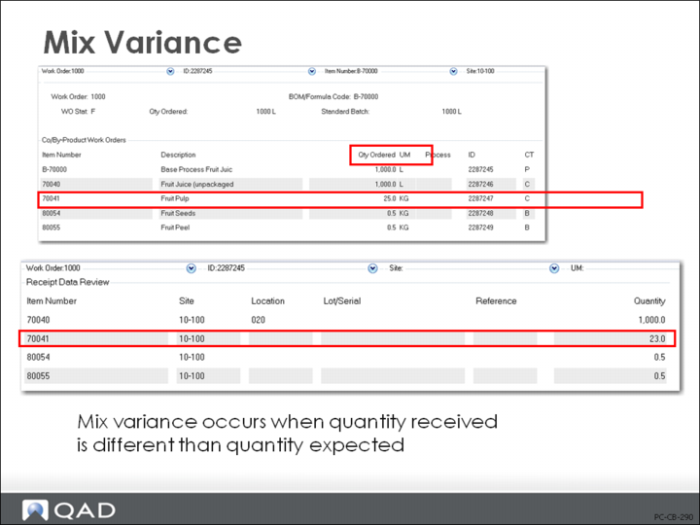
Mix variance results if the quantity of co/by-product received to stock differs from quantity expected.
[Order Qty - (Rec Qty + Scrap Qty)] * Unit Cost
Standard costs for co-products/by-products are derived based on the quantity per base process batch defined in the co-product/by-product structure. When the joint order set is closed, a mix variance occurs if the quantity of a co-product/by-product that is received to stock differs from the quantity expected, or if a substitute item is received. In a standard product structure, this would be recorded as a material usage variance.
Mix variance amounts, if any, are updated on the affected co-product/by-product work order and subtracted from the WIP amount of the base process work order. A GL transaction is created debiting the mix variance account specified on the co-product/by-product work order and debiting (unfavorable) or crediting (favorable) the WIP account specified on the base process work order.
Mix Variance Formula
The mix variance formula is:
Mix Variance = [Order Quantity – (Receipt Quantity + Scrap Quantity)] * GL Unit Cost
The sum of the receipt quantity and scrap quantity for a co-product/by-product is the quantity produced from the base process.
You cannot see a mix variance if you changed the quantity ordered to the quantity expected. (You can change the quantity ordered only when the work order status is [A]llocated, [E]xploded, or [R]eleased.) The quantity expected, then, is the work order quantity at the time of receipt to stock, not the quantity derived from the co-product/by-product structure.
Unexpected Receipts
Unexpected joint order receipts are receipts of items against a joint order set that do not exist on any order in the set. This is different than receiving a valid substitute item. An unexpected receipt is always has a mix variance. A work order is added to the set for the unexpected item. The order quantity on the joint orders for other items are unchanged by the unexpected receipt. Use Work Order Maintenance (16.1) to change the quantities on other joint orders, if necessary.
Unexpected receipts are common in many industries. For instance, a process might be expected to yield oil that is a certain grade. If oil of another grade is produced instead, it would be received as a different product—an unexpected receipt.