Average Cost Method
Introduction
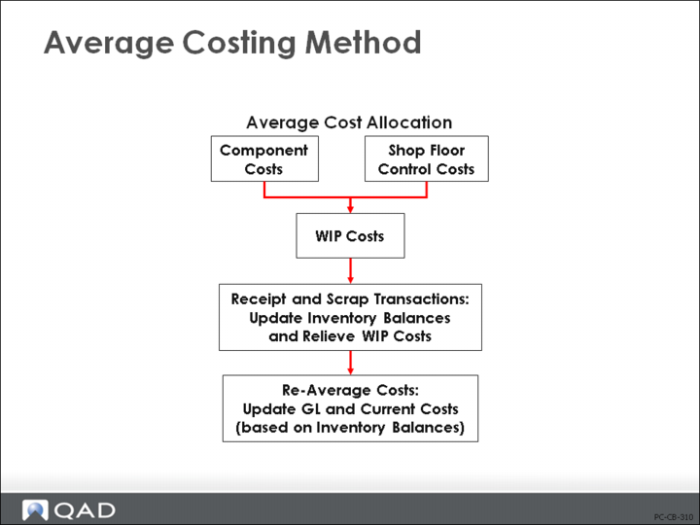
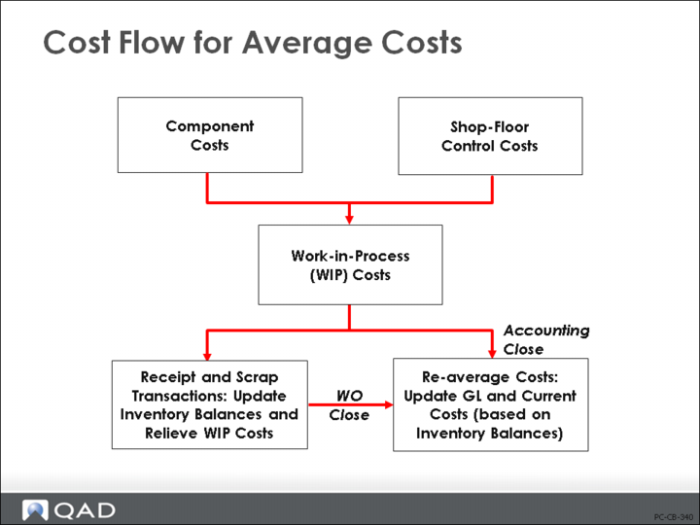
Costs are averaged by taking the costs accumulated in WIP and adjusting the costs of items in inventory received from WIP. QAD Enterprise Applications does this in the following steps.
1 WIP costs accumulate with a base process work order from component issues and shop floor control transactions.
2 Co-products and by-products are received from WIP at the “current” average GL cost.
3 When the costs are re-averaged, the remaining (positive or negative) WIP costs are allocated to the co-products.
Allocation and re-averaging of co-product costs occurs when the joint work order is closed in Work Order Receipt (16.11) or Work Order Receipt Backflush (16.12); also by running Work Order Accounting Close (16.21). If additional costs for a work order are recorded after costs are allocated, the remaining costs can be reallocated by opening the closed work order and closing it again.
Re-averaging of Costs Is Time Sensitive
Re-averaging of co-product costs is time sensitive. The greater the time between receipt and close, the greater the probability that some of the products produced have been consumed.
To maximize the accuracy of average costs and reduce costs booked to discrepancy accounts, the following should be emphasized.
• Complete reporting of co-product and by-product quantities when all quantities for all items are completed
• Set work order status to Closed when receipt quantities are reported
• Run Work Order Accounting Close (16.21) on a regular basis to process recently closed work orders
Allocation Methods
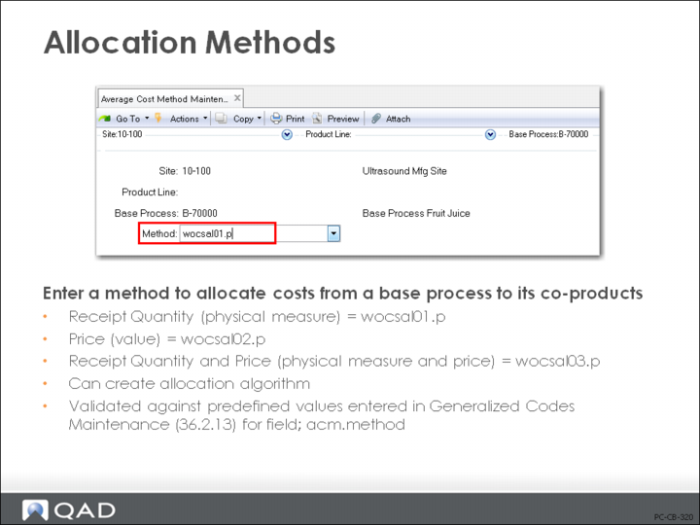
Define the average cost allocation method using Average Cost Method Maintenance (15.12.5). The system provides three methods for allocating costs from a joint order set to co-products:
• Receipt Quantity (wocsal01.p)
• Price (wocsal02.p)
• Receipt Quantity and Price (wocsal03.p)
If you need other methods, you can provide your own programs. If no method is specified for a site, the Receipt Quantity method is used.
All allocation percentages are calculated by comparing receipt quantities, price and extended price using equivalent units of measure (the unit of measure for the base process).
Price Allocation Method Example
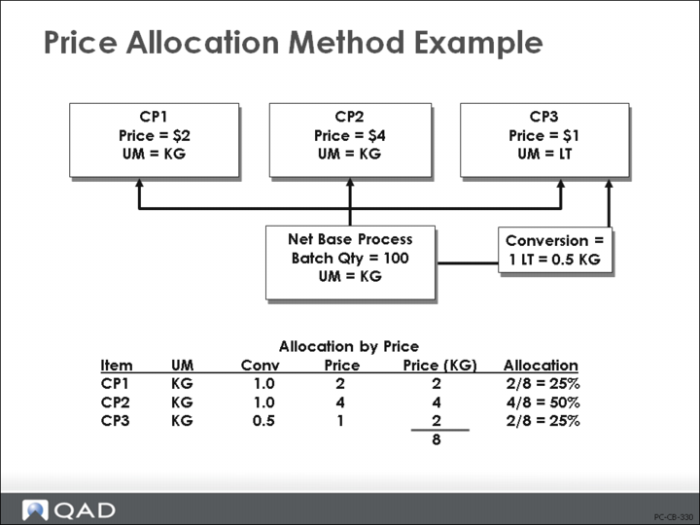
In this example of the allocation by price method of average costing, co-product CP1 has a unit of measure of kilograms (KG) that is the same unit of measure specified for the base process. The price divided by the conversion factor leaves the price the same at $2. CP2 has a price of $4.
CP3 has a unit of measure of liters (LT) and a conversion factor of 1 LT per 0.5 KG. When CP3’s price of $1 is divided by the conversion factor (0.5), the price for an equivalent unit of measure is $2. The allocation percentage for CP1 is its price of $2 divided by $8 (the sum of the equivalent prices of the three co-products). That yields an allocation percentage of 25%.
CP2’s allocation percentage = $4 / $8 = 50%
CP3’s allocation percentage = $2 / $8 = 25%
Other Allocation Methods
Allocation by Receipt Quantity
Allocation by receipt quantity is the default method, and it allocates cost based on physical measure.
Example: If 50 kilograms (kg) of CP1, 30 kg of CP2, and 20 kg of CP3 are produced, the percentage of cost allocated to the co-products based on receipt quantity would be 50% for CP1, 30% for CP2, and 20% for CP3 based on the following calculations:
CP1 = 50 kg / (50 kg + 30 kg + 20 kg) = 50%
CP2 = 30 kg / (50 kg + 30 kg + 20 kg) = 30%
CP3 = 20 kg / (50 kg + 30 kg + 20 kg) = 20%
Item | UM | Conv | Receipt Qty | Receipt Qty (KG) | Receipt Based Allocation |
CP1 | KG | 1.00 | 50.00 | 50.00 | 50% |
CP2 | KG | 1.00 | 30.00 | 30.00 | 30% |
CP3 | KG | 0.50 | 40.00 | 20.00 | 20% |
Allocation by Receipt Quantity and Price
This method allocates cost based on the combination of price and physical measure. All quantities are converted to the base process unit of measure.
Example: If the price per kilogram for CP1 is $2, for CP2 is $4, and CP3 is $2, then the percentage of cost allocated to the co-products based on receipt quantity and price would be 38.46% for CP1, 46.15% for CP2, and 15.39% for CP3 based on the following calculations:
CP1 = 50 kg × $2/kg = $100
CP2 = 30 kg × $4/kg = $120
CP3 = 20 kg × $2/kg = $40
CP1 = $100 / ($100 + $120 + $40) = 38.46%
CP2 = $120 / ($100 + $120 + $40) = 46.15%
CP3 = $40 / ($100 + $120 + $40) = 15.39%
Item | UM | Conv | Rcpt Qty | Rcpt Qty (KG) | Price | Price (KG) | Price Qty | Price/Rcpt Allocation |
CP1 | KG | 1.00 | 50.00 | 50.00 | 2.00 | 2.00 | 100 | 38.46% |
CP2 | KG | 1.00 | 30.00 | 30.00 | 4.00 | 4.00 | 120 | 46.15% |
CP3 | LT | 0.50 | 40.00 | 20.00 | 1.00 | 2.00 | 40 | 15.39% |
Cost Flow for Average Costs
Cost averaging for co-products occurs when you close a work order using the following programs.
• Work Order Receipt (16.11)
• Work Order Receipt Backflush (16.12)
• Work Order Accounting Close (16.21)
When you run Work Order Accounting Close, the following occurs.
• Co-product costs are re-averaged by taking any remaining positive or negative WIP costs and allocating them to the co-products. If additional costs are recorded for a work order after costs are allocated, the remaining costs can be reallocated by reopening the closed work order, applying the transaction, and closing it again.
• General ledger (GL) and current costs are updated
By-product Costs
By-product costs are not re-averaged. They are fixed—just as they are frozen during calculation of standard costs in cost roll-up.
• By-product costs are deducted in cost roll-up. Similarly, by-product costs are deducted from accumulated WIP costs before those costs are allocated to the co-products associated with a base process.