Cost Planning
Introduction
Cost planning functions are used to phase in new costs. When you know ahead of time that costs are going to change, you can enter those costs now, but not activate them until the actual changeover date. This is useful in several situations.
• During budgeting, where you can predict future costs, but you are not ready to phase them in yet
• For commodity-based products, where raw material costs change seasonally or on some regular basis
• In hyperinflationary economies, where costs increase by a certain percentage each period
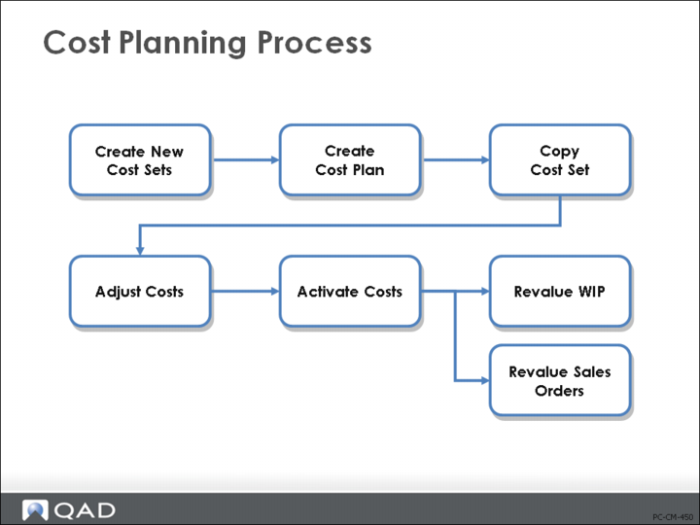
In order to use cost planning, simply set up a new GL cost set and use it to store the projected costs. Then use Cost Plan by Site Maintenance (30.15.1) to identify the date on which you expect these GL costs to take effect at this site.
• These costs are available for use on MPS Summary Reports (22.19) and MRP Summary Report (23.14). Both give you the option to use cost plans when calculating the anticipated cost of planned production. This is useful for your planners, particularly if costs are expected to change significantly. They can refer to the cost projections and reschedule production accordingly.
Note: Entering a cost plan does not change the GL cost automatically on that date. You must run the Cost Plan by Site Update (30.15.3) any time after the start date for costs to change. To activate the costs earlier, use Cost Set to Site Assignment (30.9).
Create New Costs Sets
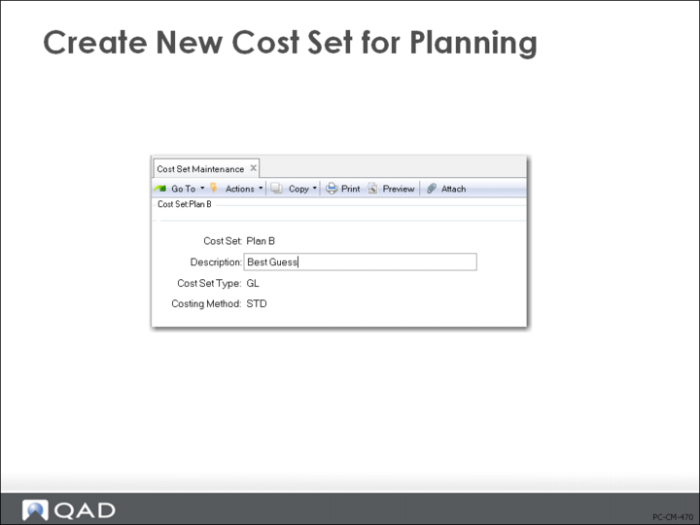
Use Cost Set Maintenance (30.1) to create a new cost set.
Create New Cost Sets
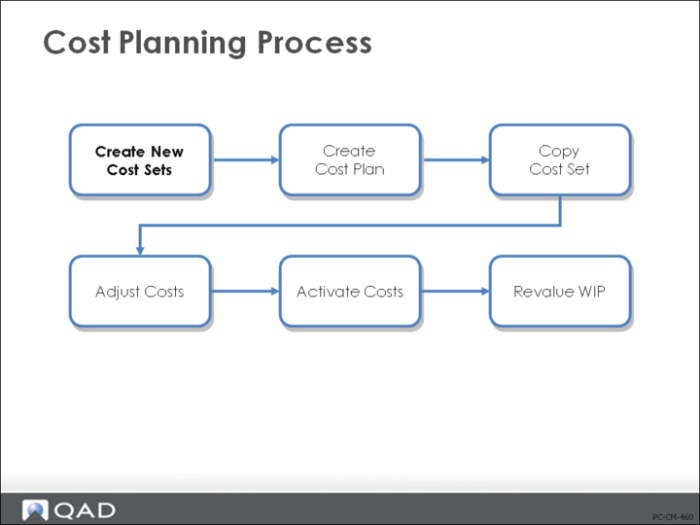
When you know how and when costs will change, record the new costs under a new Cost Set Code in Cost Set Maintenance (30.1) and attach it to a site with a starting effective date in Cost Plan by Site Maintenance (30.15.1).
Example: Suppose you experience a 10% cost increase in the second quarter. You would create a cost set with costs that are 10% higher than normal and name it “Plan” or whatever seems appropriate. Similarly, you might want to create a cost set for the third quarter if costs for that quarter were expected to be less than normal.