Introduction to Customer Schedules
Course Overview
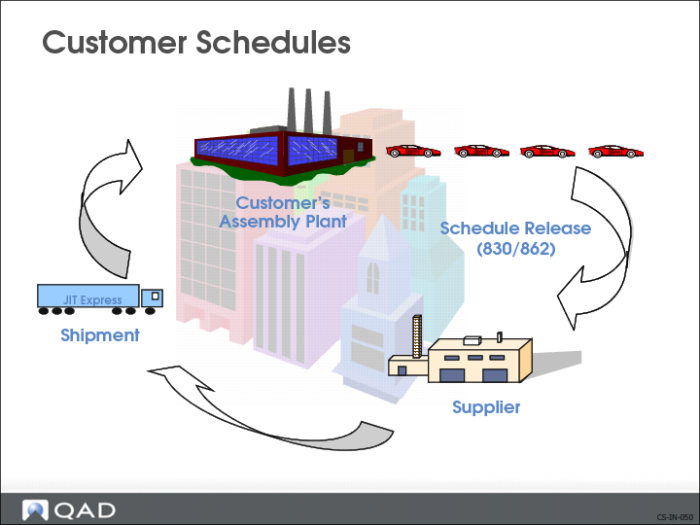
Customer Schedules
Customer schedules are cumulative, schedule-driven sales orders with multiple line items from which shipments are released. They are rooted in practices developed by the automotive industry.
• The automotive industry requires the communication of releases and the sending of Advanced Ship Notices (ASNs); some companies pay from the ASN
• Customer schedules allow automotive companies to maintain an uninterrupted flow of work through manufacturing, while maintaining minimum levels of inventory
Today many businesses and industries use customer schedules. Companies using customer scheduling share a common profile:
• High production volumes
• Long term commitments with suppliers
• Frequent shipments from suppliers
• Normally use EDI or eCommerce
When using customer schedules, the customer sends demand using shipping (862) and/or planning (830) schedules instead of a separate sales order for every date required. The schedules provide a long-term forecast of planned requirements plus the short-term or immediate shipping requirements. Schedules can also include information such as authorization quantities, recent customer receipt quantities, and special delivery requirements.
Planning schedules usually cover a time period of 2 to 6 months. Shipping schedules cover a shorter time period, usually 5 to 10 days.
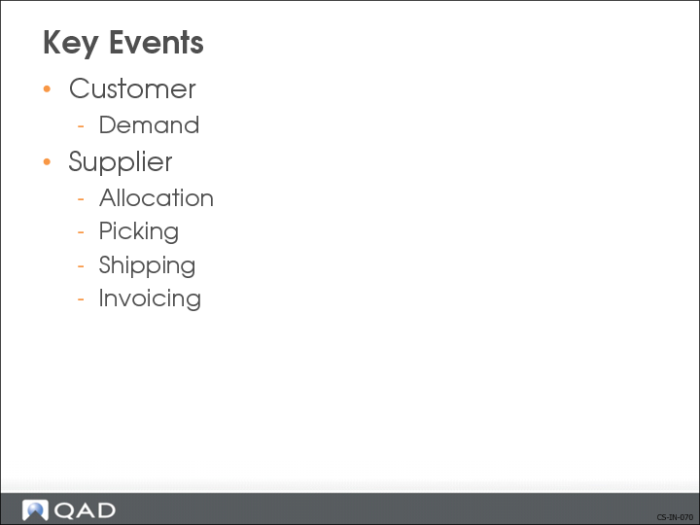
Key Events
• Customer places an order with the supplier
• Supplier creates a scheduled order
• Customer sends demand
• Shipping schedule (short-term demand)
• Planning schedule (long-term demand)
• Supplier
• Determines requirements
• Allocates and picks materials
• Ships order
• Invoices customer
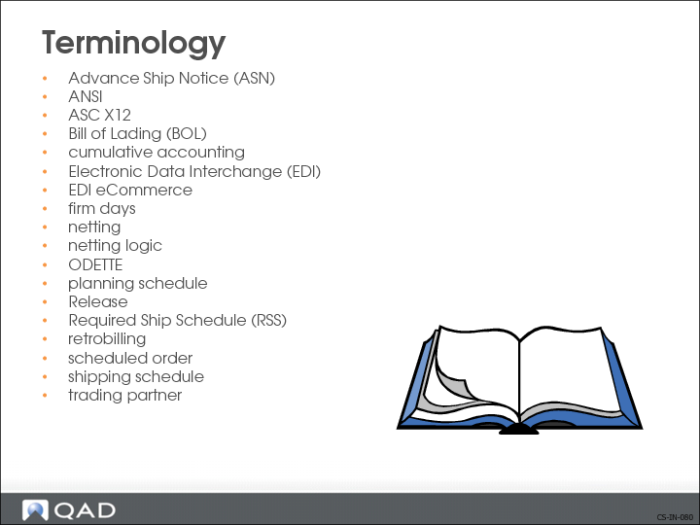
Terminology
Advance Ship Notice (ASN)
An electronic document derived from a shipper document and sent by a supplier to a customer when a shipment leaves the supplier site, informing the customer that the shipment is on the way. ASN formats are defined for various international standards; for example, an 856 Transaction Set per ANSI ASC X12. An ASN takes the place of an invoice in some supplier-customer arrangements. See Electronic Data Interchange (EDI).
ANSI and ASC X12 (American National Standards Institute Accredited Standards Committee X12)
This committee develops and maintains U.S. generic standards for electronic data interchange. Generically, X12 refers to any of the standards that have been published by the ANSI ASC X12 committee as well as any of the industry-specific standards that are a subset of any ANSI X12 standard.
Bill of Lading (BOL)
Detailed breakdown of a shipment; for example, products shipped, total weight of product, and containers used for packing. Typically, this is a third-party carrier’s contract and receipt for goods transported between two points and deliverable to a specified individual.
Cumulative accounting
A method of tracking shipments and receipts in which trading partners maintain running totals of required and shipped/received quantities.
Electronic Data Interchange (EDI)
An international protocol for electronically transmitting documents such as customer schedules, invoices, and ASNs between trading partners.
EDI eCommerce
The EDI component of QAD Enterprise Applications.
Firm days
The number of days in a schedule firm interval. The schedule firm interval begins with the first day of a schedule release.
Netting
Calculating net requirements by subtracting quantity-on-hand from gross requirements.
Netting logic
Indicates how the system calculates a required shipping schedule. There are four options.
• If 1, only shipping schedules are used.
• If 2, only planning schedules are used.
• If 3, planning and shipping schedules are combined, with the shipping schedule taking precedence where schedules overlap (replace logic).
• If 4, planning and shipping schedules are combined, with the greater of the shipping or planning schedule taking precedence where schedules overlap (consume logic).
ODETTE (Organization for Data Exchange by Teletransmission in Europe).
The primary standards organization for automotive EDI in Europe.
Planning schedule
A schedule used for moderate or long-term planning of production, materials, and resources. Shows weekly/monthly quantities and dates, and covers a time horizon from the present out 2–6 months.
Release
A schedule based on a scheduled order.
Required Ship Schedule (RSS)
A schedule containing customer requirements as derived from a customer’s planning and ship schedule transmissions.
Retrobilling
The process of determining a net amount due by applying a price change to a range of historical invoices.
Scheduled Order
A specialized sales or purchase order that has schedules attached to it for the suppliers to ship against. The scheduled order can have an indefinite term. The scheduled order serves as the basis for creating the customer and supplier schedules.
Shipping Schedule
Used for short-term planning of products, materials, and resources. Lists exact quantities with exact dates, usually covering a few days or weeks.
Trading Partner
A company with which another company engages in buying or selling.
Incoming Information Flow
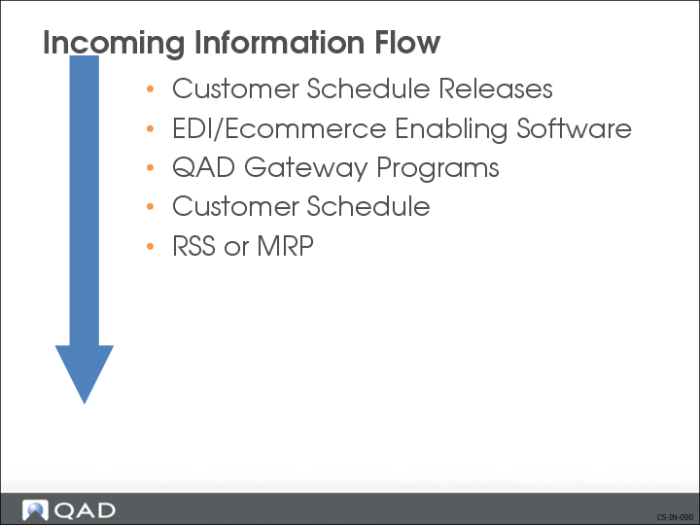
Customers communicate period-oriented demand by sending statements called releases.
Releases are generally received using EDI or eCommerce. EDI or eCommerce enabling software is used to pull the releases from a customer’s computer or electronic mailbox. Release information is then mapped through the QAD Enterprise Applications gateway programs into the customer schedule maintenance programs.
Note: Customers may have their own EDI or eCommerce requirements and signal standards, which are handled by the EDI or eCommerce enabling software. Only the required information is passed to QAD Enterprise Applications.
After the releases are entered into the customer schedule maintenance programs an RSS is generated to formulate the input for MRP.
Outgoing Information Flow
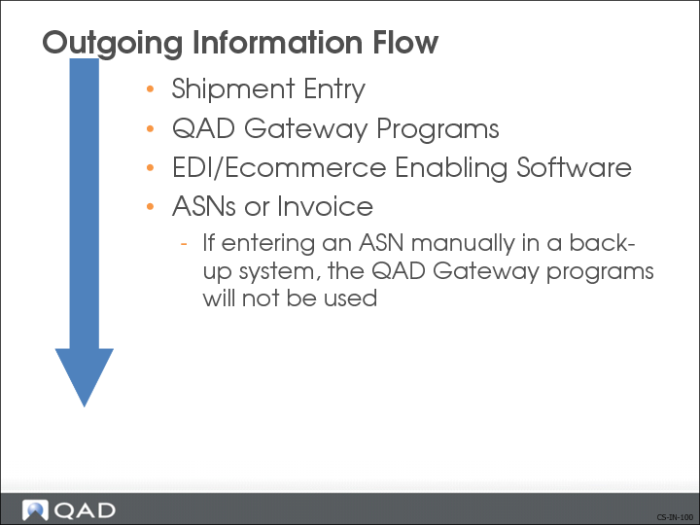
Customers can require that an ASN is communicated by EDI or eCommerce when a shipment is made. This situation can occur:
• When there is significant transportation lead time
• Where the customer has software that can significantly reduce the keying input for receipt of goods
ASNs reduce the need for expediting at the customer end.
• The customer can see when goods are on the road
• If the customer’s software allows, an ASN merely needs to be confirmed for items and quantities to make a receipt, rather than keying in all the details again
• Some customers pay from the ASN
• Some customers also require invoices be sent via EDI or eCommerce
Customer Schedules Life Cycle
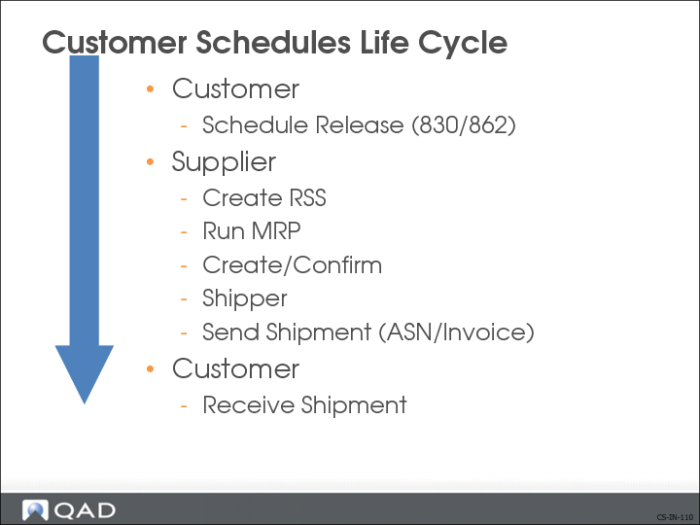
• Customer’s schedule release initiates the process
• Planning schedule
• Shipping schedule
• Supplier generates an RSS and runs MRP
• The shipment is processed
• Create pre-shippers/shippers
• Confirm
• Supplier sends shipment
• Sends an ASN or an invoice
• Customer receives shipment