High Availability
High Availability Introduction
Redundancy
Failover
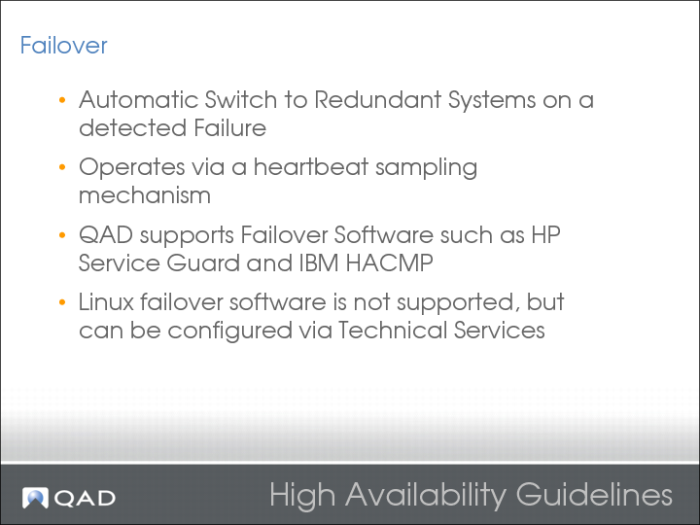
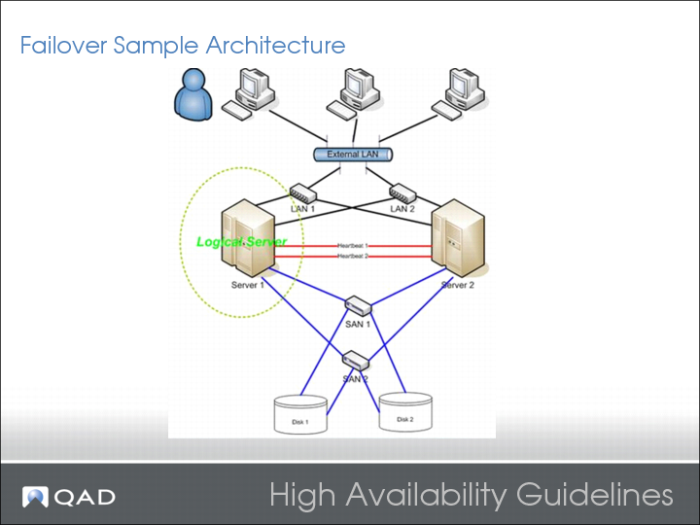
Failover is the ability to automatically switch over to a redundant or standby computer server, system, or network upon the failure or abnormal termination of the previously active server, system, or network. Failover happens without human intervention and generally without warning.
The automation is done using a heartbeat cable that is connected to the two servers. As long as there is a pulse or heartbeat from the main server to the second server, the second server does not initiate its systems. There can also be a third spare parts server that has running spare components for hot switching to prevent down time.
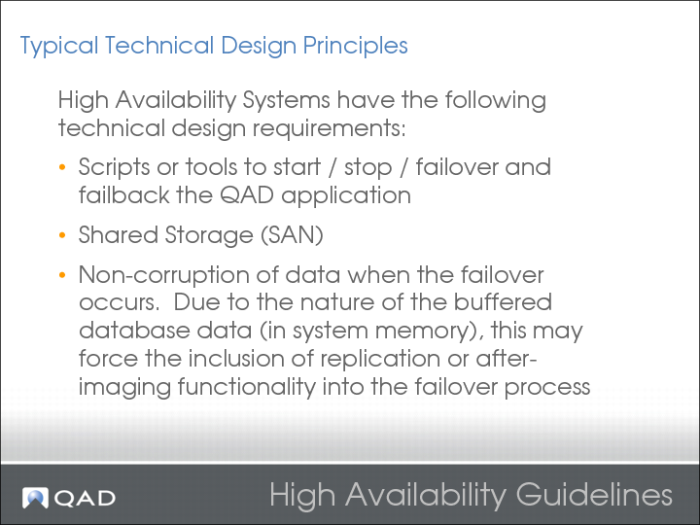
QAD systems may not be able to failover all components, especially relational databases because QAD databases tend to have large amounts of recent data in RAM (buffer memory). Because it is technically very difficult to failover buffer memory contents, the actual failover of the relational database component probably requires manual intervention.
High Availability Design
Failover Architecture
QAD and Progress OpenEdge support the following commercial HA implementations with QAD Enterprise Edition and other QAD software products using the OpenEdge database server:
• HP Service Guard 11i (HP-UX)
• IBM HACMP 5.3 (32-bit and 64-bit, AIX 5.3)
• Microsoft Cluster Server MSCS v1.2 (Windows Server 2003, 32-bit)
• Sun Solaris Sun Cluster 3.0 and 3.1+
For information on HA software support for Oracle and SQL-Server databases, contact QAD Support.