Disaster Recovery
Disaster Recovery Planning
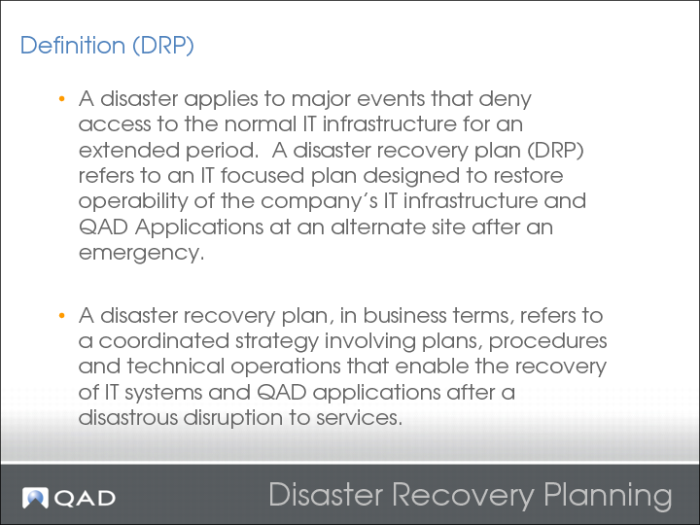
Disaster Recovery Planning Definition
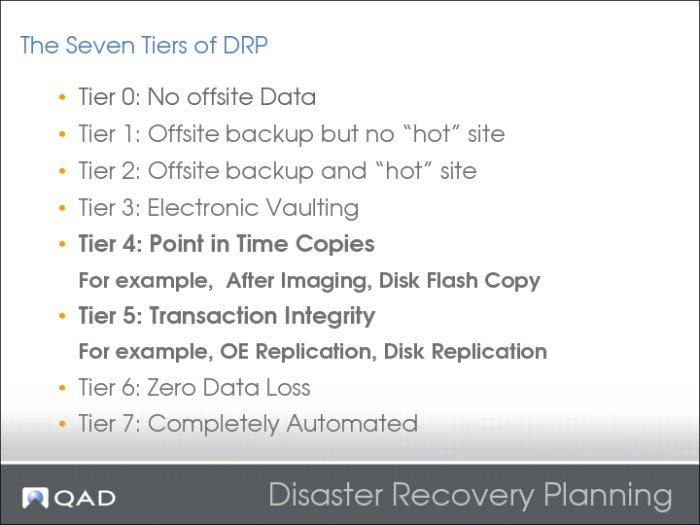
Disaster Recovery Planning Tiers
Tier 0 - No Off-site Data
Businesses with a Tier 0 Disaster Recovery solution have no Disaster Recovery Plan. There is no saved information, no documentation, no backup hardware, and no contingency plan.
Typical recovery time: The length of recovery time in this instance is unpredictable. In fact, recovery may be impossible.
Tier 1 – Offsite Backup with no Hot Site
Businesses that use Tier 1 Disaster Recovery solutions back up their data at an off-site facility. Depending on how often backups are made, they are prepared to accept several days to weeks of data loss, but their backups are secure off-site. However, this Tier lacks the systems on which to restore data.
Tier 2 – Offsite Backup with a Hot Site
Businesses using Tier 2 Disaster Recovery solutions make regular backups on tape. The backups are combined with an off-site facility and infrastructure (known as a hot site) to restore systems from tapes in the event of a disaster. This tier solution still results in the need to recreate several hours to days of data, but the recovery time is more predictable.
Tier 3 - Electronic Vaulting
Tier 3 solutions utilize components of Tier 2. Additionally, some mission-critical data is electronically vaulted. This electronically vaulted data is typically more current than that data which is initially installed. As a result, there is less data recreation or loss after a disaster occurs.
Tier 4 - Point-in-Time Copies
Businesses that require greater data currency and faster recovery than users of lower tiers use Tier 4 solutions. Rather than relying largely on shipping tape, as is common in the lower tiers, Tier 4 solutions begin to incorporate more disk-based solutions. Several hours of data loss is still possible, but it is easier to make such point-in-time (PIT) copies with greater frequency than data that can be replicated through tape-based solutions.
Tier 5 - Transaction Integrity
Businesses with a requirement for consistency of data between production and recovery data centers use Tier 5 solutions. There is little to no data loss in such solutions. However, the presence of this functionality is entirely dependent on the application in use.
Tier 6 – Zero Data Loss
Tier 6 Disaster Recovery solutions maintain the highest levels of data currency. Businesses with little or no tolerance for data loss that require the rapid restoration of data to applications use this tier. These solutions have no dependence on the applications to provide data consistency.
Tier 7 – Completely Automated
Tier 7 solutions include all the major components being used for a Tier 6 solution with the additional integration of automation. This approach allows a Tier 7 solution to ensure a higher consistency of data. Additionally, recovery of the applications is automated, allowing for restoration of systems and applications much faster and more reliably than would be possible through manual disaster recovery procedures.
DRP Solution Selection
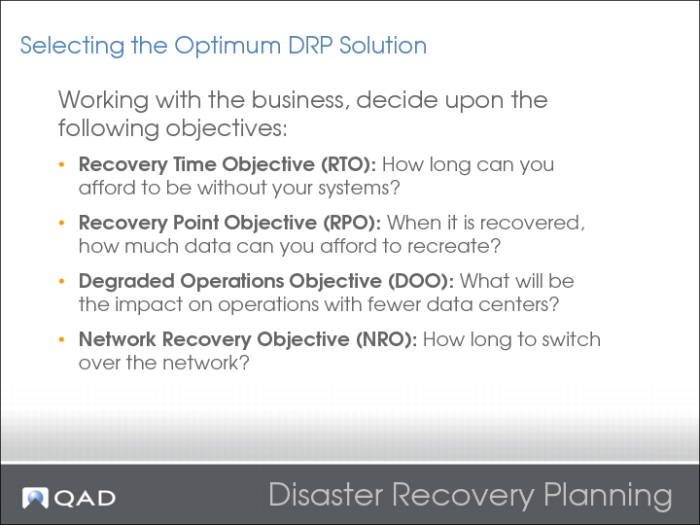
It is important to understand that the cost of a solution must be in reasonable proportion to the business value of IT. You do not want to spend more money on a disaster recovery solution than the financial loss you would suffer from a disaster.
Using the following objectives, it becomes relatively simple to decide which solution to select according to how much you can afford to spend and the speed at which you need your data recovered. The quicker the recovery, the higher the cost.
A DRP is a comprehensive statement of actions to take before, during, and after a disaster. Document and test the planning to ensure the continuity of operations and availability of critical resources in the event of a disaster.
The DRP involves more than just specifying off-site storage locations or backup procedures.
Form a planning/management team, with senior management support, to oversee the development and implementation of the plan. Expenses can be very high, so senior management should be involved at all times.
The major functions of the planning team might be:
• Defining what constitutes a disaster
• Conducting a risk analysis
• Conducting a business impact analysis
• Identifying critical resources
• Identifying disruption impact and allowable outage times and data loss
• Developing recovery priorities
• Defining the architectural solution
• Defining the personnel and sub-teams, their roles, and responsibilities
• Defining the recovery plan phase
• Selecting the disaster recovery site
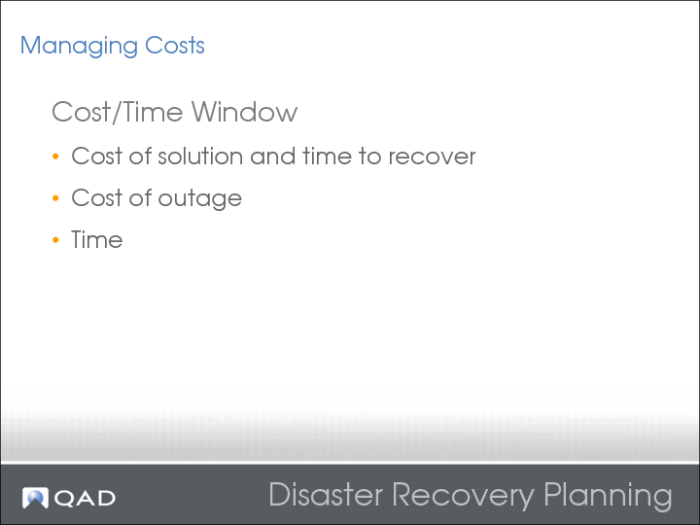
• Managing costs
Managing Costs
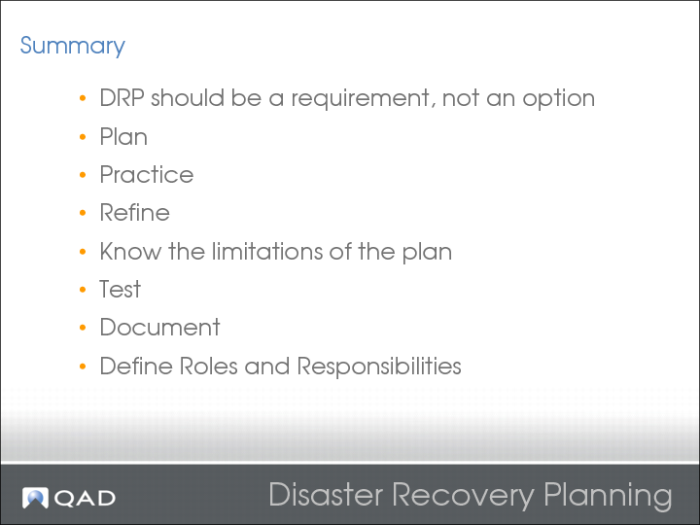
Disaster Recovery Planning Summary