Introduction
Course Introduction
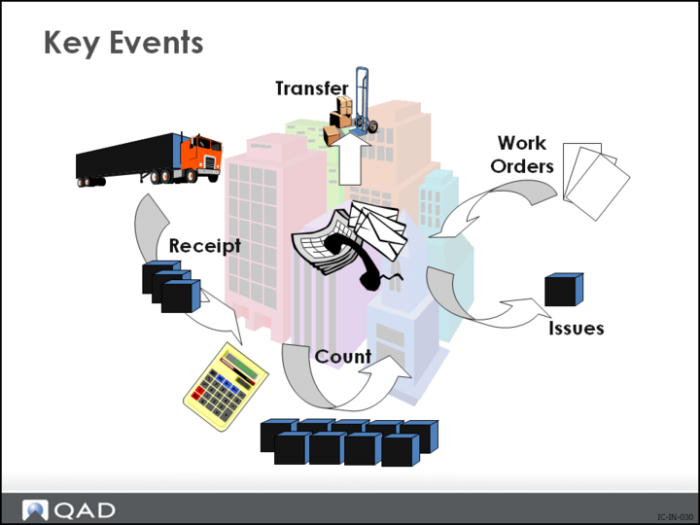
Inventory Control
• Materials are received into inventory
• Stock is issued to fulfill work orders
• Stock may also be transferred from one inventory location to another
• Stock is counted periodically to ensure that inventory records are accurate
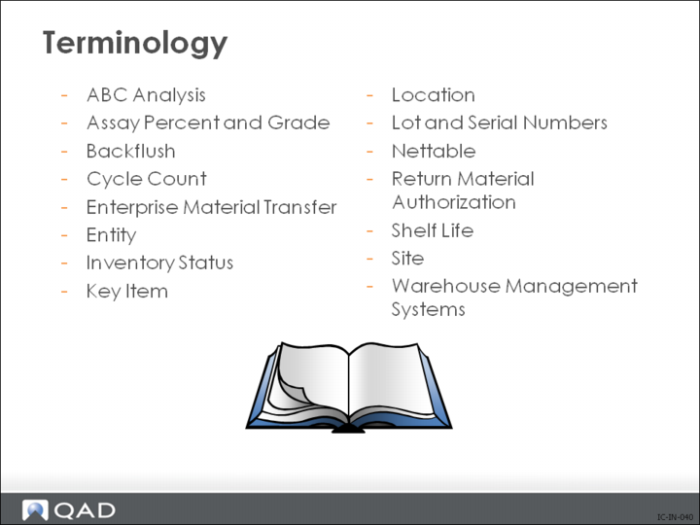
Terminology
ABC Analysis
Classification of a group of items in decreasing order of annual dollar volume or other criteria.
• The A class usually represents 10% to 20% by number of items, and 50% to 70% by projected dollar volume.
• The B class usually represents about 20% by number of items, and 20% of the dollar volume.
• The C class contains 60% to 70% of the items and represents about 10% to 30% of the dollar volume.
The ABC principle states that effort and money can be saved through applying looser controls to the low-dollar-volume class items than will be applied to the high-dollar-volume class items. This is also known as Pareto's Distribution.
Assay Percent
Assay percent and grade can be important when allocating items. Specific formulations can require a minimum assay percentage or grade. Review these values prior to allocating or picking ingredients.
An assay is a test of the physical and chemical properties of a sample.
Grades
Grades are created by the sublabeling of items to identify their particular makeup and to separate one lot from other production lots of the same item. Graded products include raw materials, intermediates, or finished goods. Grades can determine the price charged for the finished product.
Backflush
Use backflush to report production activity on manufacturing work orders. Each time you use this transaction to report production quantities, the system does one or more of the following:
• Issues (backflushes) components to the operation at which you are reporting.
• Backflushes labor and burden to the reporting operation.
• Moves the quantity processed to the input queue of the subsequent operation.
• Receives completed end items into inventory when you report production at the final operation in the routing. At this time, it also updates the quantity completed and reduces the quantity open on the applicable work order.
Cycle Count
A cycle count records the number of items physically counted, compares that number with the system quantity-on-hand, and (optionally) updates quantity-on-hand to equal the number counted.
Enterprise Material Transfer (EMT)
EMT is the automated translation of a sales order into a purchase order within a specific entity. It also includes the creation of sales orders in another entity. This process is common business practice among multinational companies.
Entity
The number of sets of financial statements produced by one database is determined by the number of entities set up. An independent unit for financial reporting purposes, an entity does the following:
• Generates a separate balance sheet and income statement.
• Plans budgets.
• Is assessed for taxes.
Inventory Status
Inventory status determines whether inventory balances are:
• Available for allocation.
• Considered by Material Requirements Planning (MRP).
• Allowed to go negative.
Inventory status also restricts particular transactions at specific locations. For example, you can restrict issues from an inspection location.
Item quantities received into inventory are automatically assigned an inventory status. You can assign a different inventory status to individual item quantities at a particular site or location, or item quantities in the same location, that are differentiated by:
• Unique lot
• Serial numbers
• Reference numbers
Key Item
A key item is an item for which there must be sufficient quantity-on-hand for a work order to be released and a picklist printed. Key items are critical items. Key items are typically difficult to obtain. They may have long lead times or may be in short supply. Only a few items should be designated as key items. For example, glass is a key item for a window manufacturer. If there is not enough glass available to fill an order, the order cannot be started.
Location
A location is a physical area where inventory is stored. Every item in inventory is associated with a location. A given item may be stored in multiple locations. Each location's parameters identify what can be stored there and how that inventory can be used. Each time you perform an inventory transaction such as an issue, receipt, or transfer, you must specify both a site and location.
You can define the same location code for multiple sites. This is useful if you use an item at more than one site because you set up default locations in the item master rather than on individual item-site records.
Lot and Serial Numbers
If required, a lot number must be entered during issues and receipts. A lot number applies to the entire transaction quantity entered.
If serial numbers are required for an item, a unique serial number must be entered for each item during issues and receipts. For example, if you receive 10, you must enter 10 serial numbers. QAD Enterprise Applications maintains complete lot and serial number traceability.
Nettable
Nettable items are items that MRP and distribution requirements planning (DRP) count as part of quantity-on-hand
Return Material Authorization (RMA)
RMA is a transaction used to manage simple returns. It is an alternative to calls for tracking customer contact. RMA has the following aspects:
• Receipt of returned items for repair or replacement.
• Issue of replacement items.
• Documentation and billing of return activity.
RMA is generally used when engineer involvement is not required.
Shelf Life
Shelf life is typically defined for items that spoil or degrade over time. You can use shelf life to set the expiration date for inventory. Inventory that has expired does not appear on picklists as a quantity to be picked. QAD Enterprise Applications calculates an expiration date when an item is received into inventory by adding the number of days specified for shelf life to the receipt date.
Site
Sites are areas where inventory is manufactured or stored. For example:
• Off-site storage
• Distribution centers
• Warehouses
• Manufacturing facilities
• Any combination of the above
All inventory control and planning information in QAD Enterprise Applications is maintained by site, including:
• Inventory availability
• Manufacturing methods and costs
• Sales
• Purchases
• Manufacturing plans and orders
• Forecasts
Each site is associated with a specific general ledger (GL) entity, allowing complete financial results to be maintained and monitored by site, or by groups of sites.
Usually, each site is split into multiple locations where the inventory is actually stored, so you may think of a site as a group of physical locations. For example:
• Stockrooms
• Inspection stations
• Shop floors
Warehouse Management Systems
Warehouse Management Systems are computer applications used in external warehouse systems that exchange data with QAD Enterprise Applications through the warehousing interface.