Business Considerations
Business Considerations
Operational Structure
Database
A database is a logical collection of computer records. Separate databases are often used to deal with geographical limitations and security concerns. Within a database, security can be defined to prevent users from modifying or viewing information.
When a multiple database environment is established, you can use distributed functionality that allows planning and execution across the databases. Each user has a profile that determines which database, or databases, they can access.
Domains
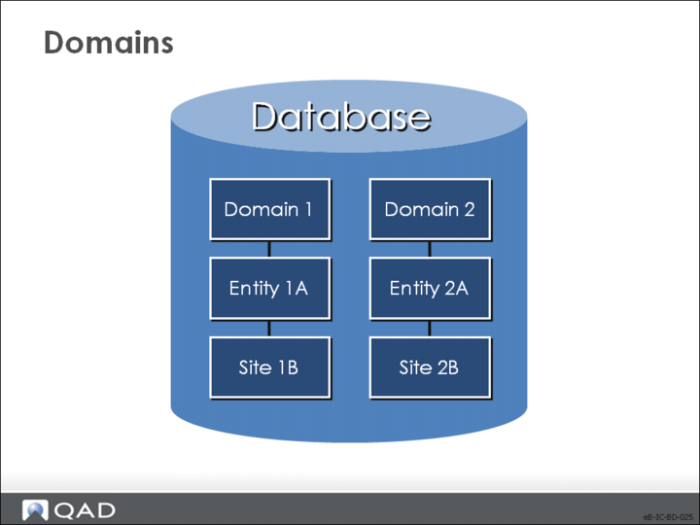
Domains comprise business operations using a single base currency and chart of accounts. There may be multiple domains within a single database.
Every database must have one system domain, indicated by a domain type of SYSTEM. The initial system domain is created when the database is created. The system domain includes default data that is required to begin implementing QAD EA such as control program settings, rounding methods, default accounts, and generalized codes.
The system domain is used as a template for new domains. When you create a new domain associated with the current database, default data is copied from the system domain. Since the system domain is used as a template, you may want to add data to it or tailor defaults before creating new domains based on it. The system domain is typically not used for maintaining active transactions.
Entities
Entities are assigned to Domains and are unique businesses with financial reporting responsibility. Financial reports, earnings statements and balance sheets, are organized by entity. There may be multiple Entities in a Domain.
You must identify one entity as the primary entity for each domain in your database. This is done in entity maintenance in general ledger setup.
Sites are assigned to Entities and are logical subsets of the business usually associated with a physical location such as a manufacturing plant, a distribution facility, or a warehouse. There may be multiple sites at a single physical location for internal control purposes. There may be many sites assigned to an Entity.
The number of sets of financial statements produced by one database is determined by the number of entities you set up. An entity is an independent unit for financial reporting purposes that:
• Generates a separate balance sheet and income statement
• Plans budgets
• Is assessed for taxes
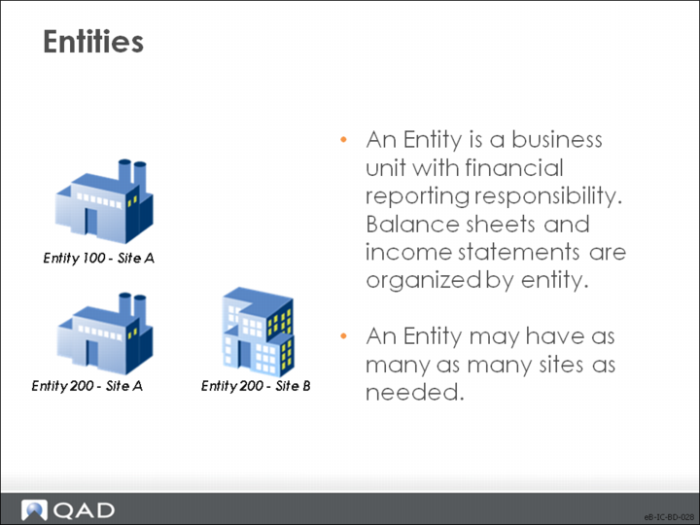
An Entity is a business unit with financial reporting responsibility. Balance sheets and income statements are organized by entity.
All GL transactions are posted by entity. The primary entity is the default entity for GL transactions. Primary entity is set up in Entity Maintenance in General Ledger setup. Default entity is set up in the Domain/Account Control.
Although there is no limit to the number of entities that can exist in a database, all information for one entity should be contained within a single database.
An entity can be comprised of a single facility (Plant A) or multiple facilities (Plant B and Warehouse), as shown in the figure above.