Materials Requirements Planning
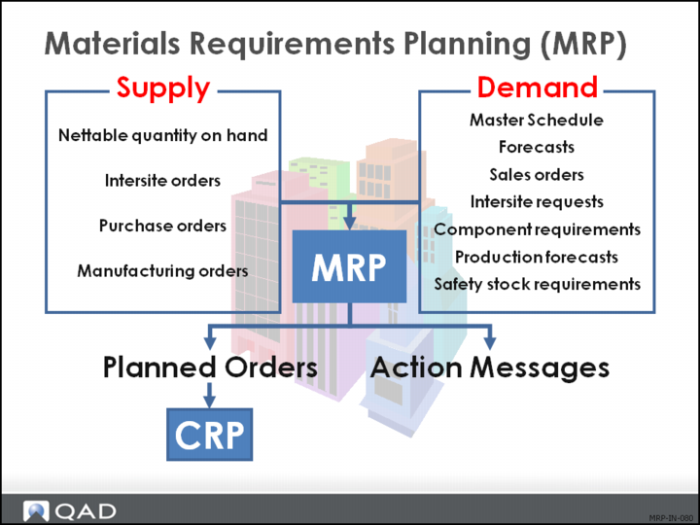
MRP balances supply and demand for purchased and manufactured items. Given a set of demands or requirements, MRP automatically calculates a time-phased schedule of planned supply orders or replenishments to satisfy those demands. It also generates action messages to alert you to any problems such as shortages and late receipts.
MRP looks at demand for finished items and uses product structure information to calculate demand for component items. For each item, MRP looks at the:
• Ordering information
• Amount currently on hand
• Lead times
MRP then generates planned orders suggesting how many of each item to buy or make and when to do so
MRP performs planning activity by site. Each site’s material plan is independent from inventory, demand, and supply at other sites. To plan for multiple sites, you run MRP for each site separately.
Reliable MRP processing depends on accurate:
• Inventory data
• Product structures and formulas
• Manufacturing and purchasing lead times
Balancing Supply and Demand
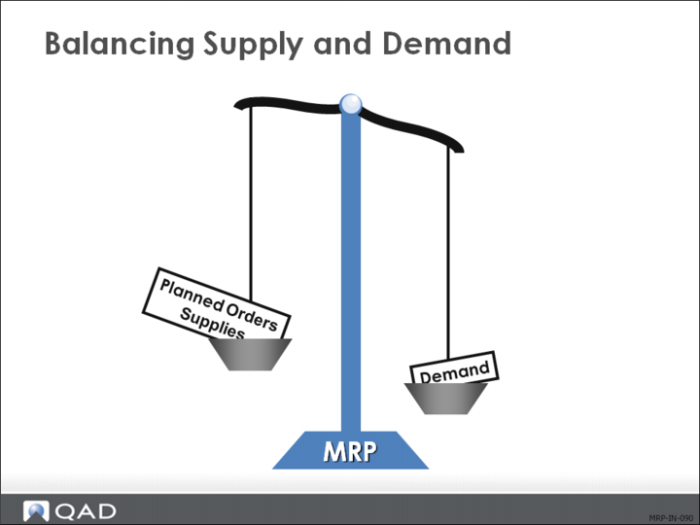
MRP attempts to balance supply and demand. It detects imbalances in the plan and makes recommendations to restore the balance.
• It tries to drive inventory to zero, never planning more than it needs
• It plans without respect to capacity
Order Timing
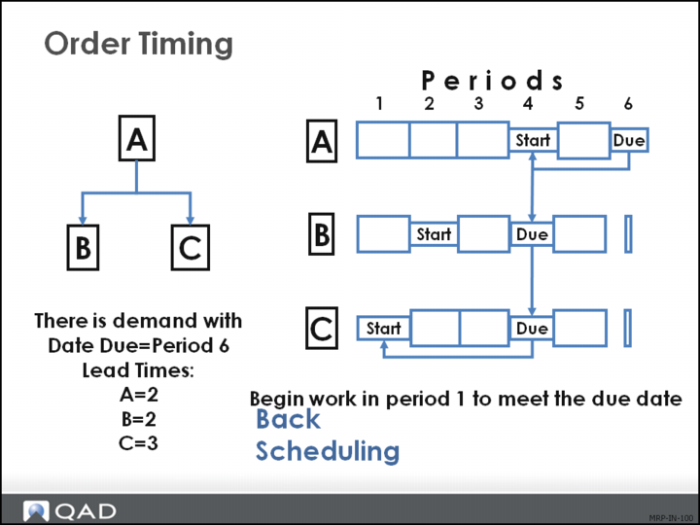
The master schedule sets the overall plan on which MRP bases the timing.MRP uses backward scheduling to determine the start date. In backward scheduling, the lead time is subtracted from the due date to arrive at the start date. MRP performs this calculation on all planned orders.
Some guidelines of MRP:
• A component due date is generally the parent item’s release date; however, lead time offsets adjust the component due date.
• For all non-purchased items, MRP counts only work days as defined in the shop calendar.
• For purchased items, MRP uses regular calendar days; if the release date is a non-workday, MRP uses the prior workday.
MRP Calculations
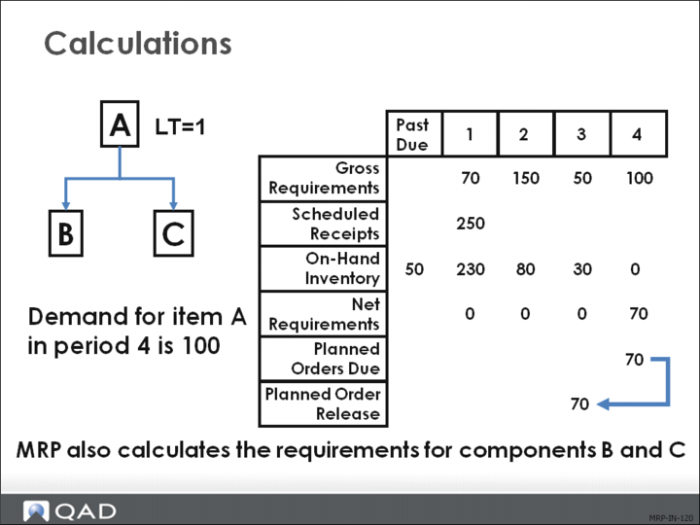
MRP uses this calculation for each period.
• Maintaining the balance across the planning horizon complicates the calculations
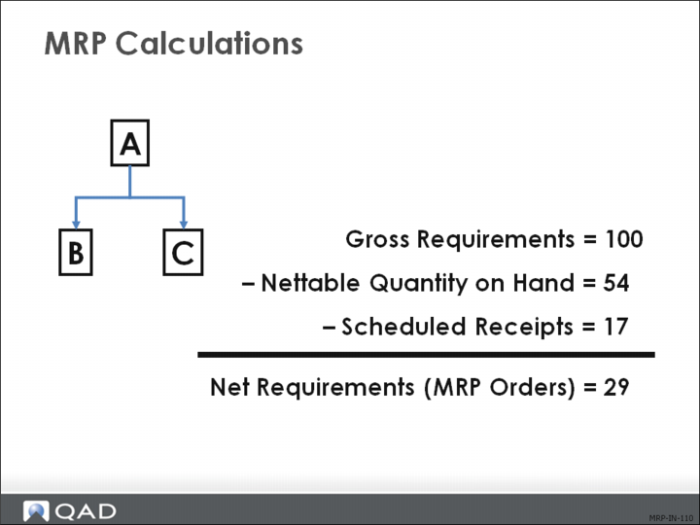
The illustration here shows the calculations for end item A. MRP also calculates the requirements for all components
Net Req. = Gross Req. - Scheduled Receipts - Nettable On Hand
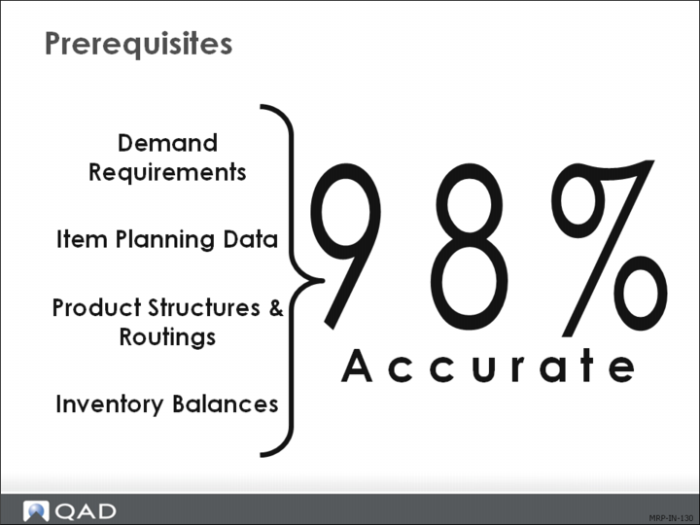
MRP Prerequisites
MRP is as accurate as its input allows it to be.
For useful output, make the inputs more than 98% accurate.