Capacity Requirements Planning
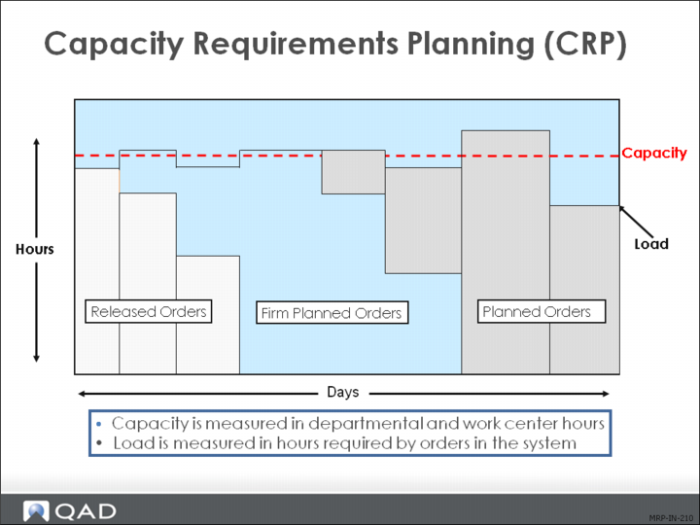
CRP calculates the workload in a given department or specific work center or machine by:
• Exploding the routings and processes for MRP planned and firm planned orders and updating or creating work order routings
• Determining the start/due dates for each operation using:
• Work center and shop calendars
• Back scheduling (start date of the last operation is the due date of the previous operation)
The Foundation for CRP
MRP provides the foundation for calculating CRP, a tool used to complete the master schedule.
Master scheduling and rough-cut capacity planning (RCCP) have removed most of the capacity constraints before MRP is run.
Note: Discussed in Training Guide: Master Scheduling and Rough-Cut Capacity Planning (RCCP)
• MRP looks at the inventory and at orders
• CRP uses routings and work centers
• RCCP uses resources and resource bills
Back Scheduling
When CRP back schedules orders, it takes the due date of an order or repetitive schedule and schedules each of its operations from the last operation in the order routing or process backward to the first one.
CRP assigns each operation a start date and a due date, using the operation lead time components—queue, setup, run, wait, and move—to calculate operation start dates.
• The start date of an operation is the same as the due date of the previous operation
• CRP calculates run times based on the actual order quantity: order quantity less the quantity completed
Departments and Work Centers
Resources used to process orders on the shop floor, from subassembly to end item, are:
• Departments
• Work centers
• Number of machines
Departments
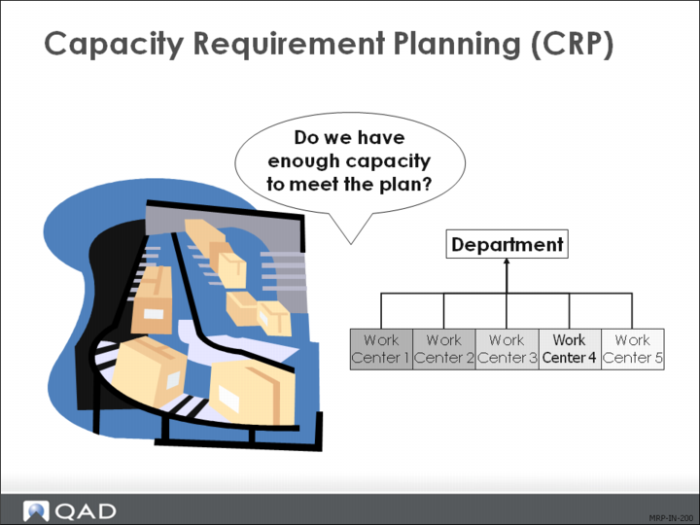
The capacity of a department is the total number of available labor hours per day for all work centers in the department, as defined in Department Maintenance (14.1).
CRP provides a Department Load Summary that shows the total load hours for all the work centers in a department against the total capacity. This function can be a useful quick check on load conditions. However, be aware that labor from one work center may not be interchangeable with other work centers in the department.
Work Centers
The capacity of a work center is the number of machines and personnel available multiplied by work hours in a period, as defined in Work Center Maintenance (14.5) and Calendar Maintenance (36.2.5).
CRP loads (or simulates) the expenditure of work center and department hours using orders as production demand. Work order routings provide data about which orders are using which work centers and when.
MRP and CRP Users
MRP and CRP are high-level operations. Control access to these functions with security so only qualified employees use them.