Exercise 9: Engineering Change using Phantom Use Up Logic
A definition of a phantom item is a non-stocked subassembly. The assumption is that you choose to not carry the phantom item in stock. The phantom logic therefore says; if a phantom item is in stock it should be issued to all requirements until consumed at which point the system would again issue the components of the phantom.
You can use this logic to ensure all current stock of an item is consumed, then, automatically switch to issuing a new item. Set up the product structure of the 01050 to consume the current CD until all stock is gone then switch to the DVD.
1 Use Product Structure Maintenance for the 01050, delete the end date from the 60014 and delete the 60014.1 from the structure.
2 Create a new product structure for the 60014 with the 60014.1 as its only component.
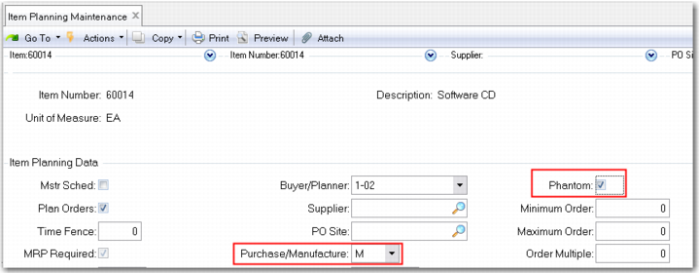
3 Use Item Planning Maintenance (1.4.7) to change the 60014 Purchase/Manufacture code from P to M, and check the Phantom field.
The system now thinks the 60014 is a manufactured item made from a 60014.1. If any item 60014 are in stock, the system will issue them; otherwise it will “blow through” the phantom and issue the 60014.1.
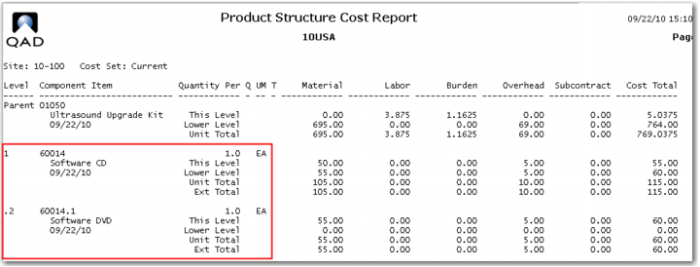
4 Run the Product Structure Cost Roll Up for the 01050 and review the Product Structure Cost Report. Note the indented structure for the 60014.1 and its cost 55.00 that has been rolled up to the 01050, not the 50.00 cost of the 60014.
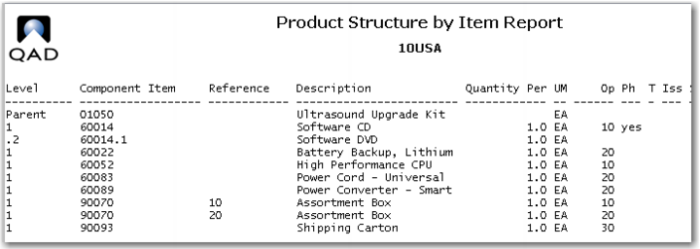
Another view of the new structure is given by the Product Structure by Item Report. Here you see the indented structure of the 60014 and that it is now a phantom. The fact that the system is using the cost of the phantom component, in this case the DVD while still consuming the CD, is something for management to be aware of and perhaps compensate for.
Effect of Structure Type on Costs
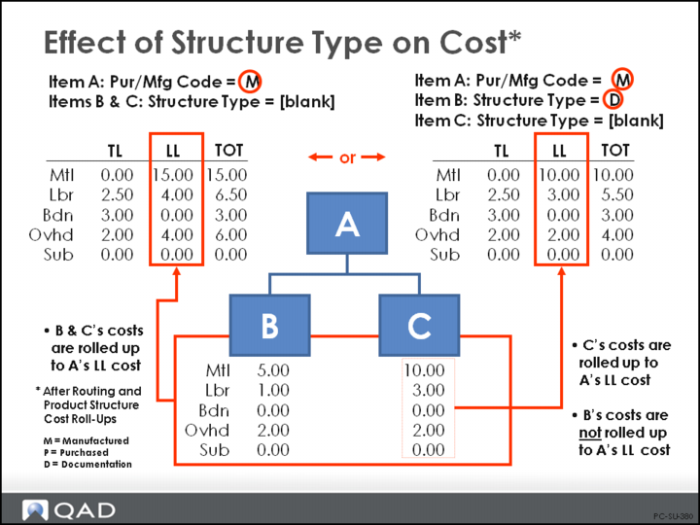
This example shows the difference in how a component in a product structure is affected by its structure code and type.
• When item A has a Pur/Mfg code of [M]anufactured and both components have blank structure type codes, all lower-level costs roll up correctly
• When component B has its structure type code changed to [D]ocumentation, only the lower-level costs for component C are rolled up to item A; lower-level costs for component B are not rolled up to item A. The same effect occurs if the structure code for a component is set to [P]lanning, or [O]ptional.