Exercise 10: Effect of Structure Type Code
1 Engineering has decided it needs to include instructions with the Ultrasound Upgrade Kit and has prepared an instruction sheet. Add this to the product structure.
Use Item Master Maintenance to create a new Item 01051, Upgrade Instructions. Assign it to Product Line 10 and make its status Active. Set its Purchase/Manufacture code to P. Advance to the Current Cost Screen and enter a material cost of 1.00.
A marketing decision is made to not include the cost of the instructions in the cost of the product.
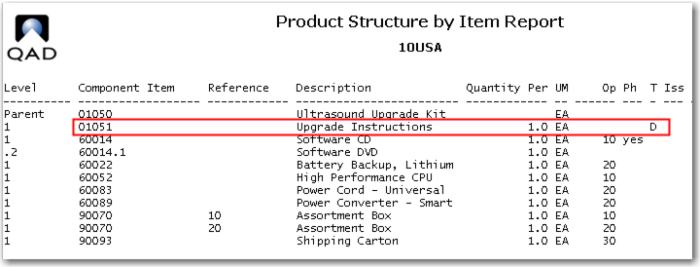
2 Use Product Structure Maintenance for the 01050 and add the 01051 with a quantity of one, at operation 10, and its Type Code set to D, document. The Product Structure by Item Report now looks like this.
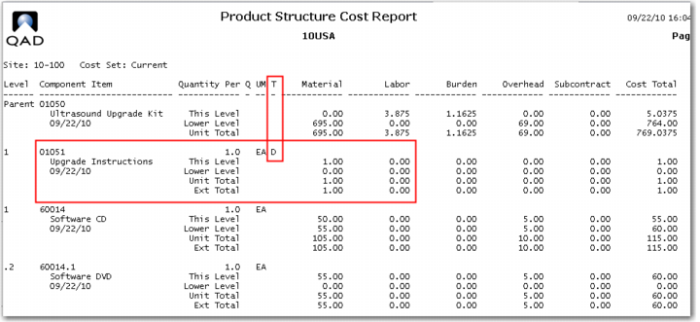
3 Run the Product Structure Cost Roll Up for item 01050 and review the Product Structure Cost Report. The 01051 is now included and shows as a cost of 1.00, but the cost has not been rolled up to the top level because of the structure type D. The 01050 lower level material cost is still 695.00.
The other structure type codes that are not included in a cost roll up are [P]lanning, [O]ption, [A]lternate and [J]oint. These are covered in detail in the course on product structures.
Reject Costing and Loss Costing
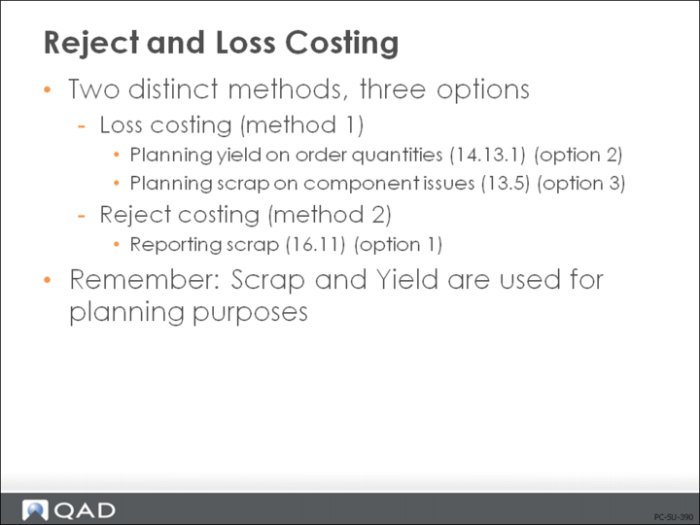
In all of the calculations so far we have assumed that the production yield is 100%. But what happens if it is not? How do cost calculations account for yield losses? You have three options for accounting for losses
• Reporting scrap in Work Order Receipts (16.11) (also Work Order Receipt Backflush (16.12), Unplanned Receipts (3.7), Repetitive Backflush (18.22.13), Repetitive Scrap (18.18), Scrap Transaction (18.22.18), and Quality Order Results Entry (19.11))
• Planning yield on order quantities in Routing Maintenance (14.13.1)
• Planning scrap on component issues in Product Structure Maintenance (13.5)
The functionality can be categorized into two distinct methods, however: loss costing and reject costing. It is advisable to review the effects of yield versus scrap and select one method on a higher level basis (per product line, site, or domain).
It is important to keep in mind that yield and scrap are used for planning purposes (to ensure that you buy enough components to make enough product), which then requires special costing consideration.
Note: Manually changing the Yield% field in the Item Planning screen for manufactured items will result in unexplained method variances if the planning yield does not equal the yield of the rolled-up routing and product structure.
Loss Costing
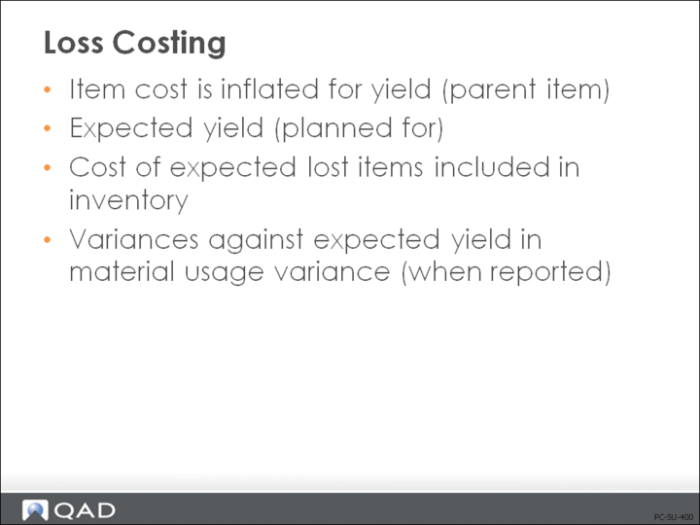
Loss costing means that the costs of lost items are factored into the good items received after production.
In QAD Enterprise Applications you can specify a yield% in Routing Maintenance (14.13.1) for each operation—the percentage of good items you expect to receive complete from the operation. If an operation has an 80% yield and you start with 100 items, you only expect to complete 80. However, from a cost perspective, you expect to issue enough materials and to incur enough labor, burden, and subcontract costs to make all 100. Using the yield percentage, you can factor these costs into the parent item.
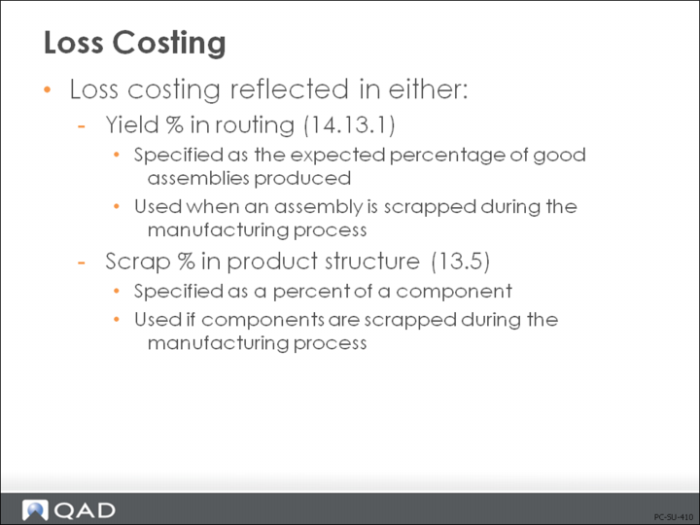
Loss costing is reflected in either:
• Yield% in Routing Maintenance (14.13.1)
Specified as the expected percentage of good assemblies produced
Used when an assembly is scrapped during the manufacturing process
• Scrap% in Product Structure (13.5)
Specified as a percent of a component
Used if components are scrapped during the manufacturing process
In QAD Enterprise Applications, loss costing affects either:
• The yield percentages in the routing
Whenever there are losses of parent items occurring in the production process, use yield in Routing Maintenance (14.13.1)
• Or, the scrap percentages in the product structure
For a component, you can specify a percent in Product Structure Maintenance (13.5)
Implementing Loss Costing (Yield Percent)
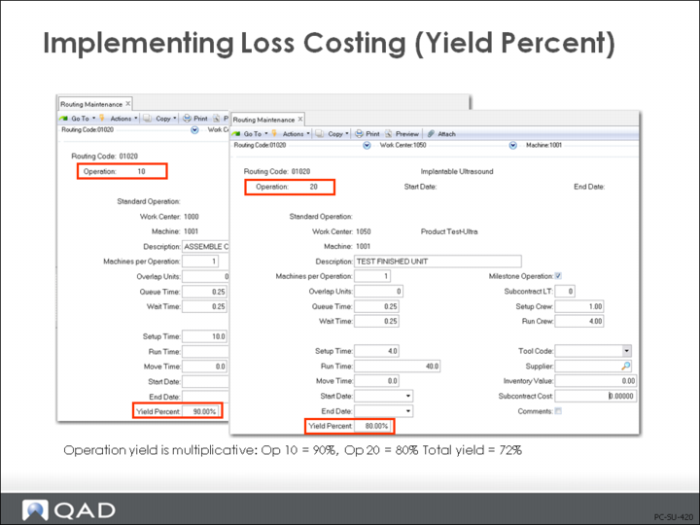
Loss costing using yield percent is expressed as a percentage of usable parts produced in the manufacturing process and the yield is entered in Routing Maintenance (14.13.1).
• Routing Cost Roll-Up (14.13.13) multiplies individual operation yield percentages and posts the manufacturing yield to item data, Item Master Maintenance (1.4.1), Item Planning Maintenance (1.4.7), and Item-Site Planning Maintenance (1.4.17), and Work Order Maintenance (16.1)
• If MRP is to plan for increased requirements due to the yield being less than 100%, then the Yield% field in item planning, Item Master Maintenance (1.4.1), Item Planning Maintenance (1.4.7) or Item-Site Planning Maintenance (1.4.17), must be set manually; or set the Roll-Up Item Yield field to Yes in Routing Cost Roll-Up (14.13.13)
• Manufacturing yield is calculated as:
Yield% for Op 10 * Yield% for Op 20 * Yield% for Op n ...
Calculation of Costs for Yield
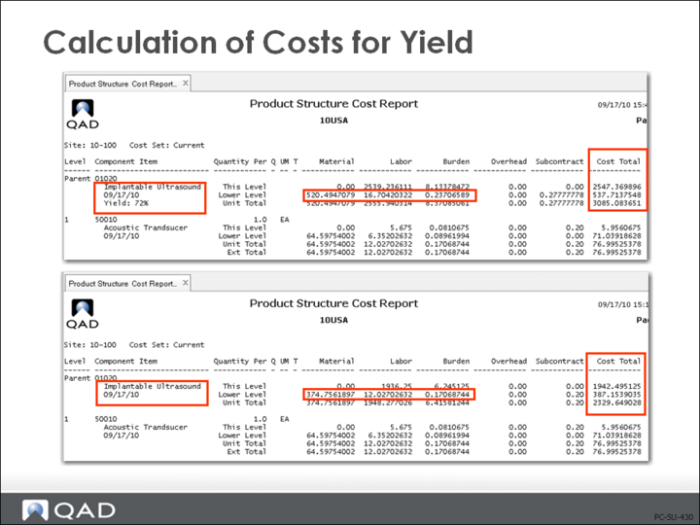
Lower-level and this-level material, labor, burden, and subcontract costs increase when yield is less than 100%, as shown in the example in the figure above.
Example: The example shown above and used on the next few pages is based on an order for 10 units of item 01020, which is manufactured in three operations. The yield at operation 10 is 90% and the yield at operation 20 is 80%, the yield at operation 30 is 100%.
In the report for item 01020 with 100% yield (the lower image) the lower level material cost is 374.7561897. The report for 72% yield shows lower level material cost as 520.4947079. 374.7561897/.72 = 520.4947079. The same logic applies to the other lower-level costs.
Yield Effect on Lower-Level Costs
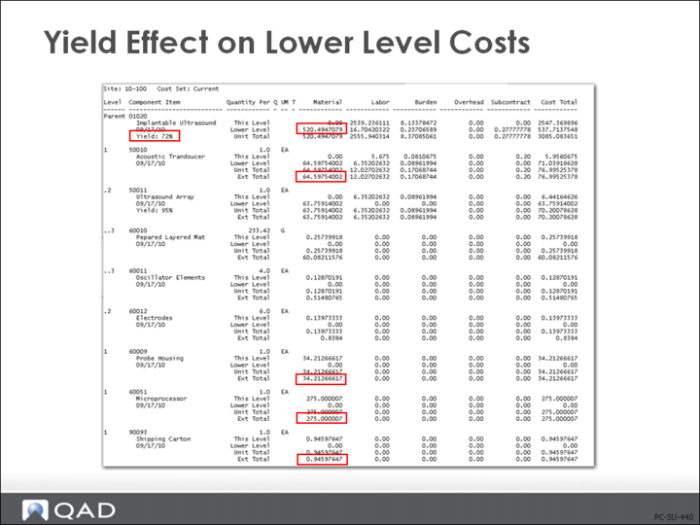
Yield losses affect both lower-level and this-level costs.
• At the lower level, you lose components, increasing lower-level material, labor, and burden costs. Lower-level costs are calculated, for each component, as:
(Material Cost / Yield%) + (Labor Cost / Yield%) + (Burden Cost / Yield%) + (Subcontract / Yield%) + (OH / Yield%)
• At this level, you lose parent items, increasing this-level labor, burden, and subcontract costs
Total costs are simply the sum of this level and lower level costs
In the example in the figure above, the lower-level costs for item 01020 are:
Material = 64.59754002/.72 + 34.21266617/.72 + 275.000007/.72 + 0.94597647/.72 = 520.4947079
Labor and Burden are calculated in the same manner.
(Note: yield percentage does not affect this-level overhead or subcontract)
This-level costs for item 01020 are:
Material = 0 / 72% = 0
Labor = 0.11 = Op 10 Labor of 0.06 + Op 20 Labor of 0.05
(Op 10 Labor 0.06 / 72%) + (Op 20 Labor 0.05 / 80%) = 0.0833333 + 0.0625 = 0.14583333
Burden = 0.28 = Op 10 Burden of 0.18 + Op 20 Burden of 0.1
(Op 10 Burden 0.18 / 72%) + (Op 20 Burden 0.1 / 80%) = 0.25 + 0.125 = 0.375
Unit total costs (this-level + lower-level costs) for item 02-0005 are:
Material = 0 + 0.7083375
Labor = 0.14583333 + 0.02777778 = 0.17361111
Burden = 0.375 + 0.05555556 = 0.43055556