Product Costing Process: Summary
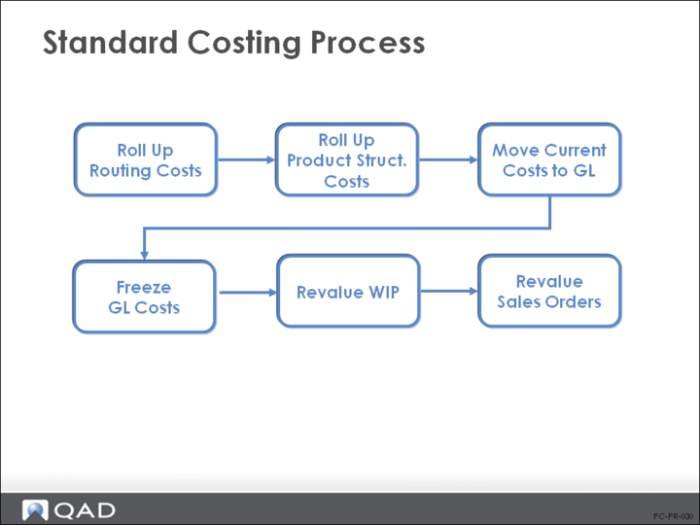
The costing process is essentially a two-step process for items other than purchased parts.
• The first step is to run the Routing Cost Roll-Up (14.13.13), which totals the labor/machine hours and cost, subcontract cost, and burden cost; computes the cumulative operation yield for a routing or routings; and sums the this-level labor and burden cost data for the specified cost set.
• The second step is to run the Product Structure Cost Roll-Up (13.12.13), which obtains purchased material and this-level labor and burden costs for the item, and performs the level-by-level computation of costs for the five cost set categories - material, labor, burden, overhead, and subcontract. The Product Structure Cost Roll-Up updates cumulative lower-level costs for all cost categories at each assembly level.
Usually, roll-ups are carried out in the Current or Simulation cost set. This permits validation prior to committing them as new GL standards.
• Using Current Cost Set
Following the routing and product structure cost roll-ups, you then move the current cost set to GL using Current Cost Set Move to GL Set (1.4.22), and then optionally freeze the newly established cost using Cost Roll-Up Freeze/Unfreeze (13.12.1).
• Using Simulation Cost Set
See Training Guide: Cost Management.
Cost Calculations
Costs are calculated in different ways depending on the cost level and element being defined.
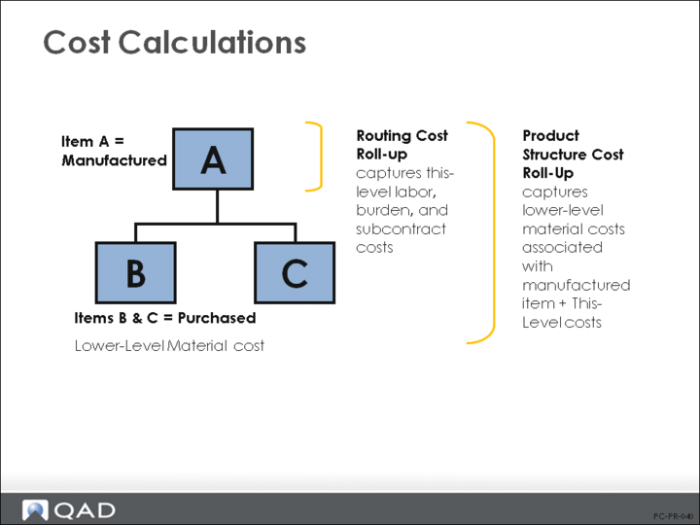
• For purchased items, the standard cost is entered manually as material, this level. Overhead is an independent cost that is also entered manually or calculated by Item Overhead Cost Update (1.4.21). Distribution items are treated in the same way as purchased items and require manual input of this-level costs.
• Manufactured items get their this-level costs from the Routing Cost Roll-Up process, which calculates costs for labor, burden, and subcontract. Product Structure Cost Roll-Up adds lower-level costs to an item. Total cost is the sum of this-level and lower-level costs.