Purchase Transactions
The following example illustrates the sequence of functions used and the accounts affected when purchasing and receiving items.
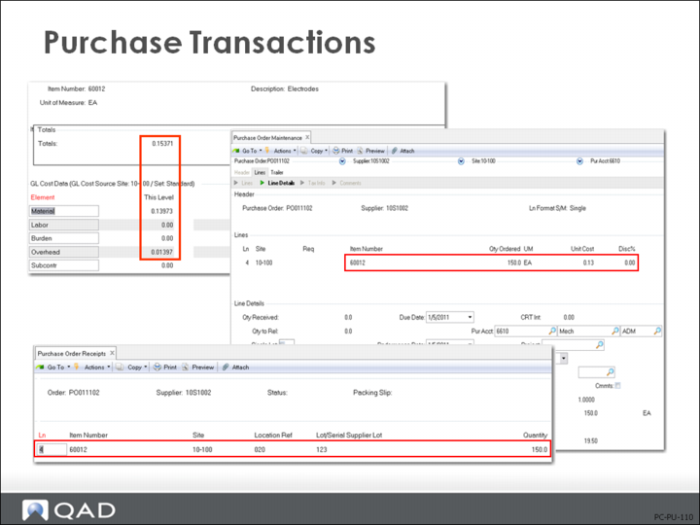
Example: A purchase order is issued for 150 electrodes (item 60012) at 0.13 each using Purchase Order Maintenance (5.7).
• The total standard cost for this item is material 0.13973 + overhead 0.01397 = 0.15371 as shown in Item Cost Maintenance (1.4.9).
• Because the PO unit cost is different than the standard GL cost, it will generate a favorable Purchase Price Variance upon PO receipt.
• This is a rate variance because the PO price is different than the GL standard.
• If the invoice price is difference from the PO price, an AP Rate variance will be generated.
Purchasing: Transactions Detail
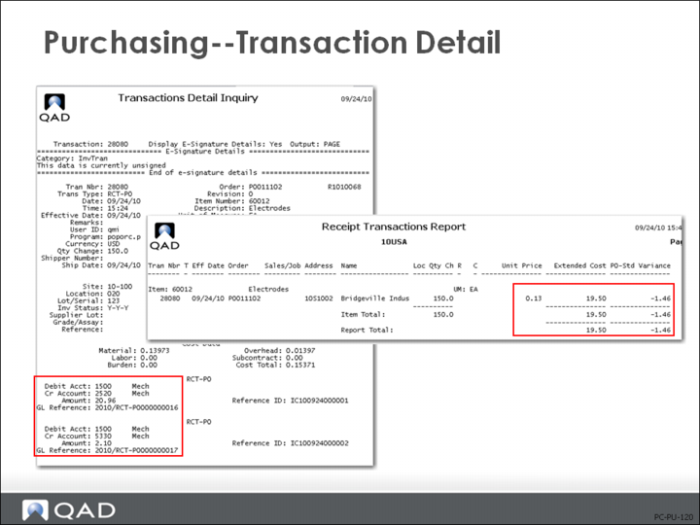
You can review the transactions by using Transaction Detail Inquiry (3.21.1). The resulting account debits and credits are shown for each transaction. In this example, upon purchase order receipt (RCT-PO), the system:
• Receives the item into inventory at standard cost less overhead
Qty rec’d * (standard GL cost - overhead)
150 * (0.15371 - 0.01397) = 20.96
• Applies the overhead amount
Qty rec’d * Overhead
150 * 0.01397 = 2.10
• Calculates the Purchase Price Variance (PPV)
[PO Cost - (GL Cost - Overhead)] * PO Qty Received
[0.13 - (0.15371 - 0.01397] * 150 = -1.4595
The Purchase Price Variance (PPV) for any given transaction or range of transaction can be viewed using the Receipt Transaction Report (5.9.14).
• Negative result is a favorable variance because it is a reduction of an expense.
• Positive result is an unfavorable variance.
All of the resulting GL transactions are type IC (Inventory Control). When you review them in Transaction Detail Inquiry (3.21.1), you will see that the journal reference begins with IC, followed by the effective date of the transaction and a sequential number.