Exercise 3: PO Returns
After receiving their 50 boxes of 50 each sterile wipes the QA Lab has decided that is more than a lifetime supply and want to return 25 boxes. The vendor agrees to accept the return for credit.
1 Use Purchase Order Returns (5.13.7) to return 25 boxes of the 01013. Enter the original PO number. On the header note the check boxes for Return All and Return to Replace; leave these both unchecked. In the case where you are returning an entire order, checking return all will prefill the return transaction with all the line items on the original PO.
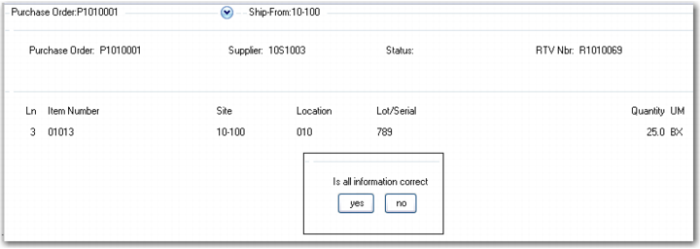
When prompted to Reopen PO line click Yes. Advance to the line items, enter line 3 for 25 and add your lot number. If the notes window appears click Back. When prompted for supplier performance data enter Category 03 and Event ISO Cert. (The system has been set up with restrictions in the area of supplier performance, use these codes to ensure your transaction processes). Your transaction should look like this. Complete the transaction.
Subcontract POs
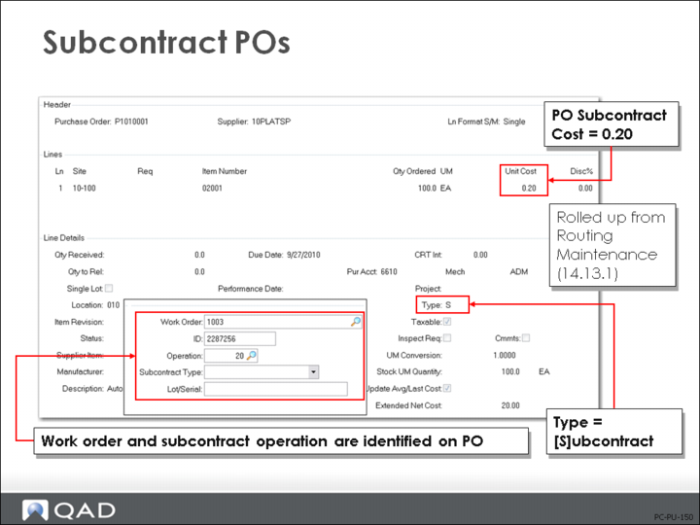
Subcontract POs reference a valid item number, but rather than receiving the item into inventory, they are received into manufacturing as a cost of production. If no work order number is specified, the process stops there. The entire PO cost is reported as a cost of production and accrued. However, if the PO references a valid work order and operation, additional transactions are generated to issue the cost to WIP and to calculate variances, if any.
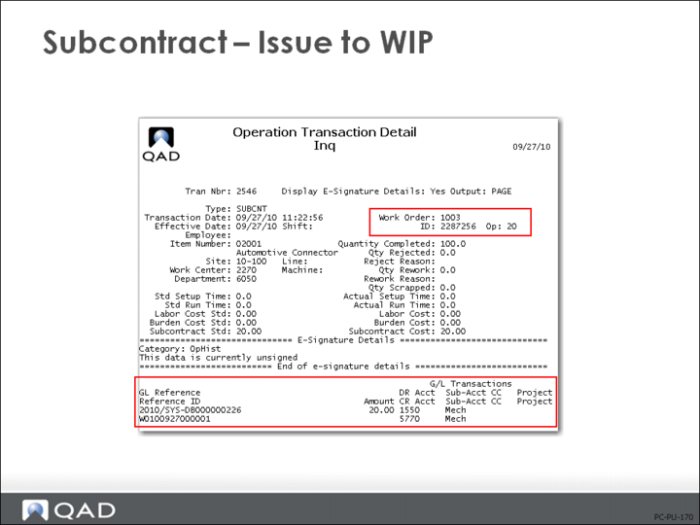
In this example, the 02001 connector has an outside operation for plating at a quoted price of 0.20 per unit. A purchase order is released for 100 pieces at 0.20 each (extended cost 20.00). The purchase order is linked to work order 1003 at operation 20.
On this PO the trailer has added a tax of 1.50, this could be a mistake as it’s likely that this operation is not taxable.
Note: Set up Supplier Item Maintenance (1.19) to automate the pricing of subcontract purchasing and avoid mistakes in pricing.
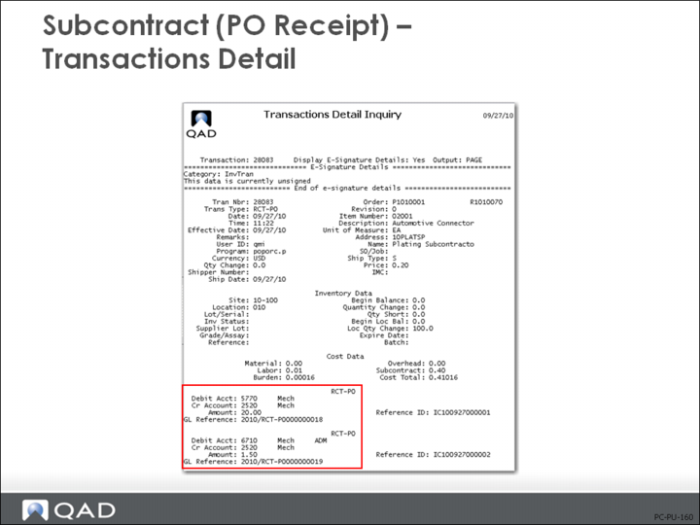
Subcontract (PO Receipt): Transactions Detail
The PO Receipts transaction uses the PO unit cost as the GL amount.
In this example, 20.00 has been debited to cost of production (5770), credited to PO receipts (2520) and 1.50 has been debited to PO variance (6710) and credited to PO receipts (2520). In this case the taxable amount (if the transaction is taxable) should have been allocated to the line item to prevent the variance.
A subcontract rate variance accounts for any difference between the PO unit cost and the standard unit cost for this operation as recorded on the Work Order Routing (16.13.13).
Subcontract Transactions: Issue to WIP
In this transaction the 20.00 cost of the subcontract operation has been debited to WIP (1550) for work order 1003 at operation 20, and credited to cost of production (5770).
The final transactions are actually work order transactions. As such, they create GL transactions of type WO with a description of SUB [op number] where [op number] is the work order operation.