Supplier Invoicing
Accounts Payable
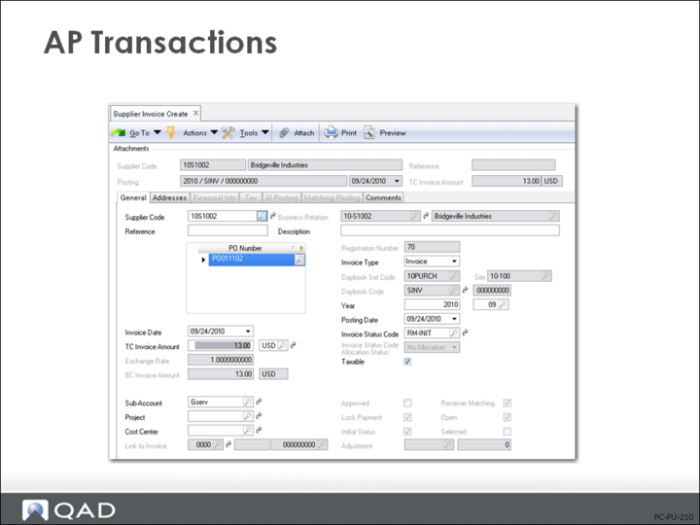
The invoice from the supplier is entered into the system using Supplier Invoice Create (28.1.1.1). It is then approved and finally released for payment. Note: You can also use Initial Supplier Invoice Create (28.1.1.10). The system matches the purchase order quantity and price with the receiver quantity and price and the invoice quantity and price. Variances are calculated and the receivers are marked as closed. This process is commonly known as a three-way match.
Example of AP Transactions
To show the AP process, we will continue with the example given on Purchase Transactions.
Example: The supplier has charged you $13.00 for 100 electrodes at 0.13 each. This is exactly correct since from the initial order of 150 you returned 50.
For demonstration purposes suppose the supplier had invoiced you for 90 electrodes at 0.15:
• Because the invoice quantity is less than the quantity actually received, this generates a favorable AP usage variance (negative amount)
• Because the invoice cost is higher than that on the PO, this generates an unfavorable AP rate variance (positive amount)
• The system also marks the invoice as not matching and the details need to be resolved before invoice approval.
When the supplier invoice is approved for payment, the system:
• Clears out the purchase accrual account (amount accrued at time of receipt)
Qty Received * PO Unit Cost
Example:100 * 0.13 = 13.00 based on your original PO
• Accounts for the difference between the PO unit cost and the price listed on the invoice
(AP rate variance)
(Invoice Unit Cost - PO Unit Cost) * Invoice Qty
Example: (0.15 - 0.13) * 90 = 1.80 based on our example of invoice not matching
• Accounts for any difference between the quantity received and the quantity invoiced
(AP usage variance)
(Invoice Qty - Qty Received) * PO Unit Cost
Example: (90 - 100) * 0.13= -1.30
• Reports entire invoice amount to the Accounts Payable account
Invoice Qty * Invoice Unit Cost
Example: 90x 0.15 = 13.50
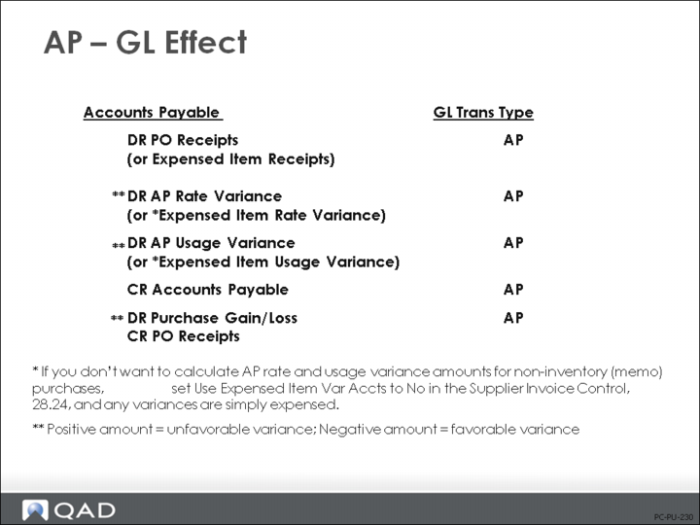
Note: If you do not want to calculate AP rate or usage variances for non-inventory (memo) purchases, set Use Expensed Item Var Accts to No (leave box unchecked) in Supplier Invoice Control (28.24), and any variances are simply expensed.
AP-Related Variances Summary
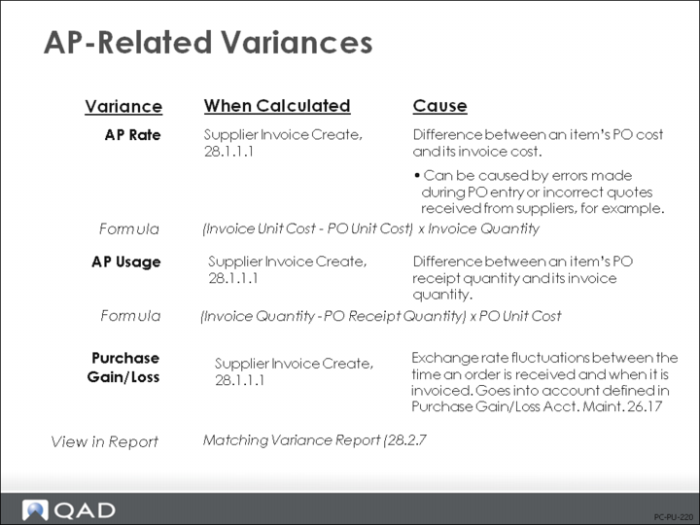
AP Rate Variance
AP Rate Variance occurs when a discrepancy exists between an item’s PO cost and its invoice cost. AP Rate Variances can be caused by a variety of things, the most common being errors made during PO entry or incorrect quotes received from suppliers. AP Rate Variance is calculated at Supplier Invoice Create (28.1.1.1) as:
(Invoice Unit Cost - PO Unit Cost) * Invoice Quantity
AP Usage Variance
AP Usage Variance occurs when a discrepancy exists between an item’s PO receipt quantity and its invoice quantity. This can be caused if you close a receiver with a quantity still open or with an invoice quantity greater than the PO receipt quantity. AP Usage Variance is calculated at Supplier Invoice Create (28.1.1.1) as:
(Invoice Quantity - PO Receipt Quantity) * PO Unit Cost
Purchase Gain/Loss
The Purchase Gain/Loss account is used to track variances resulting from exchange rate fluctuations between the effective dates of the PO receipt and the matching of the supplier invoice. It is calculated at Supplier Invoice Create. The account number defaults from Purchase Gain/Loss Acct Maint. (26.17). Purchase cost variances due to exchange rate fluctuations are usually kept separate from purchase price variances. Because they cannot be controlled by the supplier, they should not influence performance evaluation.
Managing Variances
Variances can arise because the supplier quote is incorrect. You can review and change these quotes in Supplier Item Maintenance (1.19).
When an unfavorable variance is calculated during matching, the system automatically assumes that you will be disputing the amount with the supplier and records the variance as a hold amount.
Reports
The Matching Variance Report (28.2.7) displays the details of variances resulting from mis-matches in the supplier invoice process.
AP GL Effect
The default general ledger entry when matching receipt against a purchase order (excluding the GL effects of direct taxes):
• Debits the PO Receipts account from the product line for inventory items and Domain/Account Control (36.9.24)
• Debits the AP Usage Variance account and the AP Rate Variance account from the product line for inventory items and Domain/Account Control (36.9.24). Negative amounts indicate a favorable variance; positive amounts indicate an unfavorable variance.
• Credits the Accounts Payable account from the supplier