Material Variances Summary
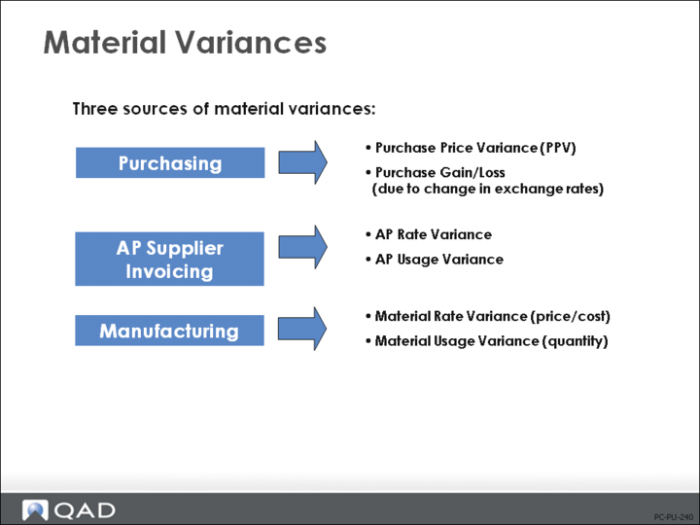
At this point, we have examined two of the three sources of material variance: Purchasing and Accounts Payable.
• In Purchasing, material variances are identified as purchase variances: Purchase Price Variance and Purchase Gain/Loss due to exchange rate fluctuations. Both of these indicate that the cost of the material purchased did not match the established standards.
• In Accounts Payable, material variances are identified as AP variances: AP Rate and AP Usage Variance. The AP Rate Variance indicates that the cost on the supplier’s invoice did not match the price on the PO; the AP Usage Variance indicates that the quantity on the supplier’s invoice did not match the quantity received.
Another source of material variance is manufacturing. In manufacturing, material variances occur when the cost or quantity of material issued to a manufacturing order does not match what was called for on that order. These are identified as material rate and usage variances.
Next, we will review how costs and variances are reported in the manufacturing modules.
Information Sources
Purchase Receipt Report (5.13.5)
Prints receipt/return transaction information-item, quantity, PO and GL cost, variance, and inventory information.
Transactions Detail Inquiry (3.21.1)
Lists detailed audit information about a specific receipt or return transaction. Includes inventory transaction information as well as all of the GL debits and credits.
Transactions Accounting Report (3.21.16)
Prints GL transactions generated by one or more inventory transactions; selected by date, account, or type.
Matching Variance Report (28.2.7)
Shows the variance between an item’s supplier invoice cost and the standard cost.
AP versus Control GL Validation (25.21.2.6)
Prints a summary of the unposted GL transactions generated by AP activities.
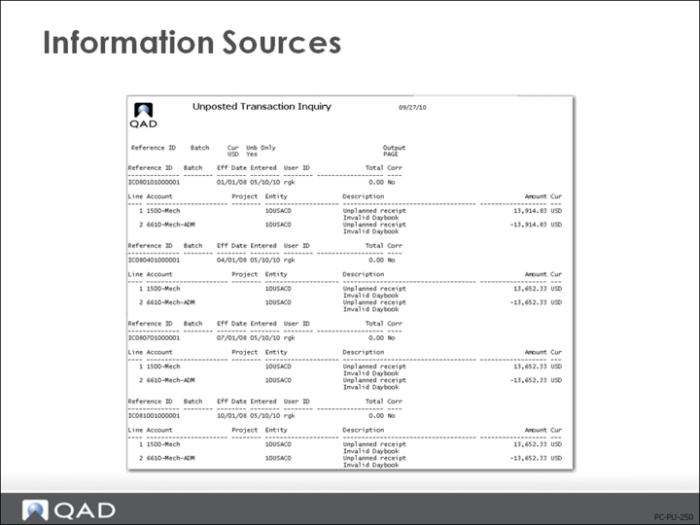
Unposted Transaction Inquiry (25.13.13)
Lists GL transactions that have been created but not yet posted. Used to review the GL effects of any transaction. All you need to know is the module code and the effective date.
Unposted Transaction Register (25.13.14)
Use to review unposted transactions prior to posting.