Overview
In QAD EE, you can view a company from either a financial or operational perspective. In financial terms, a company is an entity that publishes financial statements and files tax returns. In terms of other activities, a company can be defined by its combined operations, such as sales order entry, purchasing, manufacturing, and general accounting.
Business Model
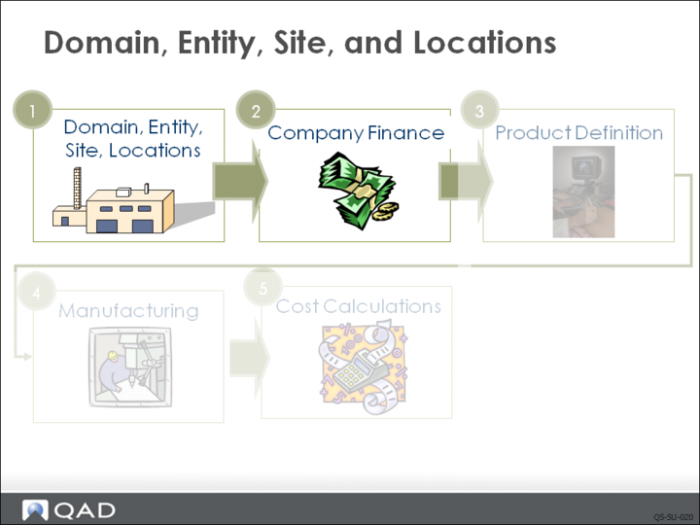
The following pages discuss the most basic pieces used to support financial and operational activities. First, is the environment itself—the database. To this are added:
• Domains, which can be thought of as templates for businesses that use the same base currency, chart of accounts, and GL calendar.
• Entities, which are used to identify business units for reporting and tax purposes, and their GL transactions and financial reports including Income Statements and Balance Sheets.
• Shared data sets with information about customers, suppliers, employees, and other data used throughout the system.
This chapter begins with a discussion of databases, domains, and the types of data they contain and share. This includes an overview of some of the basic financial information that forms part of the domain template for business activities.
Security
Protecting valuable company resources and ensuring proper separation of responsibility is a basic requirement for any business. The next topic covered is a high-level overview of how to manage who is able to complete various activities in the system by setting up users, roles, and access.
Operational Structure
Sites and locations comprise the basic structure required for managing inventory in the system, and how the inventory transactions affect the GL. Inventory status codes are an essential part of this key area of control.
Chapter Topics
This chapter covers the following topics:
• Key Concepts
Databases and System-Wide Data
Domains, Entities, and Shared Sets
Security Setup
Sites, Locations, and Inventory Status Codes
• Example
Set up Domain and Entity
Review Company Business Relation
Review Domain/Account Control
Define Inventory Status Codes
Set Up Site
Set Up Inventory Locations
• Review
• Exercise
Learning Objectives
This chapter provides a high-level overview of the QAD EE system structure. When you finish this chapter, you should be able to:
• Describe what a database is and list the key data it contains.
• Describe and understand how domains and shared sets are used.
• Distinguish between the role of domains and entities.
• Describe what business relations are and how they are used.
• Describe how users and roles control access to system functions.
• Distinguish between the kind of information sites and locations contain.
• Describe the role of inventory status codes in the system.