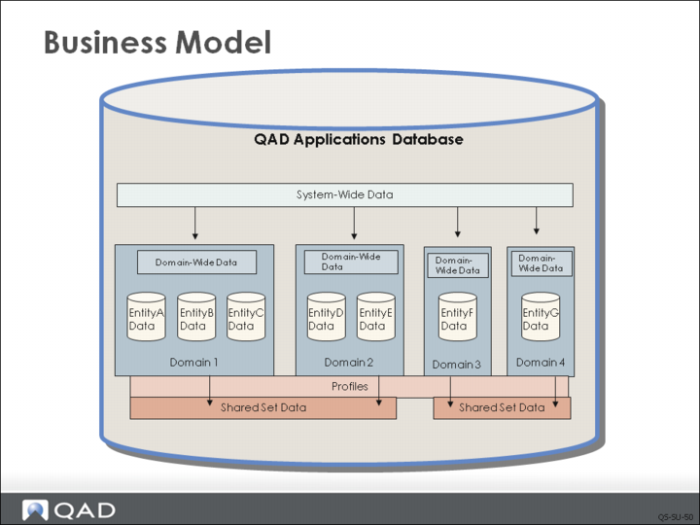
Business Model: Four Kinds of Data
System Wide
Some data is shared throughout the system, such as currency, country codes, and tax data. This data never differs from one business unit (entity or domain) to an other, so it makes sense to share it across all business organizations. System-wide data includes administrative data related to security, user interface, and technical setup.
Shared Sets
Shared sets group data that can be shared across domains. A single domain can have an independent chart of accounts or several domains can share the same chart of accounts, streamlining setup and maintenance. Other types of data that can be shared are customers, suppliers, and exchange rates.
Domain
A domain represents the base unit of the system and includes one or more entities. Each domain has its own base currency, and, optionally, statutory currency, which is then shared by the entities within the domain. Domains derive some data from shared sets and also use system-wide data. However, most operational data is domain specific. So for example, all the item data and order transactions take place within a specific domain.
Entity
An entity exists within a domain and inherits the domain attributes, such as base currency. Entity-specific data is limited, for example, the organization’s own bank account number. General ledger transactions are associated with specific entities.
The following table summarizes the kinds of data found at each level of the business model.
Level | Category | Detailed Data Types |
System wide (database) | Business relations and address related data Address related tax data Financial codes
Security data Administrative data User interface data | Address types, corporate groups, currencies, rounding methods, languages, counties, countries, states Tax zones, tax environments, tax classes, tax usage codes, tax types Shared set codes, credit terms, invoice statuses, profiles, and Supplementary Analysis Fields (SAFs) Users, roles E-mail definitions, printers, some EDI and eCommerce setup data Labels, menus, messages, lookup definitions |
Shared sets | Financial data
Business relations
| Accounts, sub-accounts, cost centers, projects, daybooks, exchange rates Customers, suppliers |
Domain | Financial data Operational data Orders | GL mask (combination acct/sub-acct/cc/project), accounting periods Sites, locations, items, default accounts, generalized codes Purchase orders, sales orders, work orders, distribution orders, service calls |
Entity | Financial data | Employees, bank account numbers, period closing status, general ledger and sub-ledger transactions and balances, transaction numbering |