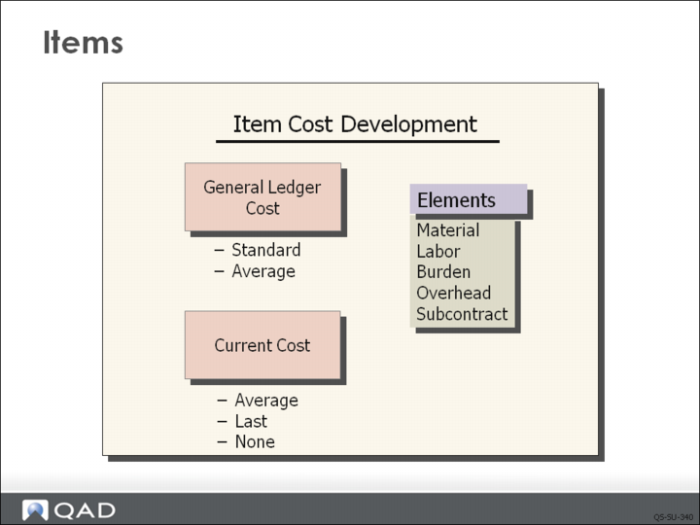
Item Cost Development
The cost of a manufactured item can be calculated based on its standard bill of material and routing. Depending upon the BOM and routing, costs can be both this-level and lower-level.
The slide shows that an item has two cost sets: GL and current. The GL cost set has either a standard or average costing method. The current cost set is determined by either the average or last cost of the item or it is maintained manually (setting = none). Both the GL and current cost sets are split into five standard cost categories and elements: material, labor, variable burden, fixed overhead, and subcontract.
In the example in this chapter, you will see how item costs are organized by these cost sets and elements.
Terminology
Average Costing
Costs are recalculated as they occur. The costs associated with a transaction are weighted with the existing costs to provide a new average cost. The average cost can be used for valuation as a GL cost or for information only as a current cost.
Bill of Material (BOM)
A listing of all subassemblies, components, and raw materials of a parent assembly with the quantity of each required to make one parent assembly. A BOM is also called a product structure or formula. The master production schedule uses the BOM to determine items for which purchase requisitions and production orders must be released.
This-Level and Lower-Level Costs
This-level costs are the costs to either obtain or produce an item. Thus, a purchased item has this-level material cost, but it has no lower-level costs. Lower-level costs represent costs that are added at prior stages of manufacturing.
Product Structures
Product structures are associated with discrete items and identify the quantity of each component needed to manufacture one unit of an item, expected scrap percentage, and the operation where the item is required. Product structures are often referred to as bills of material.
Formulas
Formulas identify ingredient usage as a quantity per batch or percent of batch. These are vital to the planning process. In QAD EE, you define these relationships in Formula Maintenance. Formulas are sometimes referred to as recipes.
In general, product structures and formulas work in the same way, and both are referred to as bills of material (BOMs).