Routings
To manufacture an item or product, you must complete one or more activities or operations. The list of required operations is called a routing, which basically defines the process needed to make the item. If a product structure is the list of ingredients in a recipe, a routing is the directions or instructions needed to process the ingredients to achieve the desired end product. The routing describes:
• The steps required to make the item (operations)
• Where the steps are performed (work center)
• How long they take (queue time, setup time, run time, wait time, and move time)
• The expected yield percentage at each operation (yield %)
Note: Queue time, setup time, run time, wait time, and move time are all elements of lead time. These will be discussed in the section on routings.
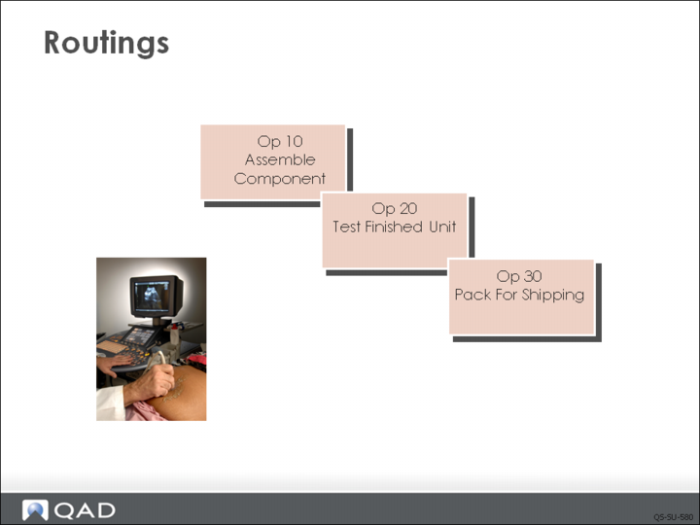
For example, to manufacture a medical ultrasound may require a routing with several operations with instructions to assemble the various components. How many operations, how they are sequenced, and how much detail is included with each is determined by how the business sets up the process and how they want to manage it. A highly automated process may have only one operation that says simply “assemble components.” A very manual assembly process may have many detailed steps.
The department and work center codes associated with routing operations link actual production results with capacity planning, cost accounting, and other programs.
Alternate Routings
The normal situation is to have the route code be the same as the item number. When several routings can be used to produce the same item, alternate routes are defined with different routing codes. The primary route, or the route you will use most often, can be linked to the item number in Item Planning Data Maintenance.