Set Up Routing Op 10
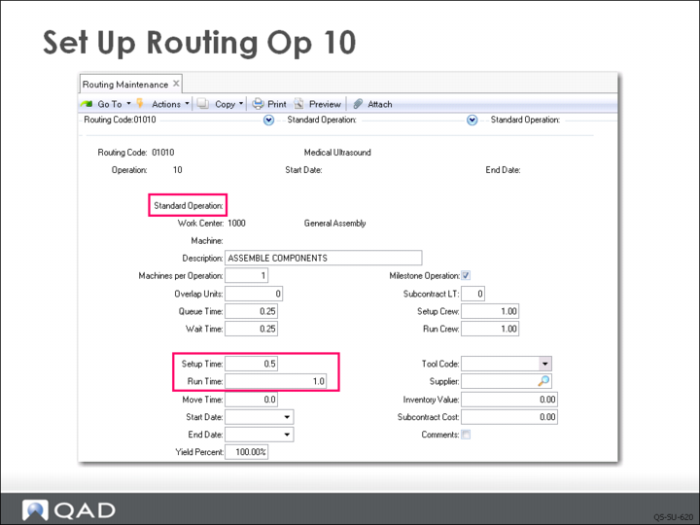
QMI’s Production Manager has set up the routing in Routing Maintenance. Notice that the routing code is the same as the item number for the completed device (01010). This is usually the case.
This example has three operations involved in assembling a medical ultrasound:
• Operation 10 (shown here) requires 0.5 hours setup time to get the jig from the tool room; additionally, per device, it requires 1.0 hour run time to assemble the medical ultrasound.
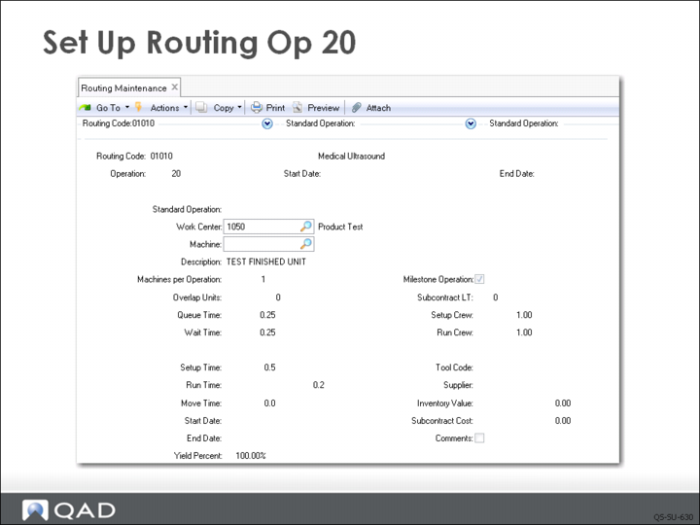
• Operation 20 requires 0.5 hour setup time and 0.2 hour run time to test the device.
• Operation 30 requires 0.5 hour setup time and 0.6 hour run time to pack the ultrasound for shipment.
These times are converted into decimal hours for the routing standard times by dividing the minutes by 60. You can also use Rate Based Routing Maintenance (14.13.2), which uses pieces per hour rather than decimal hours per piece to set the time standard for the operation.
Important: Be careful not to use the Standard Operation field by mistake. This field has a special use that is covered in detail in the course on Routings and Work Centers. This feature is not described in this course.
Set Up Routing Op 20
For operation 20, testing the ultrasound, the run time is 0.2 hour, or 12 minutes
Field Definitions
Queue Time
The time work normally waits at a work center before the operation begins.
Setup Time
The time required to prepare the work center/machines for processing. This is independent of batch size.
Run Time
The standard amount of time required to process a single unit of this item. It can be entered as the units per hour or run time per batch, but internally, this is converted to a run time per unit.
Wait Time
The time spent waiting after the operation is done; for example, drying, curing, cooling. This is based on a 24-hour clock, not the shop calendar.
Move Time
The time a work order is in transit from one operation to the next. Per order independent of order size.
Subcontract Lead Time
A routing operation can be a task performed by an outside vendor or subcontractor. In that case this is the number of calendar days it takes to process the standard order quantity at the subcontractor’s site, including any transit time.
Yield Percent
The normal yield percentage for this operation. The percentage of any order expected to be in usable condition after this operation (used to calculate costs).
Yield in the operation route is intended to be used for scrap that occurs at a specific operation because of some aspect of that operation. It consumes all of the components that have been issued up to that point.
This is in contrast to scrap in the product structure which is associated with a specific component at a specific operation. It is important in setting up structures and routings to account for scrap and yield as accurately as possible and in the correct place. Use this rule:
• At the given operation, is the component scraped before being assembled? This is component scrap in the structure.
• Is the assembly scrapped after the component is assembled? This is yield in the route.