Types of Purchase Orders
QAD EE supports three kinds of purchase orders:
• Blanket purchase orders
• Supplier schedules
• Discrete purchase orders
Although all three kinds of orders are described in this section, the emphasis is on discrete purchase orders. The Example section is based upon a discrete PO.
Blanket Orders
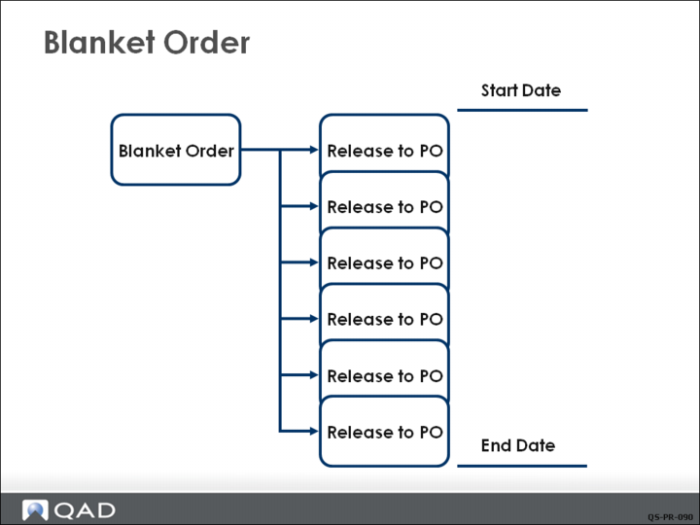
Use blanket orders for multiple deliveries of stock items, where an ongoing relationship with the supplier is assumed, but exact delivery dates are yet to be determined. Quantities and due dates can be entered up to the time when a blanket order becomes a purchase order. See figure above.
For example, QMI buys all of its components from Bridgeville Industries. Each week, the requirements change and are too small to get quantity discounts. The purchasing manager could negotiate an annual contract with Bridgeville Industries to get better pricing based on the estimated annual usage of purchased items. This pricing could be documented with a blanket order.
Each week a discrete purchase order would be released from the blanket order for the following week’s requirement. A weekly release is only one example; the actual release cycle is user defined. The blanket order keeps track of totals ordered to date.
Supplier Schedules
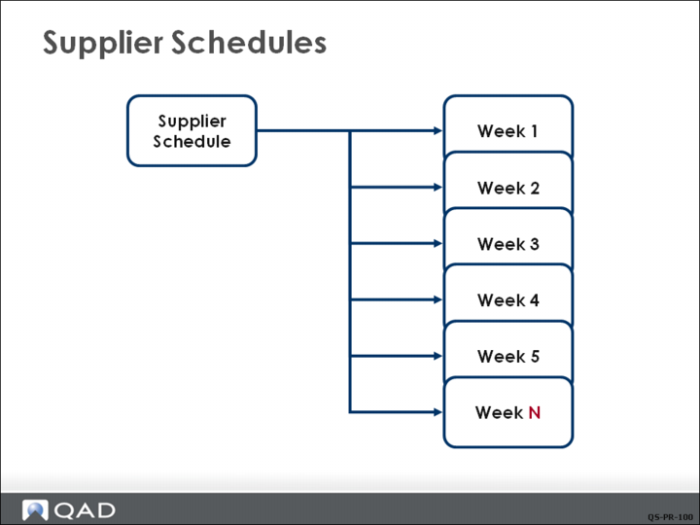
A supplier schedule is an agreement with a supplier that provides long-range planning data. Supplier schedules specify dates and even hours of delivery for the near term, and inform MRP and the supplier about long-term plans. These are used for high-volume, repetitive purchasing, often in a JIT environment. See figure above.
A manufacturer of circuit boards needs circuit board blanks supplied each week. The manufacturer knows its exact needs for the next four weeks and its approximate needs for the next 12 months. The supplier of the blanks uses the information in the supplier schedule to plan orders for raw materials and to plan production and deliveries.
Supplier schedules are designed for use with EDI (Electronic Data Interchange) and as such eliminate most of the paperwork associated with the purchasing process.
Discrete Purchase Orders
Use discrete purchase orders for single transactions with a supplier, where no assumption that further transactions will occur is made. Purchase orders contain a single delivery date for each line item. MRP treats purchase order items as supply and assumes that ordered amounts will be available on the delivery date. Receipts can be processed against these purchase orders. You will see how to process a discrete PO in the Example section.
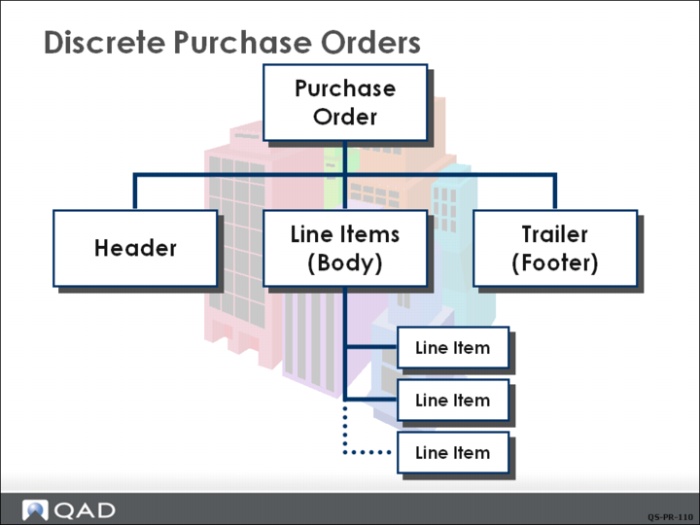
The diagram shows the three main sections to the purchase order:
• The header contains data that applies to the entire order. This includes the PO number, the supplier, the buyer, and other data.
• The line items detail the specific items being purchased. This includes item numbers and descriptions, quantities, and prices.
• The trailer records the final data applying to the entire order such as taxes and shipping charges.