Processing AP Payments
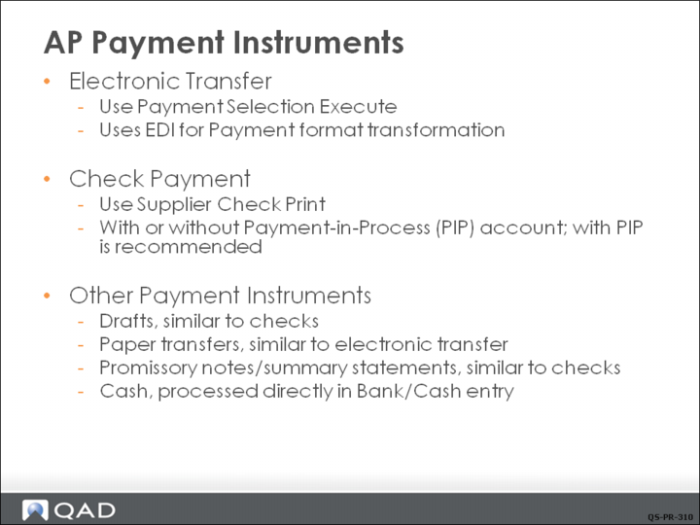
After supplier invoices are approved for payment, the AP department has a range of instruments available for actually paying the suppliers other than check or electronic payment:
• Draft. The draft or bill of exchange is a negotiable security signed and dated by its issuer (the bank). It contains an unconditional order or instruction to pay a fixed amount to the supplier on the agreed due date. Once signed, the draft is considered a collection instrument. Its form, content, and legal consequences are governed by law.
• Paper Transfer. The transfer payment instrument is an order for payment that you submit to your bank. The bank ensures that the amount is transferred to the supplier’s bank account. Transfers are in paper format.
• Promissory Notes. The promissory note is a promise to pay the supplier, instead of an unconditional payment order. The promissory note carries more risk for the beneficiary and has fewer legal consequences for the issuer if payment is defaulted summary statements: You send summary statements to the supplier. Factoring companies and banks that provide credit card services use summary statements.
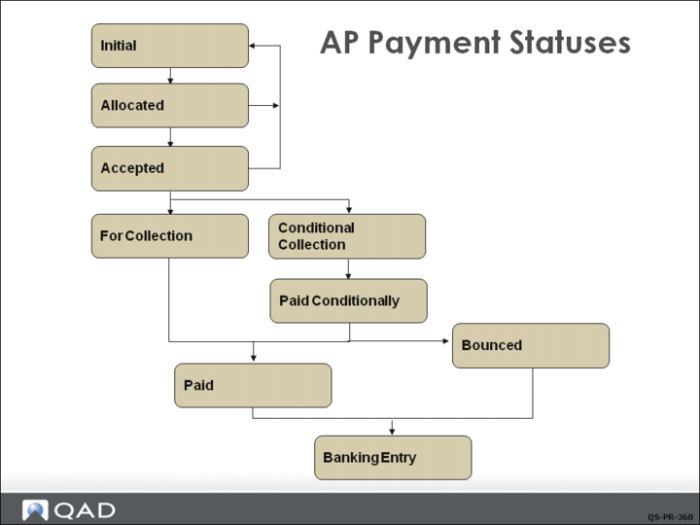
AP Payment Statuses
Payment processing is controlled by payment status codes. Different payment instruments follow different status sequences. The particular flow used is determined during financial setup. At a minimum, the Paid and Bounced statuses are used. Typically, a For Collection status is used for payments sent to the bank. The Initial status is for an initial payment registration.
You can define an account for each status through which the payment is processed, or use one GL account to record the transitions. For example, if you are processing a check through the Initial, Allocated, For Collection, and Paid statuses, you can define a GL account of type Supplier Payment for each status. This approach supports detailed reporting requirements.
Each status transition usually generates a posting, which updates the account associated with the status and bank or liability accounts.
All of this processing is managed within Enterprise Financials and is not covered in this class.