Key Concepts
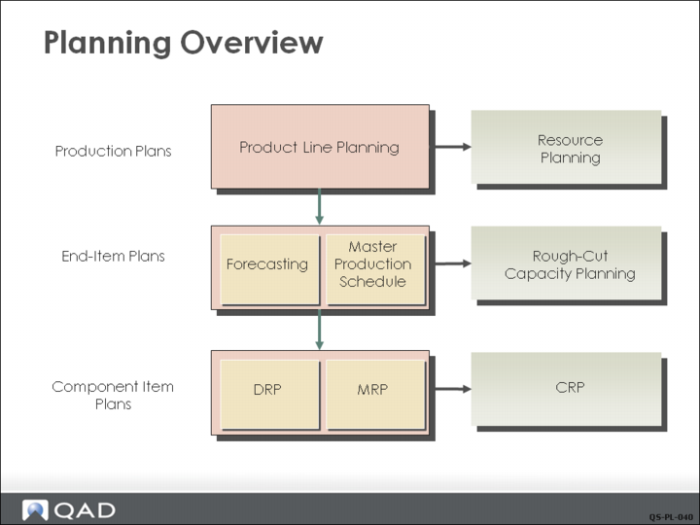
Within a corporation, planning is done at many levels by many different people. QAD EE provides an integrated set of planning tools that are useful at most of these levels. The primary components of the planning system are production planning, end-item planning, and component item planning.
Production Planning
At this level, product line planning functions are used to balance sales forecasts, production forecasts, and income forecasts for an entire product line, while meeting the profit goals established in the strategic plan. Often, these plans are created by different people and product line planning brings them together. Resource planning is used to determine whether you have the resources to meet the plans.
End-Item Planning
Once established, the product line plan is broken down into individual item forecasts. Both actual and forecast demands are reviewed by the Master Scheduler, who sets production levels in response to these demands. Rough-Cut Capacity Planning (RCCP) determines whether you have enough critical resources to meet the master schedule.
Component Item Planning
Material Requirements Planning (MRP) and Distribution Requirements Planning (DRP) both calculate the quantity of raw materials and components needed to support the master schedule. DRP generates planned orders for items to be transferred from another site. MRP generates planned orders for purchased and manufactured items. Capacity Requirements Planning (CRP) determines fairly precisely how this plan loads production resources at your site.