Scheduling Example
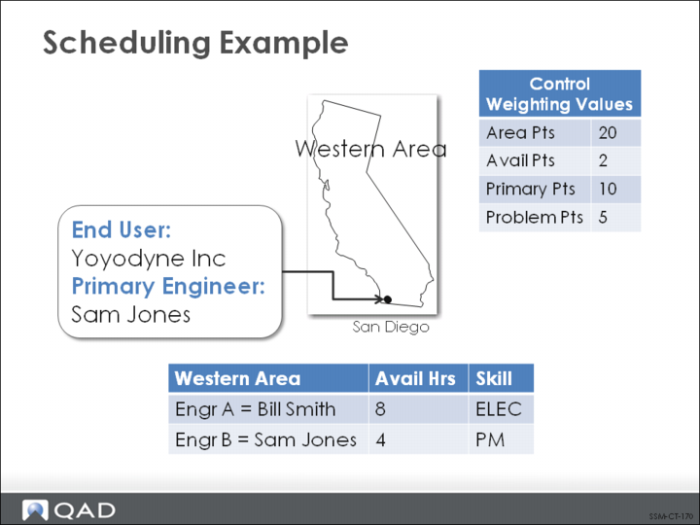
In this example, there are two engineers in the western region: Bill Smith, who has electrical skills, and Sam Jones, whose skill is preventive maintenance. An engineer can have multiple skills, but in this example each engineer has only one. MTZ is not active.
Now an end user in this region calls in with an electrical problem. Sam is already committed for four hours that day. Bill has the entire eight-hour day free.
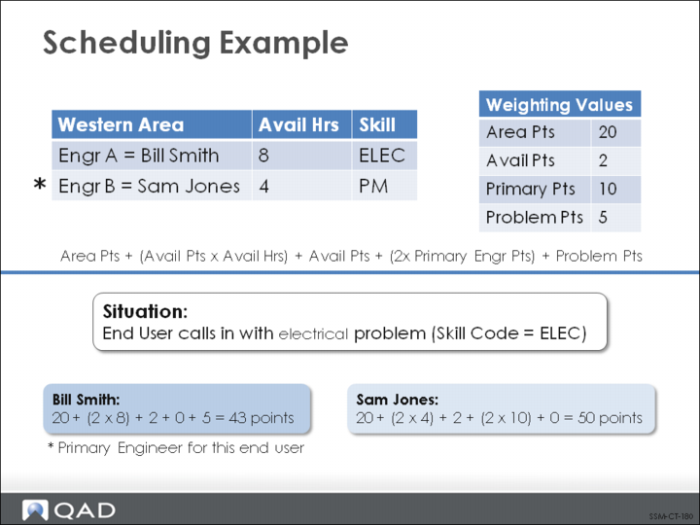
Remember the formula for calculating points:
Area + [(Availability x Hours) + Availability] + (2 x Primary) + Problem + Time Zone
How is this rule applied to engineers Bill Smith and Sam Jones?
Both engineers are in the same area as the end user, so they each receive 20 points.
Each engineer receives 2 points per available hour for that day. Bill Smith is available 8 hours, while Sam Jones is available 4. These hours are multiplied by 2 and added in, giving Bill 16 more points and Sam 8.
Sam Jones is the primary engineer for this end user, so he receives 10 points multiplied by 2, while Bill Smith receives none.
Bill Smith’s skills match the call’s problem so he receives 5 points, while Sam receives no points since his skills do not match the problem.
The system gives Sam Jones top priority for this call because he received 50 total points to Bill Smith’s 43.
The engineer point calculation is completely dependent on the priorities expressed by the weighting values you set up, letting you tailor this formula to your company’s needs and goals. Changing these settings can affect the engineer point calculation and result in different recommendations from the system. In particular, the available hours are multiples of the weighted value, and changes to them can easily outweigh the impact of other criteria.