Work Orders
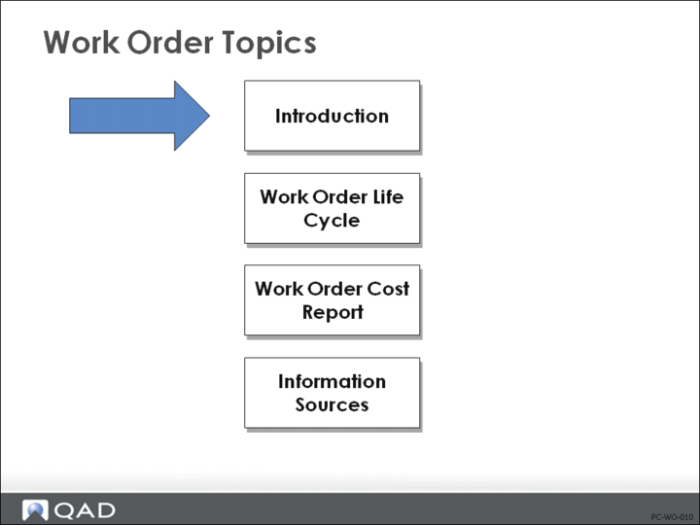
Work Order Topics
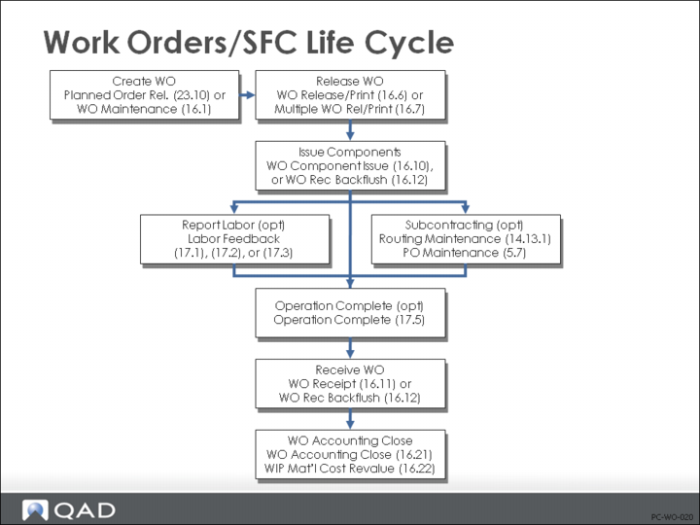
This chapter on work order transactions and costing begins with an introductory overview, which is followed by a discussion of the Work Order Maintenance (16.1) and stages of the work order life cycle: component issues, labor reporting, work order receipt, and work order accounting close. The chapter concludes with a detailed review of the Work Order Cost Report (16.3.4) and a list of information sources.
Introduction
First, we will look at work-order based manufacturing. As you can see, many functions affect cost.
Work order activities mainly concentrate on the material aspect of manufacturing. Components are issued, finished products are received, and rejects are recorded. When the entire process is complete, an “accounting close” function issues floor stock, clears out any remaining WIP balance, and calculates variances.
Shop Floor Control (36.20) functions record the movement of a work order as it goes from one operation to the next, and report the labor time spent on each operation. Both labor and burden costs are recorded and rate variances are calculated. Use of Shop Floor Control is optional. If not used, then labor and burden will be applied/absorbed at standard rates when the work order is closed with Work Order Accounting Close (16.21).
GL Transactions
All general ledger transactions are stored in the unposted transaction table until they are posted. Unposted transactions can be reviewed using Unposted Transaction Inquiry (25.13.13).The GL reference begins with IC.
A complete audit trail of all inventory transactions is maintained in transaction history (tr_hist). These can be reviewed using Transactions Detail Inquiry (3.21.1). Each transaction is identified by a transaction number and a transaction type. Several transactions are created; ISS-WO for the issues, RCT-WO for the receipts, and RJCT-WO for the scrap.