Business Considerations and Setup
Introduction to Business Issues
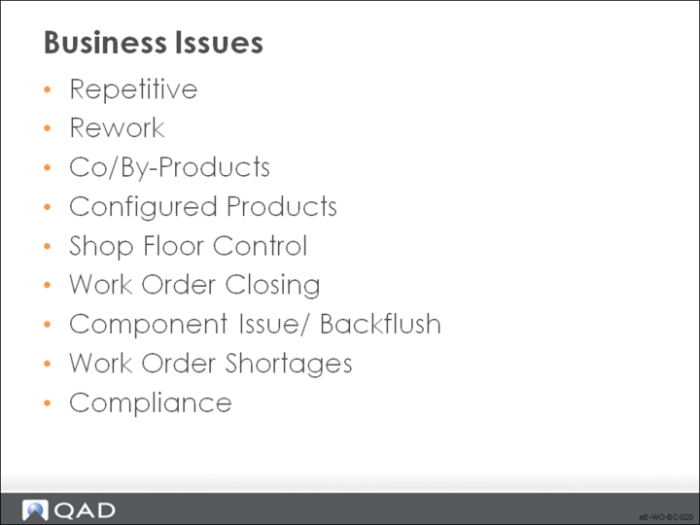
There are several business issues to consider before using work orders in QAD Enterprise Applications. This section does not discuss all potential issues, but presents some issues to generate thought and discussion.
Repetitive
Definition
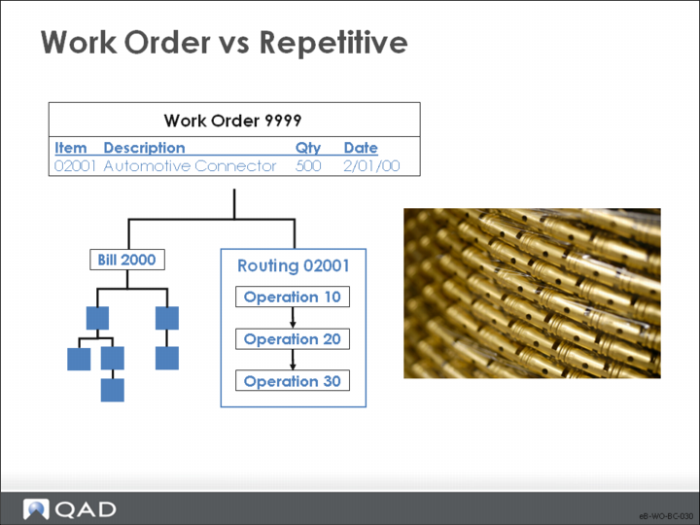
Work orders control and monitor the manufacturing of discrete items.
Repetitive manufacturing uses production line schedules.
Repetitive manufacturing typically involves continuous work and production lines dedicated to one item, or a family of items, for relatively long times.
Why Consider?
Repetitive manufacturing and work orders are appropriate to different environments.
Functionality in QAD Enterprise Applications
The system handles repetitive manufacturing in the repetitive and advanced repetitive modules.
Rework
Definition
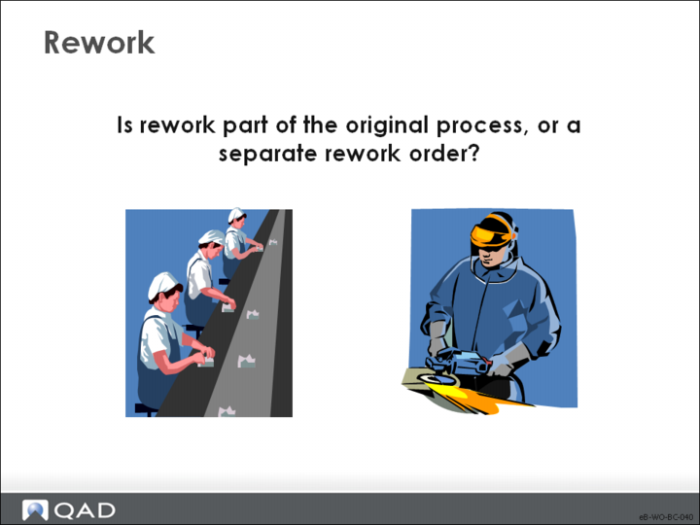
Rework work orders manage the repair, reprocessing, or completion of nonconforming items.
What to Consider?
Whether to charge the costs to the original order or to a separate order:
• Charging to the original order is easier
• Charging to a separate type R order splits out the rework costs
Setup Implications
Charging to the original order: None.
Charging to a separate order: Create a rework department, work center, and possibly alternate routings.
Possible reclassification of variances for accounting.
Co-Products and By-Products
Definition
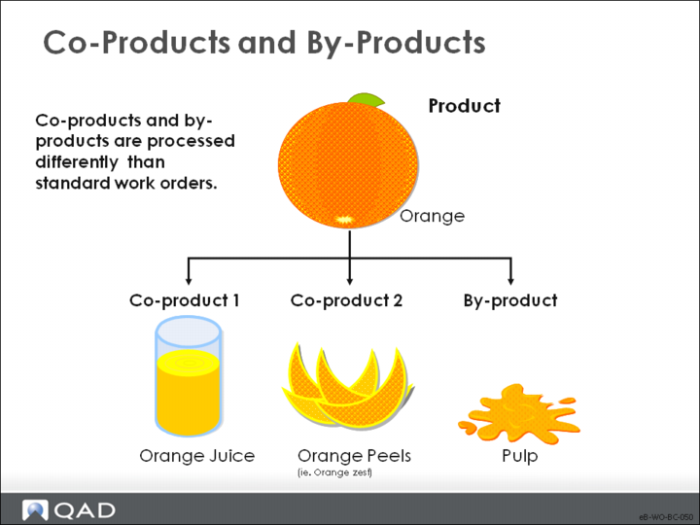
Co-products are intended results of a base product. By-products are incidental results of these same base products.
Why Consider?
The system processes these products differently from standard work orders because of the product structures, variances, and multiple end items.
Functionality in QAD Enterprise Applications
The system handles co/by-products differently from regular products.
Implications
This course does not cover co/by-products.
Configured Products
Definition
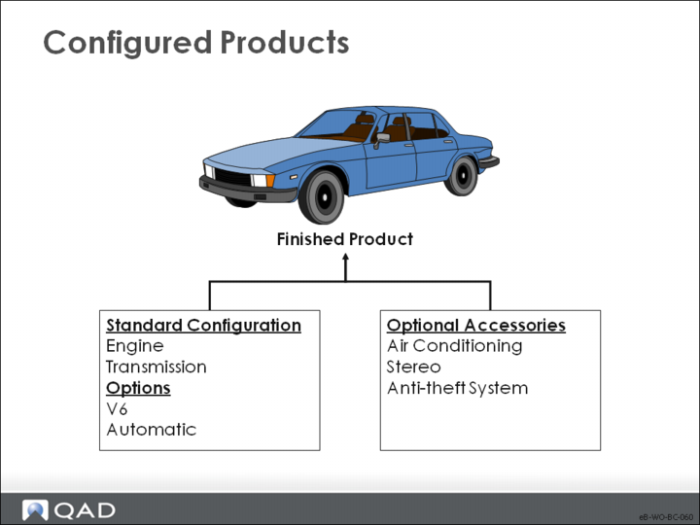
Configured products offer the customer variations on the original product.
What to Consider?
Configured products come out of the Sales Order module.
Functionality in QAD Enterprise Applications
Configured products come from Sales Order Release to Work Order.
Implications
Set up Configured Products Control.
Discussed in Training Guide: Sales Orders
Shop Floor Control
Definition
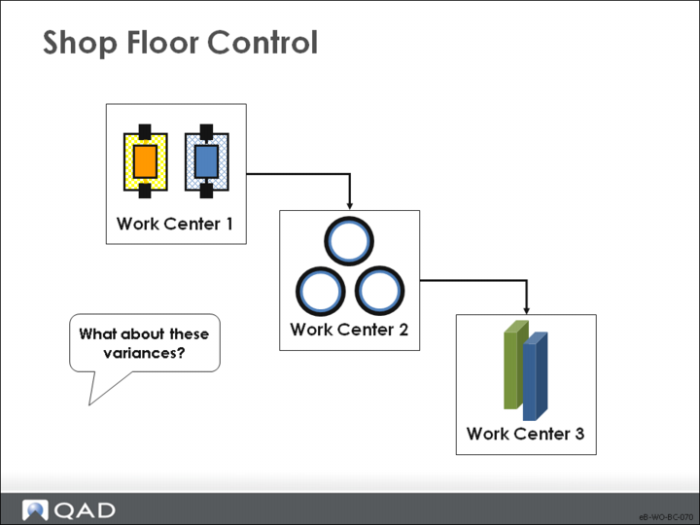
Shop Floor Control enables you to move items through work centers and operations to provide detailed analysis of the work.
What to Consider?
Identify variances the Post Variances at SFC setting in Work Order Control affects.
Implications
Work Order Control settings.
Discussed in Training Guide: Shop Floor Control.
Work Order Closing
Definition
The closing of work orders completes the life cycle and:
• Reports unreported items at standard
• Calculates variances to post to the general ledger
What to Consider?
If work order transactions have not been properly completed before the closing process, then the variances created are possibly not legitimate.
Setup Implications
Procedures must be in place to ensure proper reporting.
Component Issue/Backflush
What to Consider?
The timely issuance of work order components affects the value of work in process inventory and the ability to verify inventory accuracy through cycle counting.
Setup Implications
Set procedures for your company that allow you to maintain accurate counts.
Work Order Shortages
Definition
Shortages of work order components are one of the worst non-value-added problems, using up human resources and causing delays.
Setup Implications
Set strict procedures to ensure accurate inventory counts.
Compliance
Definition
The compliance module controls lot and batch numbers and work order bill substitutions.
Note: The Compliance module was renamed Regulatory Attributes in the Enterprise Edition of QAD applications.
What to Consider?
Compliance is important for highly regulated products and controlled substances