Source Networks
DRP uses source networks in the same way MRP uses product structures. MRP explodes product structures for manufactured items and creates planned orders. Similarly, DRP explodes source networks for distribution items and generates intersite requests.
Supply network relationships can represent a simple, single-tiered distribution environment. At the other extreme, the network can represent a complex, multi-tiered environment. This is typical when one or more plants supply product to each other and to regional distribution centers, which, in turn, supply branch warehouses.
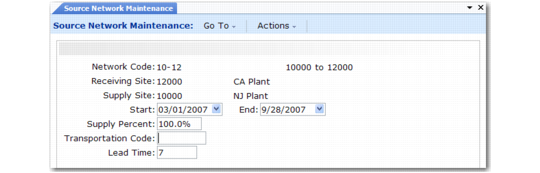
A network code defines one or more supply relationships. Each relationship in the network contains a receiving (demand) site, a supply site, and a supply percentage. A relationship is a one-way, site-to-site relationship. Set up one for every demand-to-supply site link. You can group multiple site-to-site relationships under the same source network.
Example: If material travels from site A to T and from T to A, two relationships are required.
You must assign each distribution item to a single source network. Do this in Item Master Maintenance (1.4.1), Item Planning Maintenance (1.4.7), or Item-Site Planning Maintenance (1.4.17). DRP plans intersite requests the same way for all items assigned to the same source network. Requests for those items are sent to the same supply sites, calculated using the same supply percentage, and request the same transportation mode or specify the same lead time.
Use Network Code Maintenance (12.1.1) to define network codes. Optionally, you can assign the codes to a planner. Then, use Source Network Maintenance (12.1.13) to specify relationships in the network.
Source Network Maintenance (12.1.13)
Optionally specify a transportation code or lead time. If you have two methods of transportation between the same sites, you must set up separate network codes for each.
A demand site can receive supply requirements for one item from multiple supply sites. Specify this in Supply Percent.