Transportation Management
Use the functions on the Transportation Management Menu to define codes and schedules used by DRP when it creates intersite requests.
Transportation Modes
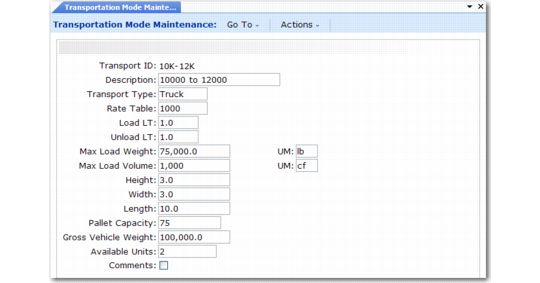
The methods a company uses to transport items from source to receiving sites—trucks, ships, containers, and so on—are transportation modes. Define transportation modes in Transportation Mode Maintenance (12.5.1). DRP uses the transportation mode’s effectivity dates, load lead time, transit lead time, unload lead time, ship days, and receive days to schedule intersite requests.
Transportation Mode Maintenance (12.5.1)
Transportation modes can designate available units—for example, how many trucks or rail cars are available—and the capacity for each unit. You must designate a different transportation mode for each type of transportation unit you want DRP to plan. For example, a company-owned fleet of trucks would use a different transportation mode for each type or size of truck.
Transportation Networks
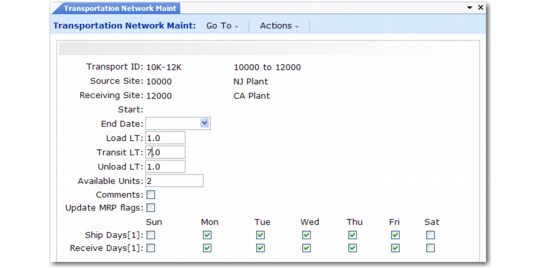
A transportation network identifies which method or methods are used to move products between a shipping and receiving site. Define transportation networks in Transportation Network Maintenance (12.5.5) by entering a transportation mode, also called a transportation code or ID, a shipping site, a receiving site, and effectivity dates. Lead times and available units default from the transport ID. Specify the days when shipping and receiving can be scheduled.
Transportation Network Maintenance (12.5.5)
When generating and scheduling intersite requests, DRP calculates transportation lead time by adding the load lead time, transit lead time, and unload lead time. The lead times for the transportation network override the source network lead time. Departure and receipt dates are scheduled only on days permitted by the transportation network, unless there is a holiday or fixed shipping schedule to override it.
In determining transportation load profiles, DRP calculates the projected load at departure using intersite requests for traffic between two sites, transportation modes, and item data for weight and volume. Projected capacity is calculated using transportation modes and transportation networks between the same two sites.