Introduction to Master Scheduling and RCCP
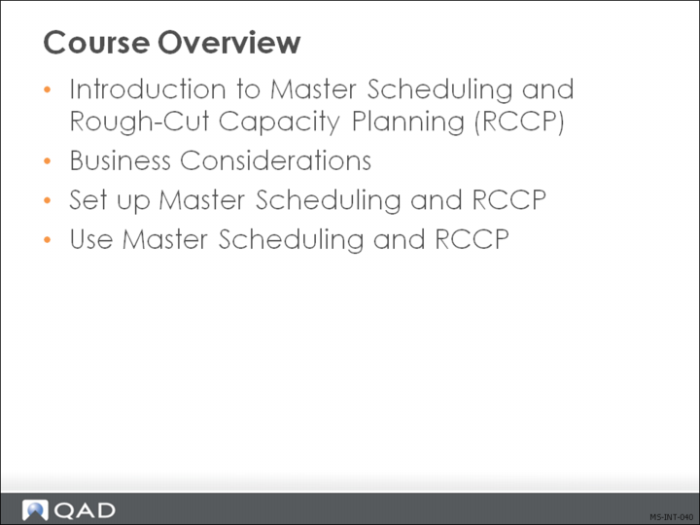
Course Overview
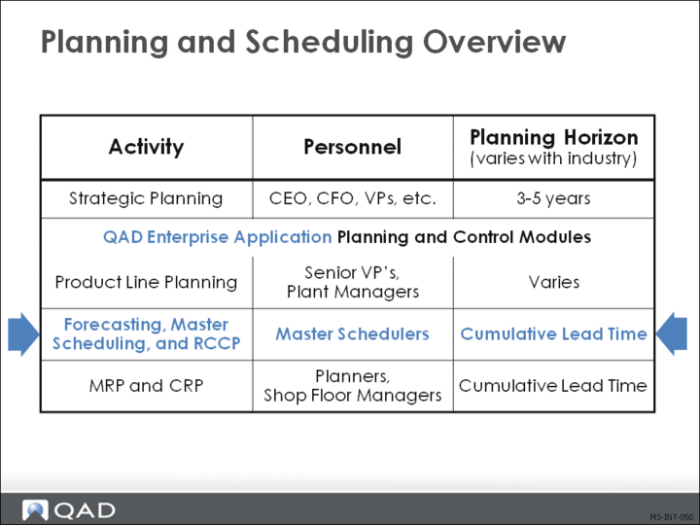
Planning and Scheduling Overview
All plans set expectations about how resources are used and provide reality checks to determine if plans can be implemented. Planning is done by different people at many levels throughout a corporation and QAD Enterprise Applications provides an integrated toolset that is useful at most of these levels.
Note: Students unfamiliar with the planning process described by the American Production and Inventory Control Society (APICS) may find it useful to look at planning level integration.
Strategic Planning
Strategic plans set guidelines for production and sales. Because they are done for the longest term, they are the least integrated and least precise of the planning levels. Chief Executive Officers and Chief Financial Officers look beyond the immediate year’s demands to set expectations for growth. Strategic plans set out the overall mission, goals, and initiatives for an organization, largely in terms of gross sales or overall income.
Planning Levels Supported by QAD Enterprise Applications
The following planning levels are supported by QAD Enterprise Applications.
Product Line and Resource Planning
Production planning is done in the Product Line Planning module of QAD Enterprise Applications. The check against resources is done in the Resource Planning module.
This tool enables you to:
• Balance sales forecasts, production forecasts, and income forecasts for an entire product line
• Determine whether you have enough resources, in aggregate, to meet the plans
The production plan sets expectations for a:
• Factory
• Site
• Division
• Department
Sales forecasts, production forecasts, and income expectations are produced by different people. Various sets of expectations must be balanced to determine the plan’s feasibility.
Production plans:
• Define manufacturing output and other activities to satisfy current planned levels of sales
• Incorporate and coordinate all activities
• Provide guidance for producing individual items that make up the product line
• Support the corporate objectives of increasing:
• Net profit
• Return on investment (ROI)
• Cash flow
Product line plans are broken up into end items, planned in the master schedule, and exploded to component plans by MRP.
End-Item Planning
End-item planning is done in the Forecast/Master Plan module of QAD Enterprise Applications. This tool enables you to set production levels in response to actual and forecast demand over a period roughly equivalent to the cumulative lead time.
The cumulative lead time is the longest length of time it takes to produce and ship an item, assuming that nothing is in stock or production.
At this stage, you can develop a rough-cut capacity plan to determine if critical resources will be available. For example, if you want to make 50 items next week but your fabricator only makes 25 in a week, you cannot meet the plan.
The end-item plan sets the number of priority items (end items, level 1 items, service parts, and so forth) that are going to be produced and sets the schedule to produce them.
End-item plans are usually done by master schedulers who:
• Estimate demand for a product
• Determine how many items to produce
Master schedulers modify factory plans to accommodate current situations. The horizon tends to be at least as long as the cumulative lead time.
Component Planning
Component planning is done in the Material Requirements Plan (MRP) module and the plans are checked against capacity in the Capacity Requirements Plan module of QAD Enterprise Applications.
This tool enables you to schedule and issue orders for the items and work that will be needed to support the master schedule. You can use Capacity Requirements Planning (CRP) to determine at a fairly precise level how this plan will load the resources you have at your site.
Component planning enables you to determine which work centers and components will be used to meet the plan. The check is to determine whether the work centers have capacity to meet the schedule.
Items that are not master scheduled will be planned using MRP with the master schedule as input. MRP uses this demand to schedule orders for components.
Planners and shop floor personnel use MRP results to determine manufacturing schedules that have the same time horizon as master schedules.
Enterprise Resource Planning (ERP)
In companies that use Enterprise Resource Planning (ERP), operations planning is the key link between long-term business planning and medium- to short-term planning and execution activities.
ERP calculates target inventory levels that support company objectives for:
• Profitability
• Inventory reduction
• Lead time reduction
• Customer service
ERP also calculates corresponding production demands. These demands eventually pass into:
• Production
• Purchasing
• MRP
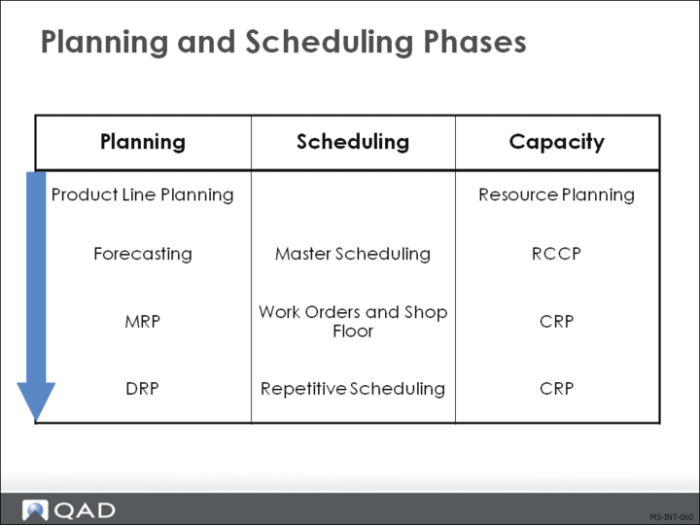
Planning and Scheduling Phases
Planning and execution generally move down and to the right through the matrix shown above.
The Product Line
Product line plans generally cover 1 to 3 years, usually shown by months and quarters. They are composed of aggregate forecasts that are converted into end-item forecasts. These detailed forecasts provide input that the master scheduler uses to create a statement of production.
The purpose of a product line plan is to:
• Aggregate forecasts
• Establish aggregate production goals (aligned to corporate goals)
• Plan efficient and cost effective use of production resources, such as machines and manpower
• Outline the level of planned manufacturing output
• Convert demand into a master schedule and rough-cut capacity plan
• Balance sales forecasts, production forecasts, and income forecasts for an entire product line
• Determine whether there are enough resources, in aggregate, to meet the plan
Product line plans are broken into:
• End items planned in the master schedule
• Component plans by MRP
The Forecast
Forecasting and sales orders introduce independent demand into QAD Enterprise Applications.
Independent demand is demand for an item that is unrelated to demand for other items. These demands serve as the primary reason for establishing the master schedule in QAD Enterprise Applications.
• Forecasts
• Estimate future demand for an item
• Are typically a sales function
• Can be an integral part of master scheduling
• Represent one point of input to the master schedule
• Source of independent demand can be created for any item, but is usually created for:
• End items
• Critical subassemblies
• Service parts
The Master Schedule
Developed by site and item, a master schedule is the key plan that provides primary input to MRP. A master schedule is a statement of production determining:
• Which items to schedule
• When orders are needed
• How much to produce
Master scheduling can be done to:
• Anticipate sales as entered in QAD Enterprise Applications
• Control production when no sales orders are used in inventory replenishment or build-to-stock environments for example
Using master scheduling and MRP is an effective method to:
• Set production levels in response to actual and forecast demand over a period roughly equivalent to the cumulative lead time
• Determine in a rough way (RCCP) whether critical resources will constrain supply
Qualifications and Responsibilities of a Master Scheduler
A master scheduler must have:
• Expertise in manufacturing
• Comprehensive product knowledge
• General business insight
• The ability to:
• Reduce lead time to bring new products to market
• Sell ideas and negotiate compromises
• Resolve conflict
• Minimize impact of changing requirements
• Meet customer goals
A master scheduler must know how to prepare data quickly and verify its accuracy in order to deal effectively with:
• Management (overall goals)
• Marketing and sales (available-to-promise)
• Engineering (changing bills of materials)
• Finance (cash flow)
• Distribution (scheduling)
• Customers (demands)
• Vendors (reliability)
The master scheduler is responsible for providing:
• Manpower
• Materials
• Manufacturing capability
• Money (cash flow)
• Management of all logistical activities
Material Requirements Planning (MRP)
MRP is a time-phased priority planning system that calculates material requirements using:
• Product structures
• Inventory status
• The master schedule
• Open order dates
Supply is scheduled and rescheduled to:
• Meet changing demand
• Maintain valid due dates
Capacity Requirements Planning (CRP)
• Determines how much labor and how many machine resources are required for production
• Calculates workload for a department, work center, or machine
• Used for medium-range capacity management to:
• Determine and provide the resources required to meet MRP’s detailed item schedules
Distribution Requirements Planning (DRP)
• Balances supply and demand for items transferred between sites. It is done by:
• Calculating item requirements
• Creating planned orders
• Managing shipment schedules and transportation
DRP is the extension of distribution requirements, inclusive planning of key resources contained in a distribution system, such as warehouse space, workforce, money, trucks, and freight cars.