Business Considerations
Course Overview
Business Considerations
There are several business issues to take into consideration before setting up master scheduling and RCCP in QAD Enterprise Applications.
This section does not discuss all of the potential issues, but presents some issues to generate thought and discussion.
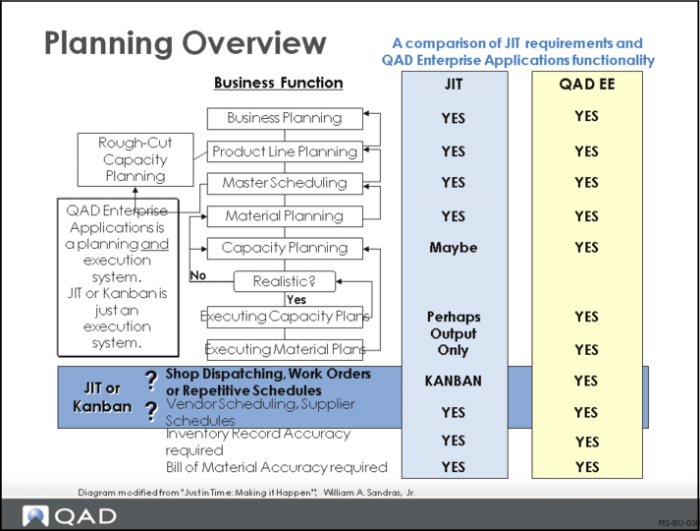
Planning Overview
Set planning parameters in Item Planning Maintenance (1.4.7) or Item-Site Planning Maintenance (1.4.17).
Definition
Planning parameters are established for each item in your database; they govern the way MRP handles the items.
Why Consider?
MRP is only as accurate as the data it processes; your planning parameters should have 98% plus accuracy.
Functionality in QAD Enterprise Applications
The item planning data is the most used information in your database.
Setup Implications
• Inaccurate data can be catastrophic
• A good clean-up of the database is always worthwhile
• Once clean, database update procedures should be in place to maintain data integrity.
Items to Master Schedule
Definition
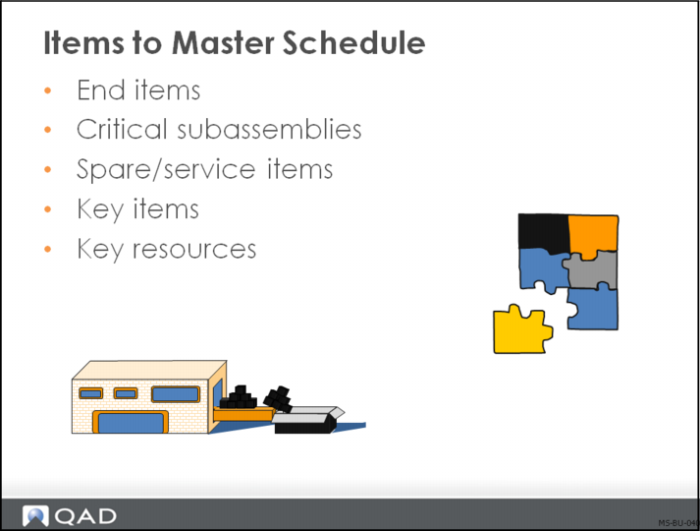
Determining which items to master schedule is a reflection of the industry, the products, and the manufacturing processes used in a particular company and requires the expertise of an experienced master scheduler.
Why Consider?
Sometimes, demand for an item is dependent on demand for another item. This is common when the master schedules for several sets of items are related by planning bills or product structures.
Functionality in QAD Enterprise Applications
Set Master Schedule to Yes in Item Planning Maintenance (1.4.7) or Item-Site Planning Maintenance (1.4.17) for multiple sites.
• Output for the master schedule is a plan for all items using MRP and product structures
• Input for the master schedule can come from:
• Forecast Maintenance (22.1) (automatic link)
• A product line plan
Note: In QAD Enterprise Applications, there is no link between the master schedule and the product line plan
Setup Implications
An item can be master scheduled at one site and not another.