Operational Allocation Codes
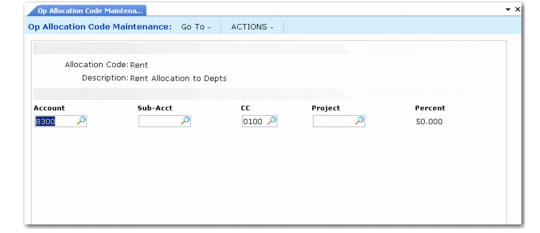
To simplify data entry in operational transactions, use Operational Allocation Code Maintenance (25.3.23) to define codes that allocate fixed percentages of expenses to different accounts, sub‑accounts, cost centers, and projects. You can specify an allocation code anywhere you enter an account in operational transactions, such as sales orders and purchase orders.
Transactions involving an amount allocated among several accounts can reference an allocation code rather than individual accounts, sub‑accounts, cost centers, and projects. Transaction amounts are distributed automatically to allocation accounts when transactions are posted.
You can define nested allocation codes so that one allocation code references another. When the system calculates amounts, it explodes each level of allocation codes, multiplying the amount to be apportioned by the percentages at each level.
Operational Allocation Code Maintenance (25.3.23)
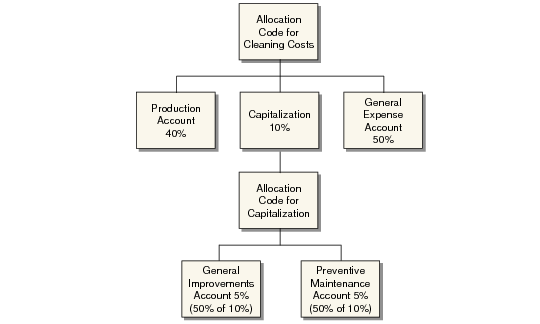
Example: When ABC Company posts utility expenses to Accounts Payable, a part of the expense is posted to cleaning costs. Cleaning costs are pro-rated among several accounts: 40% to Production, 50% to General Expense, 10% to Capitalization. Rather than enter multiple account codes for each transaction, ABC defines an allocation code for the group of accounts, allowing the data entry operator to enter one allocation code rather than three accounts.
Taking this example one step further, allocation codes can be nested. In the example above, 10% of cleaning cost is capitalized as improvements. This 10% is split evenly between accounts for general improvements and preventive maintenance. An allocation code is set up for capitalization. The accounts for general improvements and preventive maintenance each have an allocation percentage of 50%. However, only 5% of the total cleaning cost expense is posted to each account.
Allocation Code Examples