What is a Pull System
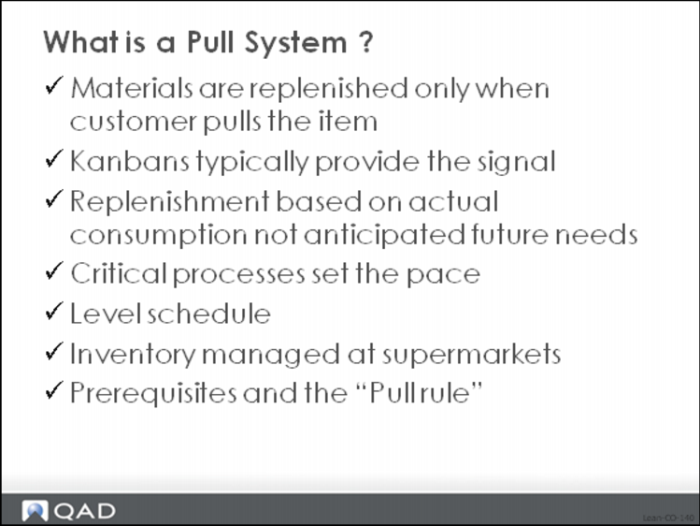
Materials are replenished only when customer pulls the item
Pull replenishment is based on a visual scheduling technique called kanban. Although the term kanban is Japanese and in this context comes from the Toyota Production System and Taiichi Ohno, the technique itself, when applied to inventory replenishment, is actually much older. Taiichi Ohno got his inspiration for the Toyota Production System, at least in part, from observing replenishment processes in an American supermarket: when the bread shelf was empty, the supplier was authorized to replenish. (His other inspiration was another American innovation: Henry Ford’s manufacturing practices developed at the Rouge production complex.)For example, as early as the end of the 19th century, the iceman and the milkman in urban areas in America were receiving signals to determine whether to walk from their horse-drawn cart to the porch with ice or milk. The customer's signal was either a card (ICE) in the window or an empty milk bottle.
The way that a pull replenishment system works is quite simple. Inventory for an item is divided into equal units (kanbans). As a kanban-worth of inventory is consumed it is reported, and when the inventory level reaches a predetermined level, a signal is generated to schedule replenishment. In a company with reduced setups, small order quantities and lots of manufacturing flexibility, one kanban of consumption might signal replenishment. In a company with typical stamping processes, presses, etc., several kanban cards might have to accumulate before a lot size is reached and replenishment signaled.
Kanbans provide the replenishment signal
The visual signal used for KANBAN might be any of the following:
• Card
• Flag
• Colored golf ball or ping pong ball (running in a race between the point of consumption and the supplying process)
• Empty bag, box, tray, pallet or container
• Empty rack or square on the floor
• Empty truck
• Fax (to suppliers)
• Electronic signal (e-kanban)
Replenishment is based on actual consumption not anticipated future needs
Any system that replenishes inventory based on consumption of inventory is defined as a pull system. Any system that replenishes inventory based on predicting or anticipating future needs for that inventory is defined as a push system. Whether these are good definitions or not, or whether they even make sense based on the normal connotations of pull and push is really irrelevant. In the same way, the tools that are the underpinnings of push and pull concepts are neither good nor bad. Each tool and technique has situations where it works better than the other, and vice versa.
So by these definitions, a kanban-based replenishment system is pull and an MRP-based replenishment system is push. Even in cases where MRP or some similar process is being used to project future needs, if the actual replenishment activities are based on Kanban then the system is considered a pull system.
For items that are being replenished using pull, traditional techniques often associated with MRP are shut off. Examples would include order releasing based on planned orders and traditional shop floor control based on push dispatching rules. However, executing to a pull signal is not in conflict with MRP planning itself. Typically, MRP planning continues to run, for the purpose of projecting requirements for suppliers of purchased parts and raw materials.
Critical processes set the pace
As noted above, the pacemaker process in each value stream establishes the drumbeat for all production and replenishment activities. Components produced in processes upstream of the pacemaker are pulled from their source processes based on consumption of inventory from a strictly controlled inventory. Processing beyond the pacemaker (finishing, configuration, burn-in, and so forth) is handled on a first-in-first-out (FIFO) basis: as work arrives it is processed in a strict first-in first out sequence.
Level Schedule
The level schedule creates a repetitive pattern and regularity to production activities. Without it, the surges of work to the upstream processes create erratic production, material movement, and capacity usage. By leveling total volume and each of the items to the average rate, upstream manufacturing processes and suppliers see a relatively constant capacity requirement and a leveled stream of component usage. The average rate expressed in units of time (hours-minutes-seconds) is the takt time and it becomes the basis for all process design activities. The design of the finishing cell and all the supporting processes, the number of operators in the cell, and the distribution of work to those operators is a key output from leveling to the average rate.
In addition, material plans projecting supplier requirements will be derived from this and shown to the supplier as a supplier schedule.
Lean producers have a choice when it comes to the actual execution of the long term leveled schedule. In some cases, like Toyota, the backlog of customer orders will extend far enough into the future that longer term leveling can be based on the exact, actual flow of customer orders. However, in many companies the long-term heijunka—essentially a volume leveling process—will try to plan based on the anticipated average flow of customer orders. The short-term leveling process—which reflects what actually will be produced, in what sequence, and when—can match the exact customer orders as they are received. This is one case where what Toyota does often does not dictate what other companies choose. In fact, many of the Western lean consultants, often ex-Toyota employees, advise an execution strategy different from Toyota’s.
Inventory managed at Supermarkets
Supermarkets of tightly managed and strictly limited inventory help decouple processes that run at different rates—for example, a finishing process that flows at a constant rate and a stamping or machining process that runs large lot sizes at a much faster cycle time, but requiring a substantially longer setup time. As a buffer of finished goods, a supermarket can decouple highly variable customer demand and the pacemaker process that must run at a more stable and leveled rate. And because supermarkets are set as a maximum amount of inventory with a hard and fast rule stop production when the supermarket is full, they have the effect of limiting the amount of inventory at all stages of the lean production system. In fact, supermarkets make pull systems possible. Consumption from the supermarket sends pull signals to replenish. Full supermarkets signal that the source process must stop producing.
Prerequisites and the Pull Rule
For a pull system to work effectively, however, some basic prerequisites and some rules need to be followed. Here are the prerequisites:
• Demand for each item must be relatively repetitive, regardless of whether the item is a finished part, subassembly, fabrication, etc.
• Lead times must be relatively short
• Components must be available so that an item can be produced on demand when the visual signal is generated (in other words, setups have been reduced, reducing the production interval and associated lot sizes).
Note that of these prerequisites, one of the most difficult to achieve is often relatively repetitive demand. As noted above, leveling is one of the techniques used for creating relatively repetitive demand. Using finished goods supermarkets to buffer the variability of customer ordering patterns, understanding and using the EPE Interval to establish the smallest possible lot size for each item, and focused efforts to reduce setup times so as to reduce the EPE I even further are additional methods for reducing the variability of demand being passed through the value stream.
The other essential element in making a pull system work is adherence to the pull rules:
• Downstream processes can withdraw ONLY the required quantity from the supplying upstream source.
• A process can produce (replenish) ONLY the quantity withdrawn by the downstream process; in other words, stop producing when the kanbans are full.
• NEVER send defects on to the next process
• MINIMIZE the number of kanbans for each item.
• FINE TUNE the number of kanbans as fluctuations in demand occur.
In the next section we’ll restate the basic mechanics of pull systems.