Lead Times
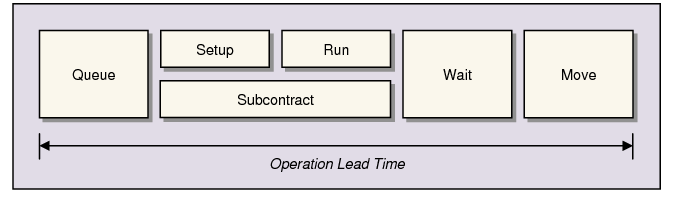
Lead times for operations and manufacturing are expressed in terms of several components.
Lead Time Components
• Queue. Amount of time a lot must wait at a work center before the operation is set up and production begins. Occurs when there is a backlog of jobs at a work center and is frequently the single longest component of manufacturing lead time.
• Setup. Time required to prepare a work center to process a lot or batch quantity for a specific operation.
• Run
• In Routing Maintenance (14.13.1), the average time required to manufacture a single unit.
• In Process Definition Maintenance (15.13), the average time to process an entire batch.
• In Routing Maintenance (Rate Based) (14.13.2), run time is expressed in terms of an hourly production rate.
In all cases, the system stores run time internally as the run time per unit.
• Wait. Amount of time a lot or batch must remain at a work center after production is completed before it can be moved to the next operation.
• Move. Time a lot or batch spends in transit from one operation to the next.
• Subcontract. Number of days required for an outside supplier to process the lot.
Operation Lead Time
Planning programs use these lead times to determine the duration of an operation and the time between successive operations. The amount of time a work center is actively involved in producing an item is determined by setup, run, and subcontract times. The time between operations—interoperation time—is determined by queue, wait, and move times. Most of these times are stated in hours, except for subcontract, which is stated in days.
The operation lead time is calculated using each of the lead time components, the number of machines per operation, and the item order quantity. The work center or shop calendar is used to convert queue, setup, run, and move times from hours to manufacturing days.

If you examine this formula, several concepts become apparent:
• Queue, setup, and move times are completely independent of the order quantity or lot size.
• Queue, setup, and move times are also independent of machines per operation, since these do not require that a machine be available.
• Queue, setup, and move times are a function of available work center or shop calendar hours since the operation can only be performed during working hours. If queue, setup, and move times add up to 16 hours and there are 8 working hours in a day, 2 manufacturing days are needed.
• The total run time for an operation is a function of order quantity. If the unit run time is 1 hour and the item order quantity is 48, a total of 48 hours of run time is needed.
• The run time for an operation is a function of total run time, work center or shop calendar hours, and the machines per operation. If a work center is open for 8 hours per day and there is one machine per operation, run time is 6 manufacturing days (48 hours over 6 days with 8 machine hours per day). However, if there are 3 machines per operation, run time will take only 2 days (48 hours over 2 days with 24 machine hours per day).
• Wait time is the amount of time a lot must remain at a work center after an operation is completed before it can be moved to the next operation. It is calculated from a straight 24-hour clock, since no machines or people are required.
• Subcontract lead time is stated in days. It is added directly to the other lead time components.
The system schedules work order and repetitive operations sequentially, assigning start and due dates for each operation. The duration of a specific operation—the time between its start date and due date—is determined by the setup, run, and subcontract times for the operation. The interoperation lead time—the time between the due date of one operation and the start date of the next operation—is calculated using the first operation’s wait and move times and the following operation’s queue time.
Note: Setup and run times are used for operation scheduling, lead time calculations, product costing calculations, and GL transactions created by activities such as reporting labor and completing repetitive operations in the manufacturing modules. Changes to setup and run times should be coordinated to prevent adverse effects in any one of these areas.
Manufacturing Lead Time
The manufacturing lead time for an item is the sum of its operation lead times, stated in manufacturing days. Capacity planning uses manufacturing lead time, in conjunction with the work center or shop calendar, to determine order release dates.
There may be differences between operation schedules for an order and the manufacturing lead time for an item due to any one of several reasons:
• The item order quantity used to calculate the manufacturing lead time may be different than the actual order quantity for an operation, resulting in differences in the run time for an operation.
• The shop and/or work center calendars may be scheduled for more (or less) hours than the default calendars used to calculate manufacturing lead time.
• Queue time for the first operation does not affect its start date; therefore, it may fall after the release date of an order.
• Two successive operations may overlap.