Open Item Adjustment
Use Open Item Adjustment Create (25.13.5) to reconcile unpaid or incorrectly paid invoices and credit notes. In addition, you can record prepayments and adjustments, change the value of an existing open item, or create a new open item. All open item adjustments are recorded in the official layer.
Before using open item adjustment, it is recommended that you configure settings for the netting of transactions across business relations and for customer and supplier compensation.
Setting Up Open Item Adjustment
Netting settings in the entity record let you control the level of flexibility provided in Open Item Adjustment Create (25.13.5) for the netting of transactions. In addition, customer and supplier compensation settings at entity and business relation level control whether you can net credits and debits for customers and suppliers that belong to the same business relation.
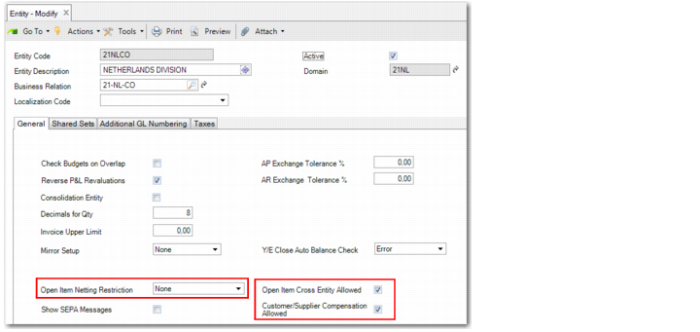
The entity record includes three fields that let you control open item adjustment.
Entity Modify (36.1.1.2.2)
Open Item Netting Restriction
This field provides three options for the netting of open items across business relations.
• None. This option does not impose restrictions on the netting of open items across business relations. It is the least restrictive setting, and is the default.
• Single Business Relation. This option restricts the netting of open items to items that belong to the same business relation. It is the most restrictive setting.
• Related Business Relations. This option restricts the netting of open items to items from business relations that belong to the same corporate group.
Important: A business relation with a blank corporate group is not considered to be related to a business relation that has a corporate group assigned. Similarly, two business relations, each with blank corporate groups, are not considered to be related.
Open Item Cross Entity Allowed
Select this field to enable open items to be adjusted across entities. This field is enabled by default.
When this option is enabled, you can use Open Item Adjustment Create (25.13.5) to display and net items from other entities.
When an open item adjustment includes cross-entity transactions, the entities involved must have compatible netting control settings. If the entities have different control settings, the most restrictive setting is applied.
For example, if one entity has a netting restriction of Single Business Relation, the whole open item adjustment must be for a single business relation. If there is a conflict with the most restrictive control setting, an error is displayed and the open item adjustment cannot be saved.
If this option is disabled, the All Entities field in Open Item Adjustment Create (25.13.5) is disabled for editing, and you cannot display and net items from other entities.
Customer/Supplier Compensation Allowed
Specify how the system treats open items during payment processing when a customer and supplier belong to the same business relation. This option is enabled by default.
When customer and supplier compensation is enabled at entity level and an open item adjustment involves transactions from two different entities, customer and supplier compensation must be enabled for both entities in order for the adjustment to be saved. In addition, the corresponding Customer/Supplier Compensation Allowed field must be enabled for the business relations involved in the adjustment. This restriction applies regardless of the entity’s netting restriction or whether the customer and supplier compensation is cross-entity.
When customer and supplier compensation is disabled at entity level, you cannot net items from customers and suppliers with the same business relation. This setting overrides the Customer/Supplier Compensation Allowed setting at business relation level for customers and suppliers.
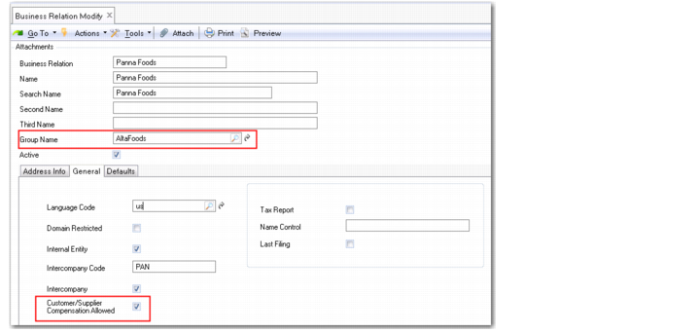
The values of two business relation fields affect open item adjustments: Group Name and Customer/Supplier Compensation Allowed.
Business Relation Modify
Group Name
Specify the corporate group to which the business relation belongs. When the entity Open Item Netting Restriction field is set to Related Business Relations, you can only use Open Item Adjustment to net transactions from business relations that belong to the same corporate group.
Note: A business relation with a blank corporate group is not considered to be related to a business relation that has a corporate group assigned. Similarly, two business relations, each with blank corporate groups, are not considered to be related.
Customer/Supplier Compensation Allowed.
Select the field to allow open items for customers and suppliers that belong to that business relation to be netted against each other.
When customer and supplier compensation is enabled at entity level, the Customer/Supplier Compensation Allowed field must be enabled for the business relations involved for an adjustment to be saved.
When customer and supplier compensation is disabled for the entity, this overrides the customer and supplier compensation setting for the business relation if compensation is enabled here.
The following example illustrates how the netting controls at entity level and their possible values, and the customer and supplier compensation controls at entity and business relation level and their possible values interact to control open item adjustment.
Example:
This example uses the following customers, suppliers, business relations, and corporate groups.
Suppliers and Customers | Business Relations | Customer/Supplier Compensation for Business Relation? | Corporate Group |
Supplier 1 | Business Relation 1 | Yes | Group 1 |
Supplier 2 | Business Relation 2 | No | Group 2 |
Supplier 3 | Business Relation 3 | Yes | Group 1 |
Supplier 4 | Business Relation 1 | Yes | Group 1 |
Customer 1 | Business Relation 1 | Yes | Group 1 |
Customer 2 | Business Relation 2 | No | Group 2 |
Customer 3 | Business Relation 3 | Yes | Group 1 |
Transactions are created for these customers and suppliers in four different entities: Entity 1000, Entity 2000, Entity 3000, and Entity 4000.
Entity 1000
Entity 1000 has the following netting and compensation settings:
Open Item Netting Restriction | Netting Across Entities Allowed? | Customer/Supplier Compensation Allowed? |
None | No | Yes |
You attempt to save the following open item adjustments in Entity 1000:
• An invoice from Supplier 1 is netted against a credit note for Supplier 2.
The transaction is saved. The Supplier 1 and Supplier 2 belong to separate business relations. However, there are no restrictions on netting across business relations in Entity 1000.
• An invoice from Supplier 1 is netted against an invoice from Customer 1.
The transaction is saved. Supplier 1 and Customer 1 belong to the same business relation, and Customer/Supplier Compensation is allowed for the business relation.
• An invoice from Supplier 2 is netted against an invoice from Customer 2.
An error is displayed, and the adjustment cannot be saved. Supplier 2 and Customer 2 belong to the same business relation, and the Customer/Supplier Compensation Allowed field is disabled for the business relation.
Entity 2000
Entity 2000 has the following netting and compensation settings:
Open Item Netting Restriction | Netting Across Entities Allowed? | Customer/Supplier Compensation Allowed? |
Related Business Relations | Yes | Yes |
You attempt to save the following open item adjustments in Entity 2000:
• An invoice from Supplier 1 is netted against a credit note for Supplier 2.
An error is displayed, and the adjustment cannot be saved. Supplier 1 and Supplier 2 belong to separate business relations and separate corporate groups. In Entity 2000, you can only net transactions from business relations that belong to the same corporate group.
• An invoice from Supplier 1 is netted against a credit note for Supplier 3.
The adjustment is saved because the suppliers belong to the same corporate group.
• An invoice from Supplier 1 is netted against a credit note for Supplier 4.
The adjustment is saved because the suppliers belong to the same business relation.
• An invoice from Supplier 1, created in Entity 1000, is netted against an invoice from Customer 2, created in Entity 2000.
The adjustment is saved. Supplier 1 and Customer 1 have the same business relation, customer and supplier compensation is allowed for the business relation, and cross-entity netting is enabled.
Entity 3000
Entity 3000 has the following netting and compensation settings:
Open Item Netting Restriction | Netting Across Entities Allowed? | Customer/Supplier Compensation Allowed? |
Single Business Relation | Yes | Yes |
You attempt to save the following open item adjustments in Entity 3000:
• An invoice from Supplier 1 is netted against a credit note for Supplier 3.
An error is displayed, and the adjustment cannot be saved. In Entity 3000, you can only net transactions from the same business relation. This restriction applies even though the suppliers have the same corporate group.
• An invoice from Supplier 1 is netted against a credit note for Supplier 4.
The adjustment is saved. The suppliers belong to the same business relation.
• An invoice from Supplier 2 is netted against an invoice for Customer 2.
An error is displayed, and the adjustment cannot be saved. Customer and supplier compensation is disabled for the business relation to which Supplier 2 and Customer 2 belong.
• An invoice from Supplier 1, created in Entity 2000, is netted against a credit note for Supplier 4, created in Entity 3000.
The adjustment is saved. Netting across entities is enabled for Entity 3000, and Supplier 1 and Supplier 4 belong to the same business relation.
Entity 4000
Entity 4000 has the following netting and compensation settings:
Open Item Netting Restriction | Netting Across Entities Allowed? | Customer/Supplier Compensation Allowed? |
None | Yes | No |
You attempt to save the following open item adjustments in Entity 4000:
• An invoice from Supplier 1 is netted against an invoice for Customer 1.
An error is displayed, and the adjustment cannot be saved. Customer and supplier compensation is disabled for the entity, and this setting overrides the compensation setting for the business relation to which Supplier 1 and Customer 1 belong.
• An invoice from Supplier 1, created in Entity 2000, is netted against an invoice for Customer 1, created in Entity 4000.
An error is displayed, and the adjustment cannot be saved. Entity 4000 does not allow customer and supplier compensation. Both entities must allow compensation for the transaction to be saved.