Levels
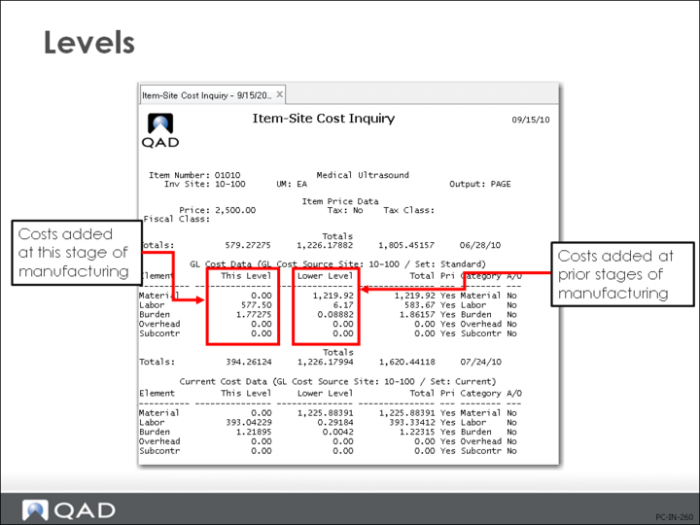
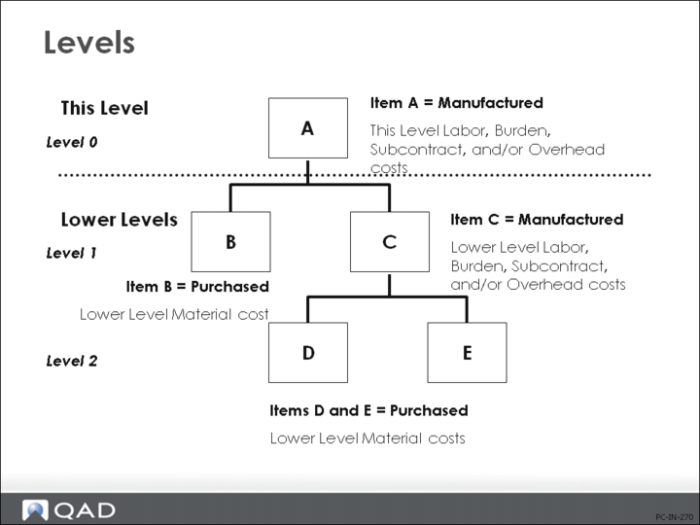
Costs added at the current stage of manufacturing are called This Level costs (level 0); costs added at prior stages of manufacturing are called Lower Level costs (levels 1 through 99). These are discussed in more detail on the following page.
This Level
This Level costs are the costs to either obtain or produce an item. Thus, a purchased item has This Level material (and optionally material overhead) cost, but it has no Lower Level costs. Likewise, a manufactured part has This Level labor, subcontract, burden, and overhead cost, but normally no This Level material cost. The manufactured item will, however, have Lower Level material cost for components and possibly Lower Level labor, material, subcontract, burden and overhead if the structure has more than two levels.
Lower Level
Lower Level costs represent costs that are added at prior stages of manufacturing. Lower Level material costs are the costs of all purchased materials used in the final manufactured product and any subassemblies. Lower Level labor, burden, and subcontract costs are developed from the cost of making any lower-level subassemblies.
Phantom
Phantom items are used in manufacturing to define items that are made and consumed in the production process without being inventoried. They represent a method of defining bills of material and formulas to satisfy design/engineering, cost, and production. They can be set as Local phantoms, Global phantoms, or both.
Global Phantoms
Global Phantoms are defined in Item Master Maintenance (1.4.1), Item Planning Maintenance (1.4.7), or Item-Site Planning Maintenance (1.4.17) and identify this item as a phantom on all bills of material.
Local Phantoms
Local phantoms are defined by an asterisk (*) in the Product Structure code field in Product Structure Maintenance (13.5) for each bill of material where this item is to be considered a phantom. Local phantoms can cause manufacturing variances if they have This Level costs.
Phantoms are discussed in more detail later in the course.