Domain, Sites, Entities, and Locations
Domain
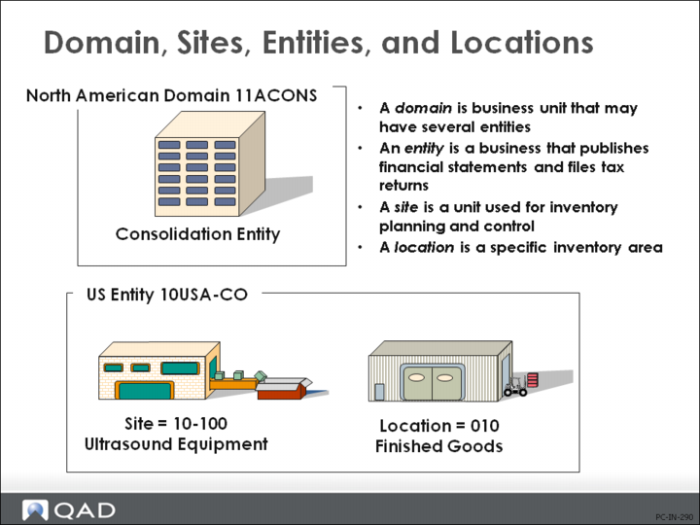
A domain is a high-level corporate structure that can have many entities. It can be used to provide an accounting template for the entities.
Entity
An entity is an independent unit for financial reporting purposes, a separate balance sheet and income statement are generated by entity, budgets are planned by entity, and taxes are assessed by entity. All GL transactions are posted by entity.
Site
A site is an inventory and planning concept. All inventory is stored by site and all planning is done by site. Each site belongs to one and only one entity, but each entity can have more than one site. Site 10-100 is an examples of a site.
Because each site is attached to an entity, the site on any transaction is used to determine which entity to post the inventory transaction to in the GL.
Location
A location is a specific inventory storage area. Each site can have as many locations as needed. Location 010 is an example
Note: Balance sheets cannot be produced by site, only by entity unless you have a single entity for each site in the system. However, you can use sub-accounts or cost centers to get profit/loss statements and activity reports by site. If you have multiple sites in a single entity, you cannot generate a balance sheet by site, because retained earnings and year-to-date profit/loss are only maintained in aggregate by entity.