QAD 2016 Enterprise Edition Training Guides
>
Product Costing Introduction
>
Account Structures
>
Product Line Work Order Accounts
Product Line Work Order Accounts
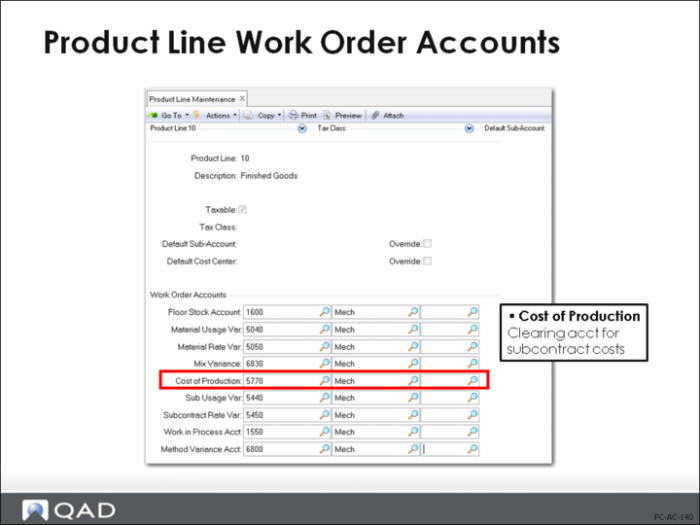
These product line accounts are used in manufacturing to track the cost of floor stock, miscellaneous production costs, and work order variances. They appear on each manufacturing order as the defaults, but can be changed on any order.
Floor Stock
This is an Inventory clearing account for bulk issue items (for example, nails or nuts and bolts) that are part of the product structure, but which are not issued in the normal manner. Such items, coded in Item Master Maintenance (1.4.1) (or Item Planning Maintenance (1.4.7) or Item Site Planning Maintenance(1.4.17)), with an Issue Policy = No, are issued to the floor using an unplanned issue transaction (Issues, Unplanned, (3.7)). The system uses the Floor Stock account rather than the Cost of Production account, though, so that the material is not expensed. The issue transaction creates a debit to Floor Stock and a credit to Inventory.
Material Usage Variance
Tracks the difference between actual quantity issued and the standard quantity required in work orders. Since the standard cost of the item is inflated for yield losses, differences due to yield are reflected here. This variance is calculated and posted when the manufacturing order is accounting closed. Usage variance will also be calculated for substitute materials issued to work orders, work order bill modifications that add materials, phantom use-up logic under some conditions, component issues to rework jobs, and for any materials issued to an expense job that is accounting closed.
{actual qty issued – [qty per * (qty complete + qty reject)]} * GL cost
Material Rate Variance
Tracks the difference between the GL cost of an item at the time it is issued to a work order and the frozen cost of the item in the work order bill. You get this difference when you issue material from a different site and it has a different cost or when you change GL costs without updating WIP.
(WO BOM unit cost at issue – GL unit cost) * actual qty issued
Mix Variance
This is the GL account code normally used to track the mix variance. The product line Mix Variance account is used as a default on all manufacturing orders for Co-Products/By-Products in the product line.
[order qty – (receipt qty + scrap qty)] * GL cost
Cost of Production
Miscellaneous production costs that cannot be tracked to a specific work order, such as unplanned issues. Also serves as the clearing account for subcontract purchase transactions on work orders. When a subcontract purchase order is received, the cost of the subcontract item will remain in the Cost of Production account if no work order was linked to the subcontract purchase order.
Subcontract Usage Variance
Tracks the difference between the quantity received on a subcontract PO and the quantity completed in work in process.
This variance can be due to yield differences and rework, for example. It is calculated and posted by Work Order Accounting Close (16.21). A positive quantity multiplied by the subcontract operation cost is debited to Subcontract Usage and credited to WIP.
Subcontract Usage Var =
[qty received – (qty complete + qty reject)] * subcontract frozen WO BOM unit cost
Subcontract Rate Variance
Tracks the difference between the subcontract PO price and the standard subcontract cost in the routing for an item. This is calculated and posted at the time the PO Receipt is processed. A positive rate difference multiplied by the quantity received at purchase order receipt is credited to WIP and debited to the Subcontract Rate Variance account.
Subcontract Rate Variance = (subcontract PO unit cost – subcontract frozen WO BOM unit cost) * qty received
Work in Process (WIP)
Tracks work-in-process inventory value.
Method Variance
Tracks any unexplained manufacturing variances at work order or cumulative order accounting close. Method variance might be due to alternate routings, alternate product structures, timing of changes to item cost standards, lot size variance, or a rounding remainder.
Purchasing Accounts Maintenance
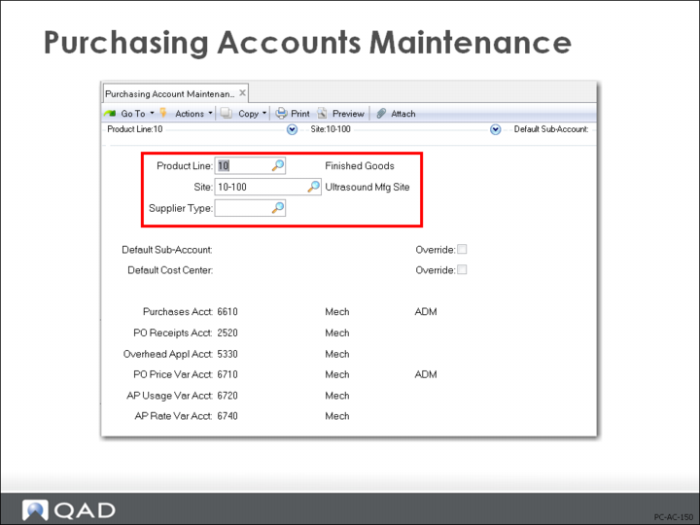
Purchase accounts can be defined by site and supplier type.