Introduction to Product Change Control
Course Overview
Learning Objectives
• Identify key business issues that affect the setup tasks
• What these business issues are
• How they might affect setup
• Why should these issues be considered prior to setup
• Specific implementation setup procedures for Product Change Control
• Identify required versus optional setup procedures
• Understand general processing flow for PCOs, with primary and alternative procedures
Understand general processing flow for PCRs, an optional procedure
Pre-Setup Business Issues
• Key business issues that affect setup and process procedures
• Definitions of these issues
• Some reasons to consider the issues
• The functionality of these procedures in the context of QAD Enterprise Edition
• Setup implications of these issues
Overview of Business Needs
The Product Change Control module of QAD EE can help you meet your business requirements in three major ways:
1 Evaluate, define, approve, and incorporate proper change control. PCC provides an integrated process to support your business requirements.
2 Control and monitor changes to the contents of the product or its product structures.
3 Leave an audit trail for legal, economic, and regulatory agencies to review. PCC is a tool that will do that for you.
Typical Characteristics
Product changes have some common characteristics:
• Close teamwork to coordinate incorporation and implementation
• Input from many groups, including methods to prioritize different inputs
• Close and careful monitoring to ensure accuracy
Various groups involved in the product changes include:
• Engineers
• Planners
• Approvers
Solution Characteristics
Using PCC to introduce changes into QAD EE can provide a framework for complete change management, including control over:
• Item engineering data
• Product structures
• Routings
• Formulas
• Processes
• Specifications
Limitations
• Item-site data must be maintained locally
• Cannot automatically control
• Alternate routings
• Co/by-product structures
Milestone Events
Need to track, evaluate and manage three stages during product change
• Request for change is placed
• Plans to initial changes are designed
• Actual changes are incorporated and implemented in QAD EE
Requests for Changes
Need to ensure:
• Accurate notification
• Security measures to establish authorization levels
• Established methods for timely communication between involved parties
Planned Changes
Need to:
• Minimize the costs involved
• Coordinate all changes with all concerned groups; engineers, sales persons, production staff, purchasers
• Coordinate change information across geographic and database separation, such as minimizing downtime and information lag
Actual Change Implementation
Need to ensure:
• Accurate effective dates are established
• Approvals have been correctly assigned, controlled, and verified
• Changes to planning data and production are both accurate and timely
Terminology
Product Change Request (PCR)
An optional change document used as a template for a full change order. They tend to have a shorter lifecycle, they do not affect production, and multiple PCRs can exist for an item whereas only one order can exist.Once approved, is either closed or converted into a PCO for further work.
Product Change Order (PCO)
A change document that details changes to a production process and is moved through a defined approval sequence before updating production tables.
Revision Level
An engineering change level for an item. Typically used in place of a number change to control modifications that do not change the form, fit, or function of an item.
Effective Date
The date when a component or an operation is to be added or removed from a bill of material or assembly process. Used in the explosion process to create demands for correct items. Normally, bill of material and routing systems provide for an effectivity start date and stop date for each relationship. Can be controlled by serial number rather than date.
Disposition
Validated against predefined values entered in Generalized Codes Maintenance, if any. The disposition of the PCO or PCR. This field is user-defined.
Product Change Requests (Optional)
• Can be used in the same way that sales quotes precede sales orders
• Planning data and production not affected
• Optional
• Requests come from many sources
• Customers
• Field Reps
• Engineers
• PCRs are not strictly controlled
• Can be approved to a PCO or rejected/unapproved and closed
• More than one PCR can exist for an item
Product Change Orders
• Required in PCC
• Very strictly controlled
• Affect Planning Data when Incorporated
• Affect Item Master when Incorporated
• Only one PCO can exist per item
Product Change Order
Header
Generic change information
Body
Specific changes for:
• Items, Product Structure, Routing, and Item Specs
• Formulas and Processes, if applicable (optional in this training guide)
Trailer
• Close or reopen a PCO
Displays information for the release process:
• Routing slip
• Distribution group
• Date submitted
• Date approved
Product Change Life Cycle
• After PCOs are approved by Planning/Engineering, they are released to Manufacturing
• Incorporating a PCO puts it into Production with an Effective Date
• Incorporation makes the information available to Planning Data
• When the Effective Date is reached, the PCO is implemented into Production
• Changes move into the item master
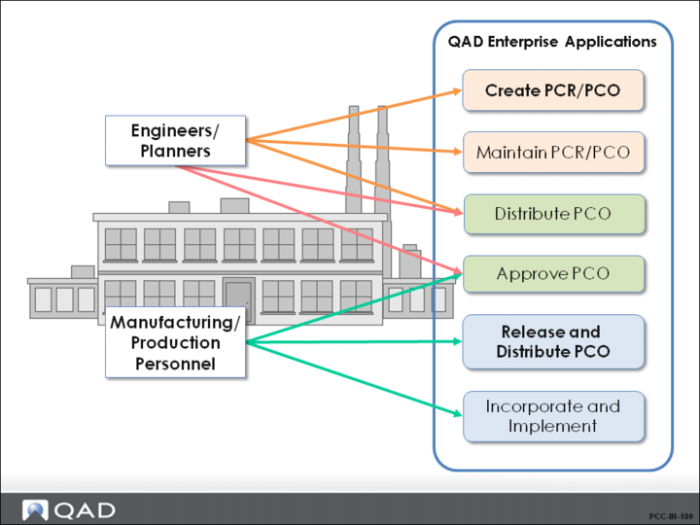
Product Change Control Users
• Distributing PCOs is often done by either engineers or planners
• Approving PCOs is often done by engineers, planners, and/or production personnel
Discussion Questions
1 How are multiple PCRs for a single item merged into a single order?
2 What kinds of data is controlled by PCC?
3 What is the difference between incorporating and implementing a change order?