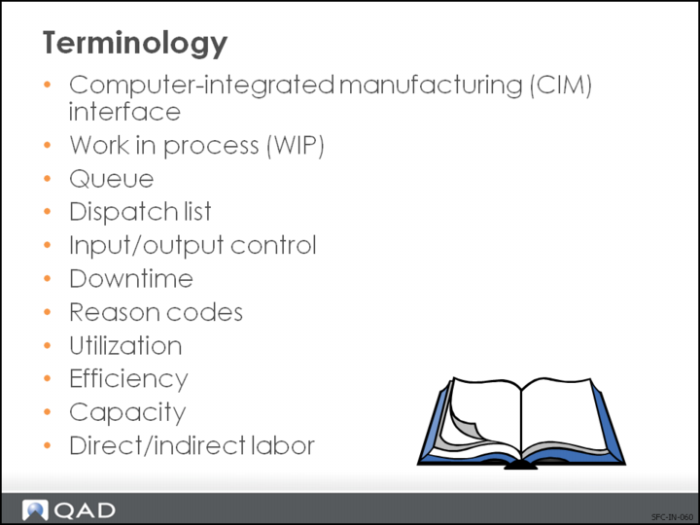
Terminology
Computer Integrated Manufacturing (CIM) Interface
The CIM interface takes imported transactions from an external file or system and loads them into QAD Enterprise Applications.
Work in Process (WIP)
WIP indicates a product in various stages of completion throughout the plant. Stages include raw material released for manufacturing up to processed material awaiting final inspection and acceptance as finished product.
Queue
Can apply to any of the following:
• A waiting area
• The time work normally waits at a work center before the operations begin
• A holding area for calls, call quotes, and service requests before the next event takes place in their life cycle
Dispatch List
A dispatch list is a listing of all manufacturing orders ranked in relative priority. The list contains information of priority, location, quantity, and the capacity requirements of the order by operation. Dispatch lists are normally generated daily and grouped according to work center.
Input/Output Control
Input/output control is a technique for capacity control where actual output from a work center is compared with the planned output developed through capacity requirements planning (CRP). Input is also monitored to see if it corresponds to plan and is adequate for the work center to meet its capacity requirements.
Downtime
Downtime is time when a resource is scheduled for operation but is not producing for reasons such as maintenance, repair, or setup.
Reason Code
In the Sales Quotes, Repetitive, and Shop Floor Control modules, a reason code is a code that categorizes or describes a transaction. In the Product Change Control module, reason codes are user-defined and specify severity levels related to approval of change documents.
Utilization
Utilization is a measure of how well a resource is being used to produce goods or services. It compares actual time used to available time. Utilization is the ratio of time available for work/time used for work expressed as a percentage
Efficiency
The relationship between the planned standard time and actual time charged to the task. Efficiency is calculated by dividing the standard hours earned by the actual direct labor hours. It is possible for efficiency to be more than 100%.
Capacity
Capacity is the maximum work load for a work center, machine, and so on.
Direct Labor
Direct labor is labor applied to the product being manufactured or utilized in the performance of the service.
Indirect Labor
Indirect labor is the work necessary to support production without being related to the production of a specific item or product (meetings, for example).