QAD 2017 Enterprise Edition
>
User Guides
>
Item Attributes and Quality Control
>
Quality Control
>
Test Specifications
Test Specifications
A test specification is a set of one or more attributes that are measured by a process, such as the set of attributes for physical dimensions, physical properties, chemical composition, electrical properties, or biological analysis. The collective set of attribute specifications on a test specification and revision represent what should be true for conforming material.
A test specification and its attributes are managed very much like an attribute profile and its attributes. Both are essentially collections of item attributes — one for a test specification identified for a test specification ID and revision, and the other for an item. A test specification and an attribute profile can have attribute specifications that determine whether attribute values are conforming or non-conforming. Like an attribute profile, you can copy attributes and specifications from another test specification or another profile.
A test specification is different than an item profile because a test specification is a revision‑controlled document. A test specification:
• Is identified by a test ID and revision level
• Can have multiple revisions
• Can be linked to one or more items
• Can be linked to an item, routing, and operation (for work-in-process materials)
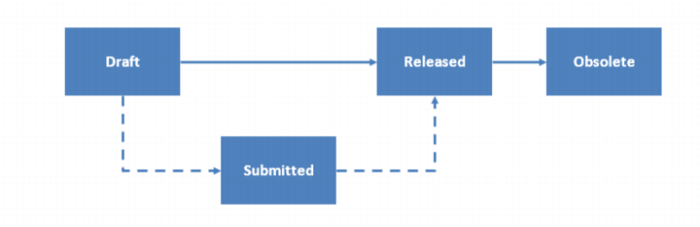
A test specification and revision may have a status of Draft, Submitted (for approval), Released, or Obsolete. A test specification and revision is only editable when its status is Draft. When its status is Released, it is an active document used to capture test records for quality orders and production operations. The following diagram shows the typical life cycle of a test specification.
Life Cycle of a Test Specification